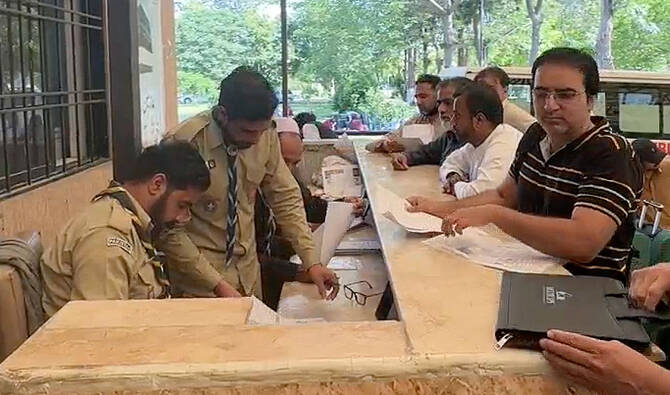

ISLAMABAD: As thousands of Pakistani pilgrims stream through Islamabad’s Hajji Camp each day, volunteers from the Pakistan Boy Scouts Association move through crowded halls in khaki uniforms, guiding elderly travelers between vaccination counters, document desks and departure queues.
Among them is 35-year-old Ejaz Ahmed, a schoolteacher from Azad Kashmir who left his hometown of Muzaffarabad last month to serve Hajj pilgrims as a scout volunteer during Pakistan’s annual pilgrimage operation.
For Ahmed, the long hours spent helping strangers navigate one of the most important journeys of their lives are not simply volunteer work but an act of spiritual fulfillment.
“When we serve the pilgrims, we feel happy. This very spirit has brought us here,” Ahmed told Arab News. “When we facilitate and guide them at different stages here, we feel deep inner peace.”
Hajj, one of Islam’s five pillars, is mandatory once in a lifetime for Muslims who are physically and financially able to perform it. Every year, nearly two million pilgrims from around the world travel to Saudi Arabia for the pilgrimage, requiring one of the world’s largest religious logistics operations.
In Pakistan, boy scouts have become a familiar presence at Hajj camps, helping thousands of pilgrims navigate the complex process before departure to Makkah.
This year, Pakistan has been allocated a Hajj quota of 179,210 pilgrims, according to the Ministry of Religious Affairs. Around 39,000 of them are expected to pass through Islamabad’s Hajji Camp alone.
The crowds at the capital’s camp have increased significantly since Pakistan joined Saudi Arabia’s Makkah Route Initiative in 2019, a system designed to streamline immigration procedures for pilgrims before they board flights.
Under the initiative, pilgrims complete Saudi immigration and customs formalities in Pakistan, allowing them to bypass lengthy airport procedures upon arrival and travel directly to accommodations in Makkah or Madinah.
“For these pilgrims, one-window facilities have been provided here,” said Qazi Sami Ur Rehman, Islamabad’s Hajj director.
“They assist the pilgrims and conduct all related activities,” he added, referring to the scouts helping manage daily operations at the camp.
“GREAT SATISFACTION“
The role of the Pakistan Boy Scouts Association in Hajj operations dates back more than four decades.
“Pakistan Boy Scouts Association members are serving at about seven Hajji Camps in the country,” veteran scout leader Raja Mumtaz Muazam told Arab News.
“This Pakistan Boy Scouts Association has been here since 1980, when then President of Pakistan Zia-ul-Haq had deputed scouts here. And I have been serving here since 1997.”
Muazam said Pakistani scouts had previously also assisted pilgrims inside Saudi Arabia.
“But for the past two to three years, that process has been suspended. Hopefully, our services will again be sought in Makkah and Madinah,” he said.
Inside the camp, many pilgrims are elderly and traveling abroad for the first time, often requiring help understanding procedures spread across multiple counters and departments.
Before departure, pilgrims must receive meningitis, influenza and polio vaccines, while those over 65 are also required to get COVID-19 booster shots. They must also complete ticketing, banking and travel documentation formalities before boarding flights to Saudi Arabia.
For Ahmed, whose two young children remain at home in Muzaffarabad, the work is demanding but deeply meaningful.
“From the moment the pilgrims enter through the gate, we guide them all the way through vaccination and other stages so that they do not face any kind of difficulty,” he said.
“Although we perform many other responsibilities as scout volunteers, serving the pilgrims in particular gives us great satisfaction.”