PCB says England have offered to host India and Pakistan Test series

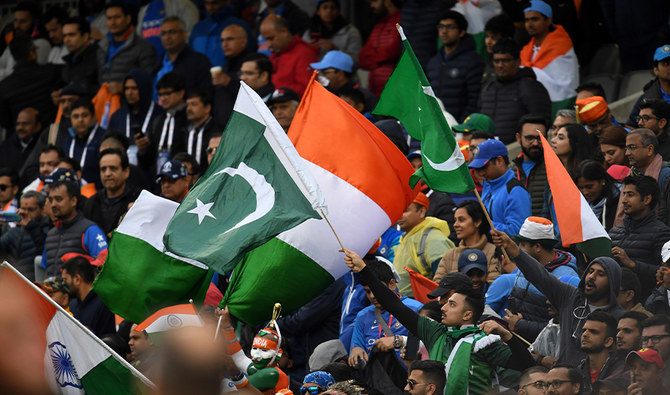
Spectators wave national flags after the 2019 Cricket World Cup group stage match between India and Pakistan at Old Trafford in Manchester, northwest England, on June 16, 2019. (AFP/FILE)
Short Url
Updated 27 September 2022
Follow

PCB says England have offered to host India and Pakistan Test series

  • Offer opens possibility of two countries playing bilateral cricket for first time in more than 15 years
  • India and Pakistan are political arch-rivals and have one of the world’s greatest sporting rivalries

KARACHI: The Pakistan Cricket Board said on Tuesday England have offered to be a neutral host for future Pakistan-India Test series, opening the possibility of the two countries playing bilateral cricket for the first time in over 15 years.

On Tuesday, the British newspaper, the Telegraph, said Martin Darlow, the deputy chairman of the England and Wales Cricket Board, had held talks with the PCB during the current Twenty20 series and offered England’s grounds as venues for ideally a three-match Test series in the future.

“This offer has been made, we confirm it but nothing beyond that,” a PCB spokesperson told Arab News, declining further comment.

India and Pakistan, who are political arch-rivals and have one of the world’s greatest sporting rivalries, play each other regularly in ICC World Cup events and last month in the Asia Cup as well, with matches attracting huge sponsorship revenue and television audiences. When India played Pakistan in the semifinal of the 2011 World Cup, the television audience was calculated to be 495 million.

“But there has been a hardening under the [Prime Minister] Narendra Modi government in India toward Pakistan and for political reasons the two countries have not played bilateral Test cricket since Pakistan toured India in 2007,” the Telegraph said.

“Pakistan players are also barred from playing in the IPL [Indian Premier League], a scenario that could spread if IPL owners buy teams in other leagues. For example, no Pakistan players are playing in the South Africa T20 league in February where all the teams have India owners, raising questions about the influence of private investment in national leagues.”

The Telegraph said Pakistan were not keen on playing India at the moment at a neutral venue but were “grateful for the ECB’s offer, which shows the growing relationship between the two boards.”

Pakistan have only recently persuaded teams to tour their own country after a decade long absence due to security issues. 


Pakistan explores underground gas storage to manage supply swings, price shocks

Updated 7 sec ago
Follow

Pakistan explores underground gas storage to manage supply swings, price shocks

  • Pakistan seeks consultants to assess feasibility of underground gas storage
  • Industry officials say storage could ease shortages, cut cargo cancelations

KARACHI: Pakistan is exploring the construction of underground gas storage facilities, a long-discussed energy infrastructure project that officials and industry experts say could help manage supply shortages and cushion the country against global price volatility during periods of geopolitical disruption.

The initiative has resurfaced after a state-run gas infrastructure company this month issued a tender seeking consultants to assess the market need and technical feasibility of underground gas storage, potentially marking the first concrete step toward a project that could cost more than $1 billion.

Pakistan’s energy ministry, through Inter State Gas Systems (Private) Limited (ISGS), posted the tender on the Public Procurement Regulatory Authority (PPRA) portal, inviting local and international firms to conduct a pre-feasibility study for the project.

Asif Inam, chairman of Sui Southern Gas Company (SSGC), welcomed the move, confirming that the idea had been envisioned decades earlier but never implemented.

“If they make it, it will be very helpful because we are forced to close the field in summer and sell LNG cargoes on the spot,” Inam, whose state-owned utility is responsible for gas transmission in Sindh and Balochistan, told Arab News.

He said the ability to store up to one billion cubic feet of gas would ease operational pressures during periods of excess supply and reduce the need to offload imported cargoes.

According to official data, Pakistan imports about $5 billion worth of liquefied natural gas (LNG) and petroleum gas annually, accounting for roughly 30 percent of the country’s total energy imports.

The energy ministry’s spokesperson, Zafar Abbas, did not answer queries about why Pakistan wanted to carry out the project. However, building such storage facilities can help the country avoid costly cargo cancelations.

In November last year, the country scrapped 21 LNG shipments under a long-term contract with Italy’s Eni after excess imports flooded its gas network, while also negotiating the deferment or resale of cargoes with Qatar.

“These storages can also be helpful in war-like situations,” the SSGC official said. “At least we should have storage for a month.”

The tender issued this month by ISGS seeks consultants to assess market demand, identify potential underground storage sites and evaluate their technical and commercial viability.

Inam said if these facilities were built at Port Qasim, then the LNG could be stored right after its arrival.

Energy analyst Muhammad Saad Ali said Pakistan had previously missed opportunities to build strategic reserves during the COVID-19 pandemic when global prices were low due to the absence of storage infrastructure.

“At that time, we did not have storage facilities and lost that opportunity,” said Ali, head of research at Karachi-based Lucky Investments Ltd.

Asked about the expected project cost, he said it could go up to $1 billion.

Ali noted that Pakistan currently has surplus gas, though he said it was a wise move since such storage facilities would provide insurance against future shocks.

“Right now, we have a surplus, so we don’t really need it that much,” he said. “But obviously, in the future, if there is a geopolitical crisis, wars, there can be an energy price shock in all these things.”