DEIR QUBEL: School teacher Claude Koteich, her teenager daughter and 10-year-old son should have all been back in class weeks ago – but a crisis in Lebanon’s education sector has left them lounging at home on a Monday afternoon.
Lebanon’s three-year financial meltdown has severely devalued the country’s pound and drained state coffers, pushing 80 percent of the population into poverty and gutting public services including water and electricity.
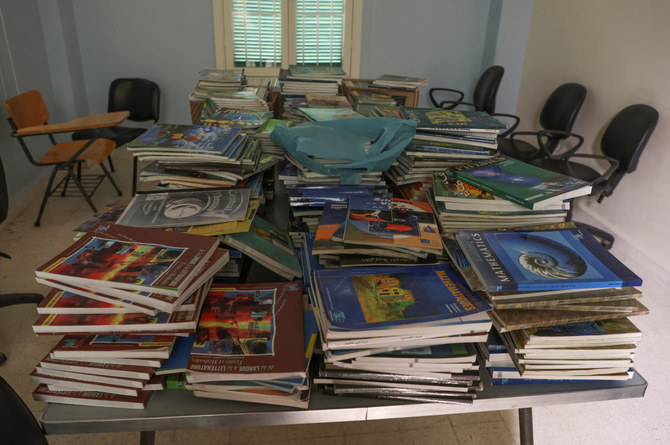
It has also left public schools shuttered so far this academic year, with teachers waging an open-ended strike over their severely devalued salaries and administrations worried they won’t be able to secure fuel to keep the lights and heating on during the winter.
Koteich, 44, has taught French literature at Lebanese public schools for exactly half her lifetime.
“We used to get a salary high enough that I could afford to put my kids in private school,” she told Reuters in her living room in the mountain town of Deir Qubel, overlooking the Lebanese capital.
But since 2019, Lebanon’s pound has lost more than 95 percent of its value as other costs skyrocket following the government’s lifting of fuel subsidies and global price jumps.
From a monthly salary that was once about $3,000, Koteich now earns the equivalent of $100 – forcing her to make a tough choice last summer over whether to put her children back in costly private schools or transfer them to a public education system paralyzed by the pay dispute.
“I was stuck between yes and no – waiting for our salaries to change, or if the education minister wanted to fulfill our demands,” Koteich said.
By September, there had been little progress on securing higher salaries given Lebanon’s depleted state coffers. At the same time, her children’s private school was asking for tuition to be paid mostly in cash dollars to guarantee they could afford to pay for expensive fuel and other imported needs.
That would amount to a yearly fee of $500 per student, plus 15 million Lebanese pounds, or about $400.
“I found the number was very high and out of this world for me,” she said.
So as their former classmates don their private school uniforms, Koteich and her two children still have no clear idea when they will return to class.
Lebanon’s education system has long been heavily reliant on private schools, which hosted almost 60 percent of the country’s 1.25 million students, according to the Ministry of Higher Education.
However, the strain on households from Lebanon’s financial collapse has forced a shift: around 55,000 students transitioned from private to public schools in the 2020-2021 school year alone, the World Bank has said.
But public education has been historically underfunded, with the government earmarking less than 2 percent of GDP to education in 2020, according to the World Bank — one of the lowest rates in the Middle East and North Africa.
And the combined stresses of recent years – from an influx of Syrian refugees starting in 2011 to the COVID-19 pandemic and the port blast which damaged Beirut – has beleaguered schools.
“My students’ worries are beyond educational – they started to think about how they can make a living. This age is supposed to be thinking of their homework,” Koteich said.
The head of the United Nations’ children agency UNICEF in Lebanon told Reuters that about one third of children in Lebanon – including Syrian children – are not attending school.
“We have worrying numbers of an increase in children being employed in Lebanon, and girls getting into early child marriage,” said Edouard Beigbeder.
A UNICEF study this year found that 38 percent of households had reduced their education expenses compared with just 26 percent in April 2021. This trend makes a return to class ever more important.
Some hope schools will re-open in October, although there has been no such indication from the government.
“There’s a kind of race against the clock to ensure the first week of October, we will have the right kind of opening,” Beigbeder said.


Teachers’ strike and soaring fees: Lebanon’s public school pupils miss class
https://arab.news/56v6y
Teachers’ strike and soaring fees: Lebanon’s public school pupils miss class

- Lebanon’s three-year financial meltdown has left public schools shuttered so far this academic year
- Teachers wage an open-ended strike over their severely devalued salaries


Of strikes and succession: How Iran’s ‘mosaic regime’ endures after Khamenei’s killing
- Experts say Iran’s dispersed power structure was built to withstand leadership decapitation and prolonged confrontation
- Succession uncertainty persists, but entrenched institutions and security networks keep the regime functioning
LONDON: Iran’s supreme leader, Ali Khamenei, was killed on Saturday along with much of the Iranian regime’s senior civilian and military leadership. But, thanks to Iran’s “mosaic” leadership structure, the regime itself is far from dead.
When Iran’s first supreme leader, Ayatollah Ruhollah Khomeini, died of natural causes in 1989, his successor, Khamenei, took office the very next day.
Now Khamenei is dead, killed along with dozens of members of his family and other senior Iranian leaders in a series of US and Israeli attacks on targets across Tehran. Days later, the succession question remains unanswered.

But this, experts suggest, does not mean that Iran is drifting rudderless in a power vacuum — or that cutting off the head will kill the snake.
“The Iranian regime is a system that was built to last,” said Dr Burcu Ozcelik, a senior research fellow at the London-based Royal United Services Institute.
“It has constitutional provisions in place and deep contingency planning, with four or five names for each key role, and so there was a high level of preparedness for a leadership decapitation campaign.”
Contingencies for just such an eventuality, which were first put in place at the end of the Iran-Iraq war in 1988, “were stepped up after Oct. 7, 2023, when the Iranians assessed that there would be a long-lasting confrontation with Israel.
“And although the attacks that followed didn’t lead to a regional confrontation of the sort we are seeing now, the Iranians have been long preparing for this.”

This is what Robert Pape, a professor of political science at the University of Chicago, specializing in international security affairs, characterized this week as “the mosaic regime.”
“Iran anticipated decapitation long before (the US operation) Epic Fury began,” he wrote on Substack.
“Under its ‘mosaic’ leadership defense doctrine, authority is dispersed into semi-autonomous cells across military, security, and political domains. Redundancy substitutes for hierarchy.”
Pape added: “Airpower kills leaders; it does not easily kill distributed function.”
This was reflected in comments from Mohammad Bagher Ghalibaf, the speaker of Iran’s parliament, who said the regime had “prepared for these moments” and had “planned for all scenarios.”
Indeed, despite multiple attacks by Israel and the US on senior civilian and military leadership, the drones and missiles keep coming across the Arabian Gulf.
The Iranian state “can be best described as polymorphous,” said Dr. Arshin Adib-Moghaddam, professor of global thought and comparative philosophies at the Department of Politics and International Studies at the School of Oriental and African Studies in London.
Western media, he added, “has a skewed understanding of the political dynamics in Iran and there is also a political agenda behind the misrepresentations.
“The tragedy is that this false reality informs decisions. This is why we are facing this horrific war. Bad, ideological knowledge created bad, impulsive decisions.”
Within Iran, he said, “there are several institutions that compete with each other and are anchored quite firmly in networks permeating society.”
At the heart of the system is the supreme leader, who supervises the other branches of government, including elected bodies such as the presidency, the Assembly of Experts and the parliament.
“And then there are the security layers, the military (Artesh), the Islamic Revolutionary Guard Corps and their underbellies — for instance the Basij units with their representation in every university, municipal council, large organizations and even the smallest villages of the country.”
In addition, “there are theological power centers in the Shiite-Islamic seminaries surrounding the holy sites in Mashhad and Qom.
“It is this polymorphic structure that explains why the Israel-US assassination campaign hasn’t disrupted the ability of Iran to govern the country, certainly for now.”
Sooner or later a new supreme leader will have to be appointed. The constitution of the Islamic Republic of Iran lays down a precise process.
In theory, a serving leader designates his preferred successor, whose appointment after his death is subject to approval by the Assembly of Experts — a panel of 88 Islamic jurists.
The Assembly of Experts building in Qom was itself struck on Tuesday as regime clerics were gathering to elect a new supreme leader, according to local media. At the time of writing, it was not immediately clear who was inside. If confirmed, the attack is likely to delay the process further.
“I don’t know that a date has been set,” said RUSI’s Ozcelik. “I think the language being used is that it would be ‘in the near future.’
“But there will be security concerns around a physical meeting of key clerical figures that would certainly be on the radar of American and Israeli intelligence and, given the circumstances, I think the regime can continue to justify not a delay but a considered longer timeline.”

It remains unknown who, if anyone, Khamenei had designated as his successor. If he had not, it might fall to the Assembly of Experts to pick someone.
The field of candidates is larger than it once was. Under the original terms of the constitution, framed after the 1979 revolution, a supreme leader had to be chosen from among the pool of Grand Ayatollahs.
That changed when Ayatollah Khomeini’s original choice to succeed him, Grand Ayatollah Hussein Ali Montazeri, fell out of favor and was dropped from the succession after he began to publicly criticize some of the violent excesses of the regime.
The constitution was then amended, opening up the field of succession beyond the limited cohort of Grand Ayatollahs, which allowed Khomeini to designate Khamenei as his successor. The Assembly of Experts endorsed his choice on June 3, 1989.
In the meantime, Iran is being run, as dictated by the constitution, by a three-man council. The council, which was formed on Sunday, consists of President Masoud Pezeshkian, judiciary chief Gholamhossein Mohseni Ejei, and senior cleric Alireza Arafi.
In theory, these are the men that US President Donald Trump would be talking to should the US decide to reopen negotiations. However, Tuesday’s attack on the Presidential Office suggests no one in the regime is safe.
“I don’t know if these three are actually targets,” said Ozcelik. “Although I think that would be consistent with what we’ve seen from the Israelis’ point of view.
“But I’m not sure how helpful it would be to take out a figure such as President Pezeshkian, who in Iranian terms is a moderate, and a potential point of contact with whom Trump and his administration could have talks going forward.
“And whenever this concludes, there will need to be someone in Tehran who is able to pick up the phone when Trump calls.”
Who that might be right now is as much a question of who remains alive as anything else, said Mona Yacoubian, director and senior adviser of the Middle East Program at the Center for Strategic and International Studies in Washington.
“I’m going to guess that the US would engage with those with whom they’ve engaged in the past, whether it’s Foreign Minister Abbas Araghchi, or possibly Ali Larijani, secretary of the Supreme National Security Council,” she said.
“Those are, I think, the two key people I would highlight, which doesn’t necessarily overlap with that Transitional Council.”
That said, as the death toll among Iranian leaders continues to mount, it could be that no one is now safe.
“And the message that sends is one of regime change,” said Yacoubian. “That’s what the US and Israel in particular have been focused on.
“We have heard President Trump, in one of his many different interactions with various members of the media, note that the US had identified successors, and that those successors had been killed.
“I think that about sums it up, and that’s why I think that any public naming of a supreme leader may not come for some time.”
She added: “In some ways, it’s not clear how important that is at this point. I think the focus in Iran right now is very much on maintaining regime cohesion, such as it exists.
“The military and security circles have long been engaged on these questions and have been thinking through this type of scenario planning.
“So I don’t know how significant it is that we have yet to hear of a new supreme leader being named because these other centers of power, which have long existed in Iran, were likely already planning for a post-Khamenei transition well before this current conflict started, and they are clearly still acting and working, perhaps in a decentralized way.
“So yes, there have been decapitation strikes. But what that actually means in terms of how the system in Iran is operating is unclear.”


