
BEIRUT: Politicians, ambassadors, academics and representatives of international organizations took part in a “consultative meeting to save the education sector in Lebanon” on Monday, held by the Ministry of Education, against the backdrop of an ongoing teacher strike.
The strike has contributed to paralyzing public schools for over four months, majorly disrupting the academic year
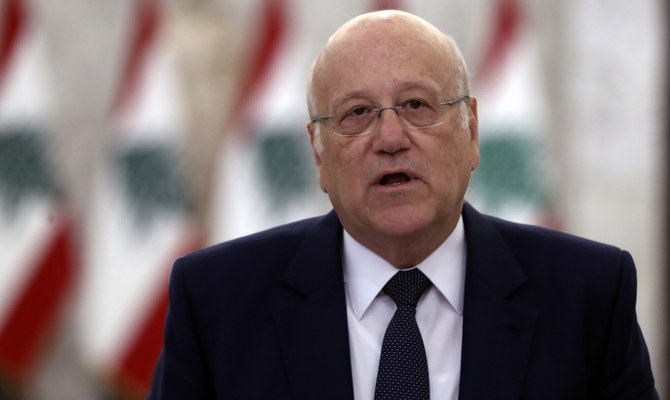
“We do not have a magic wand to address all educational issues at once,” Prime Minister Najib Mikati said as he opened the meeting. “We hope the educational staff would understand the government’s situation and the limited capabilities we have.
“We hope they can be patient, along with the students’ families, in light of the stifling economic crisis that coincided with the COVID-19 pandemic.
“We ask teachers to cooperate with us to overcome this difficult stage with minimal damage and not to throw demands at the government, students and families, as the state of the public treasury cannot handle any spending outside the most urgent issues.”
Education Minister Abbas Al-Halabi said that public school students “have barely attended 25 days of school this year, while students in the private sector are close to completing the curriculum.”
This, he said would lead to huge disparity in academic outcomes unless “we are able to compensate for the lost months in public schools and complete the curricula before we reach the point of no return.”
There are no accurate figures about the number of students in public schools for the year 2021-2022, but there were around 342,303 students in 2019-2020, with an increase in 2020-2021 of about 10,000 students, who switched from private schools due to an inability to pay fees amid the country’s soaring currency and economic crises.
According to a report by the Crisis Monitor at the American University of Beirut, 70 percent of Lebanese families depended on private schools, especially for elementary and middle school.
Before the crisis, the private education sector’s share was worth an estimated $1.3 billion.
There are 1,209 private schools in Lebanon employing about 51,215 teachers, while there are 1,235 public schools with about 40,796 teachers.
There are also 352 educational institutions which are semi-free private schools that receive support from the state, and employ 7,468 teachers.
Meanwhile, there are about 30,000 contract teachers in public and private schools.
The Contract Teachers Association is calling for raising the hourly wage from 20,000 Lebanese pounds ($13.22) to 70,000 Lebanese pounds and granting teachers a daily transportation allowance of 64,000 Lebanese pounds.
Hospital cards are also being sought for contract teachers because they are deprived of any health insurance.
Another proposal is that the academic year should be made up of 28 weeks and not 18 weeks as happened last year.
Last week, Al-Halabi said: “The circumstances that called for the teachers' strike no longer exist after the Cabinet approved a monthly social grant and raised transportation allowance.”
He said hourly wages for contract teachers had doubled, but a legislative decision was needed to improve the legal status of the teachers in terms of including them in the transportation allowance and the social grant.
“This is the best the state treasury can do at the moment,” he explained.
During the consultative meeting, Al-Halabi warned that “public education is in danger, not just the academic year, which we strive with all our capabilities to save.”
The minister’s remarks came as contract teachers held a sit-in in downtown Beirut, and a delegation later met with the concerned authorities following the consultative meeting.
The teachers agreed to end their strike provided that a decree to increase their transportation allowance was approved.
The delay to launch the academic year in public schools also affected Syrian refugee students who receive their education in these schools after regular school hours.
According to the UNHCR, about 321,512 refugee students were registered in formal and non-formal education for the year 2020-2021.
Aid for vulnerable families, meanwhile, is dwindling, and on Monday Social Affairs Minister Hector Hajjar announced that his ministry will be able to “reach 75,000 eligible families within the program for the poorest families within a maximum of four months.”
Home visits to families registered on the social protection platform will start on Feb. 15, he added.