
BEIRUT: The future of thousands of Lebanese students is at stake as private educational institutions assess their ability to continue operations in the next academic year, due to the economic crunch facing Lebanon.
“If the economic situation continues, private schools will be forced to close down for good, a move that will affect more than 700,000 students, 59,000 teachers and 15,000 school administrators,” said Father Boutros Azar, secretary-general of the General Secretariat of Catholic Schools in Lebanon, and coordinator of the Association of Private Educational Institutions in Lebanon.
Over 1,600 private schools are operating in Lebanon, including free schools and those affiliated to various religion societies, Azar said.
The number of public schools in Lebanon, he added, is 1,256, serving 328,000 students from the underprivileged segment of society and 200,000 Syrian refugee students.
“The number of teachers in the formal education sector is 43,500 professors and teachers — 20,000 of them are permanent staff and the rest work on a contract basis,” Azar said.
This development will also have an impact on private universities, whose number has increased to 50 in the past 20 years.
Ibrahim Khoury, a special adviser to the president of the American University of Beirut (AUB), told Arab News: “All universities in Lebanon are facing an unprecedented crisis, and the message of AUB President Dr. Fadlo R. Khuri, a few weeks ago, was a warning about the future of university education in light of the economic crisis that Lebanon is facing.”
Khoury said many universities would likely reduce scientific research and dispense with certain specializations.
“Distance education is ongoing, but classes must be opened for students in the first semester of next year, but we do not yet know what these classes are.”
Khoury added: “Universities are still following the official exchange rate of the dollar, which is 1,512 Lebanese pounds (LBP), but the matter is subject to future developments.”
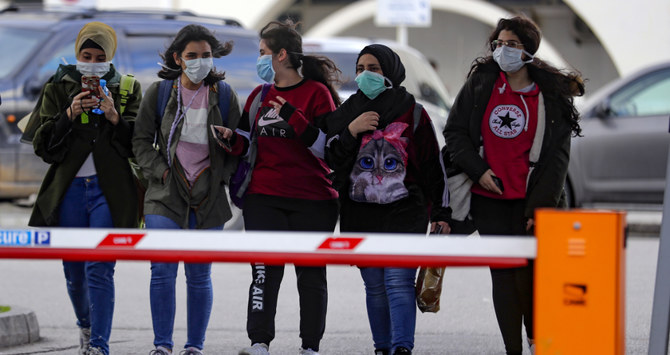
Lebanese parents are also worried about the future of their children, after the current school year ended unexpectedly due to the coronavirus disease (COVID-19) pandemic.
Dr. Tarek Majzoub, the minister of education and higher education, ended the academic year in public schools and gave private schools the right to take a call on this issue.
He said: “The coming academic year will witness intensification of lessons and a review of what students have missed.”
But what sort of academic year should students expect?
Differences have developed between school owners, parents, and teachers over the payment of tuition fees and teachers’ salaries.
Azar said: “What I know so far is that 80 percent of the Catholic schools in Lebanon will close their doors next year unless they are financially helped. Some families today are unable to pay the rest of the dues for the current year either because their breadwinners were fired or not working, while others do not want to pay dues because schools remain closed due to the pandemic.
“Lebanese people chose private schools for their children because they trusted them for their quality — 70 percent of Lebanese children go to private schools. Today, we are facing a major crisis, and I say that if education collapses in Lebanon, then the area surrounding Lebanon will collapse. Many Arab students from the Gulf states receive their education in the most prestigious Lebanese schools,” he added.
“What we are witnessing today is that the educational contract is no longer respected. It can be said that what broke the back of school owners is the approval by the Lebanese parliament in 2018 of a series of ranks and salaries that have bankrupted the state treasury and put all institutions in a continuous deficit.”
Those in charge of formal education expect a great rush for enrollment in public schools and universities, but the ability of these formal institutions to absorb huge numbers of students is limited.
Majzoub said that his ministry was “working on proposing a law to help private schools provide a financial contribution for each learner within the available financial capabilities or grants that can be obtained.”
The undersecretary of the Teachers’ Syndicate in Private Schools, former government minister Ziad Baroud, said: “The crisis of remaining student fees and teachers’ salaries needs to be resolved by special legislation in parliament that regulates the relationship between all parties — teachers, parents, and schools — and takes into account the measures to end teachers’ contracts before July 5.”
Baroud spoke of “hundreds of teachers being discharged from their schools every year based on a legal article that gives the right to school owners to dismiss any teacher from service, provided that they send the teacher a notification before July 5.”
H said it should be kept in mind that thousands of teachers have not yet received their salaries for the last four months, and some of them had received only 50 percent or even less of their salaries.
Khoury said: “The AUB received a loan from the late Prime Minister Rashid Karami at the beginning of the 1975 Lebanese civil war to keep it afloat. In the 1990s, the late Prime Minister Rafik Hariri provided aid and grants to the universities. Today, no one can help universities.”
Last Thursday, the Lebanese parliament adopted a proposal submitted by the leader of the Future Parliamentary Bloc, Bahia Hariri, to allocate LBP300 billion to the education sector to help it mitigate the effects of COVID-19.