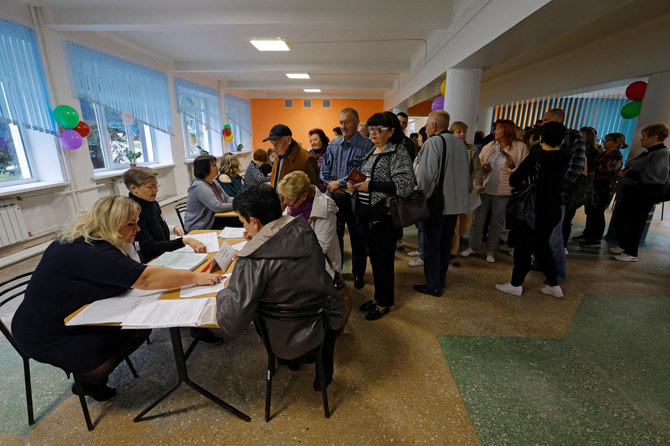
KYIV, Ukraine: Ukrainians who help Russian-backed referendums to annex large swathes of the country will face treason charges and at least five years in jail, Ukraine’s presidential adviser said, as voting in four regions entered its last day.
“We have lists of names of people who have been involved in some way,” presidential adviser Mikhailo Podolyak said in an interview with Swiss newspaper Blick.
“We are talking about hundreds of collaborators. They will be prosecuted for treason. They face prison sentences of at least five years.”
Podolyak said Ukrainians who were forced to vote would not be punished. Ukrainians officials have reported ballot boxes being taken door to door and residents being coerced into voting in front of Russian-backed security.
Moscow hopes to annex the provinces of Kherson, Luhansk, Donetsk and Zaporizhzhia, in the east and south, which make up about 15 percent of Ukraine.
None of the provinces are fully under Moscow’s control and fighting has been under way along the entire front line, with Ukrainian forces reporting more advances since they routed Russian troops in a fifth province, Kharkiv, earlier this month.
Russian President Vladimir Putin has issued a veiled threat to use nuclear weapons to protect Russian soil, which would include the four provinces if annexed.
Voting on whether to join Russia began on Friday in the regions and is due to end on Tuesday, with the Russian parliament possibly approving the annexation within days.
The British Ministry of Defense said on Tuesday that Putin is likely to announce the accession of the occupied regions of Ukraine to the Russian Federation during his address to parliament on Sept. 30.
Kyiv and the West have dismissed the referendums as a sham and pledged not to recognize the results.

Ukrainians involved in Russian-backed referendums face treason charges, prison term
https://arab.news/5kmvh
Ukrainians involved in Russian-backed referendums face treason charges, prison term
- Ukrainians who were forced to vote would not be punished
- Moscow hopes to annex the provinces of Kherson, Luhansk, Donetsk and Zaporizhzhia
Ukraine toils to restore power and heat, Zelensky warns of new attack
- Russia has systematically attacked Ukraine’s energy system since it invaded its neighbor in 2022 and the air strikes have intensified in recent months
KYIV: Emergency crews toiled to restore heat and power to beleaguered Kyiv residents on Monday, more than three days after Russian strikes on energy targets, and President Volodymyr Zelensky warned that new air attacks could be imminent.
Officials said hundreds of apartment blocks in the capital remained without heat despite round-the-clock efforts by the crews. Humanitarian centers, dubbed “resilience points,” were open for people to keep warm and charge electronic devices.
Russia has systematically attacked Ukraine’s energy system since it invaded its neighbor in 2022 and the air strikes have intensified in recent months.
Zelensky, speaking in his nightly video address, said a program was being launched to raise wages and provide support for participants in emergency work brigades.
He issued a new warning to heed air raid alerts as night-time temperatures sank to minus 15 Celsius (5 F) or lower.
“There is intelligence information. The Russians are preparing a new massive strike,” he said.
“Drones to exhaust air defense systems and missiles. They want to take advantage of the cold. The strike may occur in the coming days. Please take care of yourselves. Protect Ukraine.”
Deputy Prime Minister Oleksiy Kuleba, writing on Telegram, said 90 percent of Kyiv’s apartment buildings have had heating restored, leaving fewer than 500 dwellings still to be connected.
Mayor Vitali Klitschko put the number with no heating at 800, most on the west bank of the Dnipro River. He said a meeting of the Kyiv city council would be convened on Thursday to debate the most pressing issues facing residents.
Prime Minister Yulia Svyrydenko, presenting the program for bonus payments, said the work conducted by emergency crews stood “at the very limit of human endurance, often involving life-threatening risks across the entire country.
“This applies to specialists who, in freezing conditions, go directly to the sites of strikes and restore supplies of heat, electricity, water and gas.”
Residents made their way to one of the humanitarian centers on the east bank of the river in the evening — two tents pitched on a small area of open ground.
They charged their devices and chatted, while outside, the din of whining generators filled the air.
“It’s dark in the apartment. I have an electric stove, so it’s impossible to heat up lunch or dinner, or make tea,” said Kateryna Zubko, 67, an engineer who has lived without power, heating and water since the latest attack.
“We support each other. Ukrainians are such resilient people, I think that this war will end someday, it can’t go on forever.”


