Oil Updates — Crude slightly up; Iraq minister says OPEC monitoring oil prices; Qatar oil industry faces inflationary pressures

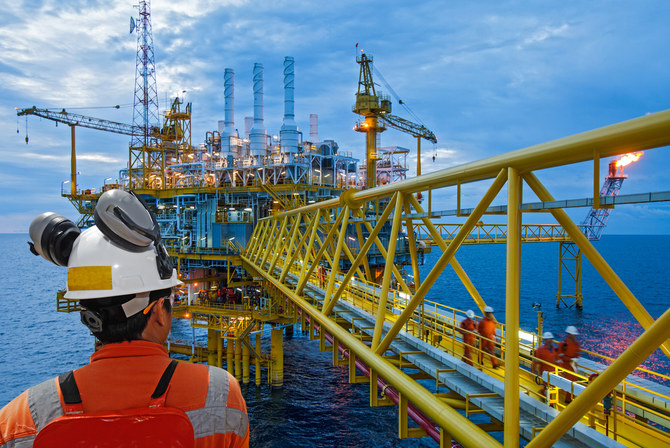
Brent crude futures for November settlement rose 65 cents, or 0.77 percent, to $84.71 per barrel by 0502 GMT. (Shutterstock)
Short Url
Updated 27 September 2022
Follow

Oil Updates — Crude slightly up; Iraq minister says OPEC monitoring oil prices; Qatar oil industry faces inflationary pressures

RIYADH: Oil prices rose on Tuesday, after plunging to nine-month lows a day earlier, on indications that the Organization of the Petroleum Exporting Countries, known as OPEC, may enact output cuts to avoid a further collapse in prices.

Brent crude futures for November settlement rose 65 cents, or 0.77 percent, to $84.71 per barrel by 0502 GMT. 

US West Texas Intermediate crude futures for November delivery were up 64 cents at $77.35 per barrel.

OPEC monitoring oil prices, seeks market balance: Iraq oil minister

Iraq Oil Minister Ihsan Abdul Jabbar on Monday said that the OPEC and allies including Russia, known as OPEC+, are monitoring the oil price situation, wanting to have a balance in the markets.

“We don’t want a sharp increase in oil prices or a collapse,” he said in a televised interview on state TV.

“We entered a challenging period. Global factors led to the decrease [in oil prices], most importantly lower growth and higher inflation rates,” Abdul Jabbar said.

OPEC+, has this year ramped up oil output, looking to unwind record cuts put in place in 2020 after the pandemic slashed demand.

Qatar says inflationary pressures impacting oil and gas industry

Qatar’s Minister of State for Energy Affairs said on Monday that inflationary pressures have led to rising production costs, delays in investment decisions, and increased policy uncertainty in the oil and gas industry.

Minister Saad Al-Kaabi said in a statement the sector needs to help people recognize that demands to cancel hydrocarbons “are not only unrealistic but, as recent months have proven, are harmful to a realistic, accelerated transition.”

Kaabi said that hydrocarbons “are not going to disappear any time in the near future.” Therefore cleaner forms of hydrocarbons were essential for a responsible transition.

“Natural gas is certainly the cleanest fossil fuel, and a much-needed reliable and economic solution to manage intermittency issues, when the sun is not shining, or when the wind is not blowing,” he said.

(With input from Reuters) 


Saudi Arabia’s non-oil exports surge 32.3% in October: GASTAT  

Updated 59 min 25 sec ago
Follow

Saudi Arabia’s non-oil exports surge 32.3% in October: GASTAT  

RIYADH: Saudi Arabia’s non-oil exports, including re-exports, rose 32.3 percent year on year in October to reach SR33.88 billion ($9.03 billion), according to official data. 

Preliminary figures released by the General Authority for Statistics showed that national non-oil exports, excluding re-exports, increased by 2.4 percent in October compared to the same period a year earlier. 

The rise in non-oil exports underscores progress under Saudi Arabia’s Vision 2030 program, which aims to diversify the economy by reducing reliance on crude oil revenues. 

In its latest report, GASTAT stated: “The ratio of non-oil exports (including re-exports) to imports increased to 42.3 percent in October 2025 from 33.4 percent in October 2024. This was due to a 32.3 percent increase in non-oil exports and a 4.3 percent increase in imports during the same period.”  

It added: “The value of re-exported goods increased by 130.7 percent during the same period, driven by a 387.5 percent increase in transportation equipment and parts, which represented 37.4 percent of total re-exports.” 

The report showed that machinery, electrical equipment, and parts led the non-oil export basket, accounting for 23.6 percent of outbound shipments and recording an 82.5 percent year-on-year increase. 

Chemical products followed with a 19.4 percent share of non-oil exports. 

In October, Moody’s said in a report that Saudi Arabia is on course to sustain annual non-oil sector growth of between 4.5 percent and 5.5 percent over the next five to 10 years as its Vision 2030 diversification program gathers pace. 

Earlier this month, GASTAT reported that Saudi Arabia’s gross domestic product expanded by 4.8 percent in the third quarter compared to the same period in 2024, driven by growth in both oil and non-oil activities. 

The authority added that oil activities advanced by 8.3 percent year on year in the third quarter, while the non-oil sector grew by 4.3 percent over the same period. 

Top non-oil destinations 

China was the top destination for Saudi non-oil goods, with shipments totaling SR14.68 billion. 

The UAE ranked second, receiving goods worth SR11.37 billion, followed by India at SR10.25 billion, Japan at SR8.37 billion, and South Korea at SR7.37 billion. 

In October, Saudi Arabia exported non-oil goods valued at SR5.20 billion to the US, while Bahrain and Egypt received products worth SR5.02 billion and SR4.01 billion, respectively. 

Export gateways  

GASTAT said ports played a crucial role in facilitating non-oil shipments during October. 

Jeddah Islamic Seaport handled the largest volume of non-oil exports at SR3.76 billion, followed by Ras Al Khair Seaport at SR3.64 billion and King Fahad Industrial Seaport in Jubail at SR3.21 billion. 

Jubail Seaport was the exit point for goods worth SR2.88 billion, while Ras Tanura Seaport and King Abdulaziz Seaport in Dammam handled non-oil shipments valued at SR2.53 billion and SR2.21 billion, respectively. 

Overall merchandise exports 

Saudi Arabia’s total merchandise exports stood at SR103.98 billion in October, representing an 11.8 percent increase compared to the same month a year earlier. 

The share of oil exports in total exports declined to 67.4 percent in October 2025, from 72.5 percent in October 2024. 

China was the Kingdom’s largest export destination, accounting for 14.1 percent of total exports. The UAE and India followed with shares of 10.9 percent and 9.9 percent, respectively. 

Japan, South Korea, the US, Bahrain, Egypt, Singapore, and Poland were also among the top 10 export destinations. 

“Exports of the Kingdom to those 10 countries account for 70.4 percent of total exports,” added GASTAT.  

Imports in October 

Imports rose 4.3 percent year on year in October to SR80.07 billion, while the merchandise trade surplus increased by 47.4 percent compared to the same month last year, according to the report. 

China was the Kingdom’s largest source of imports, accounting for 24.8 percent of total inbound shipments, followed by the US at 8.7 percent and the UAE at 6.4 percent. 

Switzerland, India, Germany, Japan, Italy, France, and Egypt were also among the top 10 countries exporting goods to Saudi Arabia. 

Sea routes remained the dominant entry channel for imports, handling SR44.49 billion worth of goods, while air and land routes accounted for SR27.25 billion and SR8.33 billion, respectively. 

King Abdulaziz Seaport in Dammam was the leading sea entry point with imports valued at SR20.57 billion. 

Jeddah Islamic Seaport handled inbound shipments worth SR15.82 billion, followed by Jubail Seaport at SR1.83 billion and King Fahad Industrial Seaport in Jubail at SR854.9 million. 

Among land entry points, Al-Batha Port processed SR3.75 billion worth of goods, while Riyadh Dry Port and the King Fahad Bridge handled SR2.13 billion and SR822.9 million, respectively. 

By air, King Khalid International Airport received SR11.99 billion in imports during October, while King Abdulaziz International Airport and King Fahad International Airport handled SR10.38 billion and SR4.65 billion, respectively.