

Judiciary has no role in breaking political impasse – Pakistan chief justice 

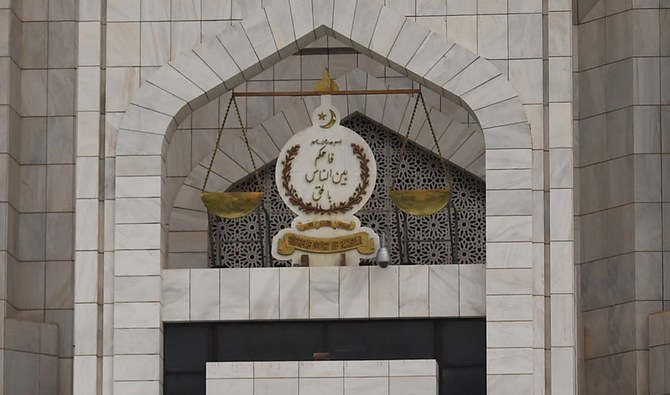
A general view of Supreme Court building in Islamabad, Pakistan, on November 28, 2019. (AFP/File)
Short Url
Updated 24 September 2022
Follow

Judiciary has no role in breaking political impasse – Pakistan chief justice 

  • Pakistan is facing political uncertainty as ex-PM Khan is demanding snap elections to end impasse 
  • Chief justice says political impasse can only be resolved through dialogue between political parties 

ISLAMABAD: Chief Justice of Pakistan’s Supreme Court Umar Ata Bandial on Friday said the judiciary has no role in breaking a political impasse, urging the legislature, the executive and other state organs to play their part in upholding the rule of law and supremacy of the constitution. 

The remarks, made by the chief justice at the 9th International Judicial Conference in Islamabad, come at a time when Pakistan is facing months of political uncertainty and as former prime minister Imran Khan plans to launch another anti-government drive. 

Khan, who was ousted from power through a parliamentary vote of no-confidence in April, has blamed his removal on a foreign conspiracy and is seeking snap elections in the country. 

Experts believe the situation would further worsen the economic crisis facing the South Asian nation, which has resulted in widening the current account deficit, rupee’s depreciation and record inflation. 

“The judiciary has no role to break a political deadlock. As with other citizens it is our sincere hope that the political leadership of the country shall take necessary corrective action and confidence-building measures with public and national interest as their foremost consideration,” Chief Justice Bandial said. 

“A pure political impasse does not have legal solutions. It can only be resolved through dialogue between political leaders and their parties.” 

The chief justice said the country could only make progress if all political parties came together to follow the established democratic practices and perform their respective roles in parliament, as specified under the constitution. 

General elections in Pakistan are scheduled to be held by October 2023, or less than 60 days from the dissolution of the National Assembly on August 13, 2023. 

Ex-PM Khan has recently said he is willing to hold talks with the government, but only on one issue: early and transparent elections in the country. 

However, PM Shebaz Sharif’s government has rejected the demand and said polls would be held next year, as per schedule. 


Pakistan says repaid over $13.06 billion domestic debt early in last 14 months

Updated 29 January 2026
Follow

Pakistan says repaid over $13.06 billion domestic debt early in last 14 months

  • Finance adviser says repayment shows “decisive shift” toward fiscal discipline, responsible economic management
  • Says Pakistan’s total public debt has declined from over $286.6 billion in June 2025 to $284.7 billion in November 2025

KARACHI: Pakistan has repaid Rs3,650 billion [$13.06 billion] in domestic debt before time during the last 14 months, Adviser to the Finance Minister Khurram Schehzad said on Thursday, adding that the achievement reflected a shift in the country’s approach toward fiscal discipline. 

Schehzad said Pakistan has been repaying its debt before maturity, owed to the market as well as the State Bank of Pakistan (SBP), since December 2024. He said the government had repaid the central bank Rs300 billion [$1.08 billion] in its latest repayment on Thursday. 

“This landmark achievement reflects a decisive shift toward fiscal discipline, credibility, and responsible economic management,” Schehzad wrote on social media platform X. 

Giving a breakdown of what he said was Pakistan’s “early debt retirement journey,” the finance official said Pakistan retired Rs1,000 billion [$3.576 billion] in December 2024, Rs500 billion [$1.78 billion] in June 2025, Rs1,160 billion [$4.150 billion] in August 2025, Rs200 billion [$715 million] in October 2025, Rs494 billion [$1.76 billion] in December 2025 and $1.08 billion in January 2026. 

He said with the latest debt repaid today, the July to January period of fiscal year 2026 alone recorded Rs2,150 billion [$7.69 billion] in early retirement, which was 44 percent higher than the debt retired in FY25.

He said of the total early repayments, the government has repaid 65 percent of the central bank’s debt, 30 percent of the treasury bills debt and five percent of the Pakistan Investment Bonds (PIBs) debt. 

The official said Pakistan’s total public debt has declined from over Rs 80.5 trillion [$286.6 billion] in June 2025 to Rs80 trillion [$284.7 billion] in November 2025. 

“Crucially, Pakistan’s debt-to-GDP ratio, around 74 percent in FY22, has declined to around 70 percent, reflecting a broader strengthening of fiscal fundamentals alongside disciplined debt management,” Schehzad wrote. 

Pakistan’s government has said the country’s fragile economy is on an upward trajectory. The South Asian country has been trying to navigate a tricky path to economic recovery under a $7 billion loan from the International Monetary Fund.