

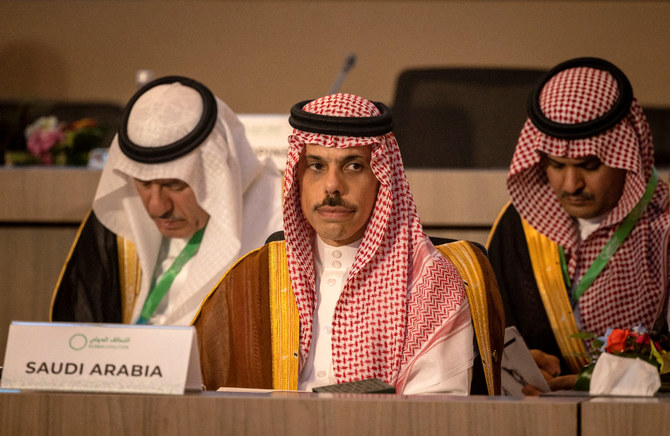
‘No one wants to be drawn into blocs,’ Saudi FM tells New York MENA Forum

Saudi Foreign Minister Prince Faisal bin Farhan made his comments at at New York’s MENA Forum on the sidelines of the 77th UN General Assembly. (File/AFP)
Short Url
Updated 24 September 2022
Follow

‘No one wants to be drawn into blocs,’ Saudi FM tells New York MENA Forum

  • Prince Faisal bin Farhan calls for more cooperation amid heightened global polarization
  • ‘We want to talk about investment. We want to talk about innovation. We want to talk about progress’

NEW YORK: At a time of heightened global polarization, Saudi Foreign Minister Prince Faisal bin Farhan on Friday called for more cooperation, saying: “No one wants to be drawn into blocs.”

His comments were made at New York’s MENA Forum, hosted by the Middle East Institute and Think Research and Advisory, on the sidelines of the 77th UN General Assembly.

“We need to discuss how we can strengthen our cooperation, how we can work closer together, how we can build an alignment that can insulate against this polarization, because none of us want to be drawn into blocs or into making choices,” he said. 

“We want to talk about investment. We want to talk about innovation. We want to talk about progress. And we hope that our international partners will focus on that as well,” he added.

“We (Saudi Arabia) have made a decision to focus on a path of sustainable development and prosperity for our people, and we don’t want that to be derailed by politics.”

The Kingdom recently brokered a prisoner swap between Russia and Ukraine that saw almost 300 people, including 10 foreigners, returning to their homelands. 

The Saudi Foreign Ministry said the move was based on the support of Crown Prince Mohammed bin Salman, and in continuation of his efforts to adopt humanitarian initiatives toward the Russia-Ukraine crisis.

When asked about the Saudi stand on Lebanon, the foreign minister said: “The Kingdom still cares about Lebanon, but the people of Lebanon have to decide what path they want to embark on, as clearly the current path isn’t working.”

Another key issue he touched on was food security in the region. “Food security is very much part of the conversation today,” he said. “Coming from a water-poor country, we’ve been dealing with these issues for many years.”

NEOM, Saudi Arabia’s smart and sustainable city, announced last week that it would build a water-desalination plant by 2024 to combat water scarcity.


Syrian Democratic ​Forces withdraws from east of Aleppo

Updated 57 min 8 sec ago
Follow

Syrian Democratic ​Forces withdraws from east of Aleppo

RIYADH: Syrian Democratic Forces have withdrawn from positions east of Aleppo, according to SDF head Mazloum Abdi.

He announced Friday that SDF will withdraw from east ⁠of ‌Aleppo at ‍7 a.m. ‍local time on Saturday and redeploy them to areas ⁠east of the Euphrates, citing calls from friendly countries and ‌mediators.

Hours earlier, a US military designation had visited Deir Hafer and met with SDF officials in an apparent attempt to tamp down tensions.

The US has good relations with both sides and has urged calm. A spokesperson for the US military did not immediately respond to a request for comment.

Shortly before Abdi’s announcement, interim President Ahmed Al-Sharaa had announced issuance of a decree strengthening Kurdish rights.

A wave of displacement

Earlier in the day, hundreds of people carrying their belongings arrived in government-held areas in northern Syria ahead of the anticipated offensive by Syrian troops on territory held by Kurdish-led fighters.

Many of the civilians who fled were seen using side roads to reach government-held areas because the main highway was blocked at a checkpoint in the town of Deir Hafer controlled by the SDF.

The Syrian army said late Wednesday that civilians would be able to evacuate through the “humanitarian corridor” from 9 a.m. to 5 p.m. Thursday and then extended the evacuation period another day, saying the SDF had stopped civilians from leaving.

There had been limited exchanges of fire between the two sides in the area before that.

Men, women and children arrived on the government side of the line in cars and pickup trucks that were packed with bags of clothes, mattresses and other belongings. They were met by local officials who directed them to shelters.

* with input from Reuters, AP