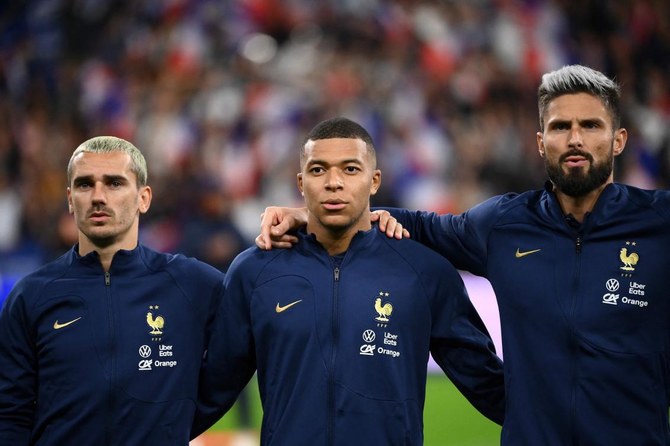
PARIS: Kylian Mbappe scored a stunning opening goal as France shook off injuries to a host of key players and a series of off-field issues to claim a welcome 2-0 win over Austria in the UEFA Nations League in Paris on Thursday.
Mbappe showcased his phenomenal pace and strength on the way before finishing emphatically to put the reigning world champions ahead in the 56th minute at the Stade de France.
The recalled Olivier Giroud doubled their lead nine minutes later as France ran out deserved winners to stave off the threat of relegation from the top tier of the Nations League, a competition they won just last year.
Didier Deschamps’ side still need to win their last Group A1 game away in Denmark on Sunday to be certain of avoiding relegation, while qualification for the four-team finals next June is already out of reach.
France’s failure to win any of their four games in June is the reason for that, but the priority for Les Bleus now is the World Cup, with the first game of their title defense in Qatar exactly two months away.
Deschamps will hope to have recovered at least the majority of his crocked stars by the time that match against Australia comes around on November 22.
Those missing from this game would make up a very strong team in their own right, with the absentees including goalkeeper and captain Hugo Lloris; center-backs Lucas Hernandez and Presnel Kimpembe; left-back Theo Hernandez; midfield lynchpin N’Golo Kante and forward Kingsley Coman.
Karim Benzema is currently out too, and then there is Paul Pogba, who faces a race against time to recover from knee surgery.
Pogba has also been in the headlines after filing a complaint with Italian prosecutors saying he was the target of a 13 million-euro ($13m) blackmail plot.
His brother Mathias is one of five people charged and detained in the case.
Meanwhile this week began with Paris Saint-Germain superstar Mbappe refusing to take part in a photo shoot in a row with the French Football Federation over image rights.
But neither Mbappe nor his teammates appeared distracted as they outclassed Austria.
Mbappe had the ball in the net inside 90 seconds only to be denied by the offside flag, and he was a constant threat in the first half.
France should have led at the interval but Austria had goalkeeper Patrick Pentz to thank for a sensational double save in the 35th minute.
Pentz tipped Aurelien Tchouameni’s acrobatic overhead kick onto the bar and then got down low to save Antoine Griezmann’s follow-up attempt.
Before that the hosts — who gave debuts to Monaco center-back Benoit Badiashile and his club colleague, midfielder Youssouf Fofana — saw their injury worries increase when Barcelona’s Jules Kounde limped out.
Goalkeeper Mike Maignan also came off at half-time to be replaced by West Ham United’s Alphonse Areola, and France went ahead soon after.
Mbappe collected a Giroud pass on the left before surging inside, bouncing off Austria’s Marcel Sabitzer, and lashing a shot beyond Pentz.
He celebrated by mimicking a photographer, an apparent nod to the troublesome quarrel over image rights.
Giroud then marked his return to the side by heading in Griezmann’s cross to make it 2-0 with his 49th international goal.
He is now just two shy of Thierry Henry’s French record of 51.

Mbappe stars as France shrug off troubles to outclass Austria
https://arab.news/5kg6m
Mbappe stars as France shrug off troubles to outclass Austria
- Mbappe showcased his phenomenal pace and strength on the way before finishing emphatically to put the reigning world champions ahead
- The recalled Olivier Giroud doubled their lead nine minutes later
‘Very different times’: Harry Redknapp on the evolution of football and growing opportunities around the globe
- Former West Ham and Tottenham Hotspur manager spoke to Arab News about the field of sport science and football in the region
- Harry Redknapp: ‘Look at Iceland beating England back in the day, Saudi beating Argentina at the last World Cup — incredible’
DUBAI: With the sun having set on a football career stretching from the Hackney Marshes to the hallowed grounds of the UEFA Champions League, former manager Harry Redknapp recently swapped a dark winter day in southern England for a balmy evening in the UAE to chat with Arab News about sport science and football in Saudi Arabia and the region.
The 78-year-old Englishman, who counts managerial spells at West Ham, Tottenham and Portsmouth on his resume, was guest of honor at the launch of the London Sport Institute in Dubai, a new hub for sport science education and research. Held inside the Burj Khalifa, the glittering launch saw Redknapp surrounded by towering professors, elite athletes, and students invested in biomechanic labs and performance analytics.
Yet the retired manager’s connection to this world — of data points and bespoke conditioning — comes through contrast rather than technical exposition. He speaks of football’s evolution not with spreadsheets and data, but rather sepia-tinged memories and yarns that make you smile.
With Premier League teams seemingly experiencing more key injuries than ever in recent years, it was put to him whether the players were being overworked. For example, Rodri, the Manchester City midfielder, was vocal in his criticism of the incessant demands on players as he amassed more than 6,000 minutes across 66 matches during the 2023-24 season. Soon after, he suffered an anterior cruciate ligament injury that sidelined him for eight months.
Redknapp, typically, however, is having none of it.
“I was looking at something the other day from when Arsenal won the title back in the day,” he says, settling into his chair. “Frank McLintock, the captain, played 78 games that year — and remember that was ankle-deep, muddy pitches and no substitutes, so you had to finish the game even if you got an injury. I played with a goalkeeper at West Ham who broke his arm in the first half against Arsenal — we tied it around his neck, and he came out and played the second half on the wing. Very, very different times.”
It is an anecdote that underlines how things used to be, long before concussion protocols, GPS tracking and recovery specialists became staples of elite squads. The era of Redknapp, who played from 1965-1982 and passed through, among others, West Ham, Bournemouth, Brentford and the Seattle Sounders, was one where the demands of the sport were borne almost entirely by instinct and grit.
Football’s present and future are now dominated by the invisible hand of performance science, recording and calculating the measurement of every sprint, muscle contraction and metabolic load. LSID, part of Middlesex University Dubai’s growing footprint in sport science, embodies this shift.
Students at the institute will have access to specialist facilities where lessons move away from theory and enable practice. They will learn to interpret data from performance labs, work alongside elite teams and contribute to research that informs real‑world coaching. A far cry even from Redknapp’s own managerial days, which only ended in 2017. Former midfielder Joe Cole recently recalled a match when a physio warned Redknapp a player had banged his head and was disoriented. The manager replied they should “tell him he’s Pele and get him back out there.”
LSID’s curriculum — from strength and conditioning to sport performance analysis — reflects the growing trend of evidence‑based practices becoming central to athlete development. Far from rehabilitation, it offers proactive performance optimization, preventing injury through programs that harness technology that would have been unimaginable in Redknapp’s day. Yet the question remains: With all the data, why are injuries at the elite level increasing rather than decreasing?
“I really don’t know,” says Redknapp, who laughs when he compares today’s pitches — immaculate surfaces, meticulously maintained — with the fields of yesteryear. “It’s certainly not the training pitches because they’re amazing, too. We used to train by just running for miles. We’d run and run and run, but we didn’t seem to get injuries. I know they’re running quicker now, but it’s certainly not as physical. When you look at the old games, the tackling was unbelievable; now it’s almost become a non-contact sport, so I really don’t know why there’s so many injuries.”
For the game’s best players, the busy calendar shows no signs of slowing down. The FIFA World Cup 2026 starts just 18 days after the last day of the Premier League season. For Redknapp — who coached Jordan for a short period in 2016 — any talk of international football inevitably brings the conversation around to Arab teams and how they may fare this summer.
The global game no longer obeys its old hierarchies, he says. This summer’s showcase will feature at least five Arab teams, with Iraq hoping to join the party after an inter-confederation playoff with either Bolivia or Suriname in Mexico next month. Results have already shown the shift, he adds.
“The world has changed, hasn’t it? Anybody can turn over anybody else these days,” he said, before reeling off some recent examples. “Look at Iceland beating England back in the day, Saudi beating Argentina at the last World Cup — incredible. It’s crackers really. Saudi won and we all thought, ‘Argentina can’t win this tournament; that’s them finished.’ Yet they win the whole thing. It was amazing.”
Once tipped to become England manager, Redknapp’s point is that football’s competitive balance has tilted toward opportunity. It was certainly an opportunity that took him to Amman a decade ago, when The Chivalrous Ones were second in their World Cup qualifying group with two games remaining. He took charge of the two qualifiers, against Bangladesh and Australia, winning the first 8-0 and losing the second 5-1. Jordan narrowly missed out on Russia 2018, but they will make history by debuting this summer.
When asked whether his old side can compete rather than merely participate, he is pragmatic. “Why not? Certainly in this part of the world now, football is up and coming. It’s improving constantly and the Arab teams will only get stronger. It’s not going to be easy, obviously, but certainly Jordan have got some decent players. Prince Ali (bin al-Hussein, president of the Jordan FA) and I became good friends when I was over there. He’s a lovely, lovely man, so it’s great to see them qualify.”
That regional rise is not confined to national teams. Saudi Arabia’s domestic league has become one of football’s major talking points, largely because of its financial muscle. Redknapp does not attempt to dress that up. “The money, you know, people move,” he said. “I don’t care where you are — people move. How many players do you see in England kissing the badge? They’re there because they’re getting paid a right few quid, yet they make out they always wanted to play for that team.”
It is not framed as criticism, so much as realism from a manager who has spent decades negotiating transfers and contracts. For players weighing the move, he in fact sees a clear calculation. “It’s a great opportunity for anyone to come here and do well. I’m sure it’s a great lifestyle, but at the end of the day, the main reason is the rewards are fantastic. That’s always going to be it.”
Blunt, yes, but in Redknapp’s mind it is simply another reflection of how modern football works, whether in London, Riyadh or anywhere in between.