

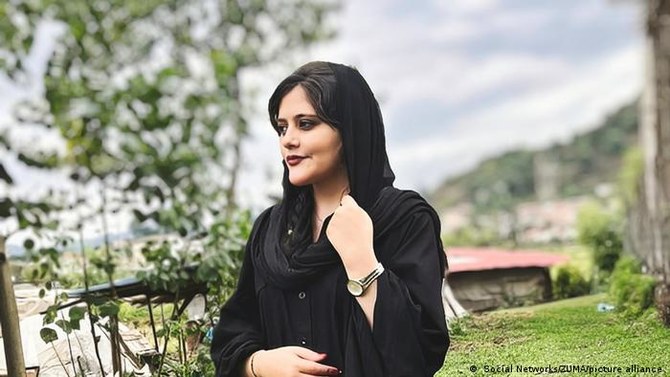
‘Shocked and saddened’: UN experts condemn Amini death in Iranian detention

Mahsa Amini’s death has sparked widespread protests throughout Iran. (Screenshot/Twitter)
Short Url
Updated 22 September 2022
Follow

‘Shocked and saddened’: UN experts condemn Amini death in Iranian detention

  • Independent panel urges Tehran authorities to end use of force against peaceful protesters

LONDON: UN experts have condemned the death of Iranian Mahsa Amini, 22, who died in police custody after being detained for allegedly violating the country’s strict dress code.

Amini’s death has sparked widespread protests throughout Iran, with several peaceful protesters suffering severe injuries after being attacked by security forces.

Amini was arrested by the country’s morality police on Sept. 13. She is believed to have been beaten during her time in detention and fell into a coma, dying three days later in hospital.

Authorities in Iran have claimed that Amini suffered a heart attack, but conflicting reports allege that she died as a result of torture and physical violence.

UN experts have urged Tehran to avoid using force to break up peaceful demonstrations.

The experts included Javaid Rehman, special rapporteur on human rights in Iran, and Reem Alsalem, special rapporteur on violence against women. They are part of the Special Procedures of the Human Rights Council, the largest body of independent experts in the UN human rights system.

“We are shocked and deeply saddened by the death of Amini. She is another victim of Iran’s sustained repression and systematic discrimination against women, and the imposition of discriminatory dress codes that deprive women of bodily autonomy, and the freedoms of opinion, expression and belief,” the experts said in a statement.

“We strongly condemn the use of physical violence against women and the denial of fundamental human dignity when enforcing compulsory hijab policies ordained by state authorities.

“We call on the Iranian authorities to hold an independent, impartial and prompt investigation into Amini’s death, make the findings of the investigation public and hold all perpetrators accountable.”

Iranian authorities have also reportedly authorized internet blackouts in parts of the country, including in the capital Tehran.

“Disruptions to the internet are usually part of a larger effort to stifle the free expression and association of the Iranian population, and to curtail ongoing protests. State-mandated internet disruptions cannot be justified under any circumstances,” the experts said.

“Over the past four decades, Iranian women have continued to peacefully protest against the compulsory hijab rules and the violations of their fundamental human rights.

“Iran must repeal all legislation and policies that discriminate on the grounds of sex and gender, in line with international human rights standards.”


Coast Guard is pursuing another tanker helping Venezuela skirt sanctions, US official says

Updated 22 December 2025
Follow

Coast Guard is pursuing another tanker helping Venezuela skirt sanctions, US official says

  • US oil companies dominated Venezuela’s petroleum industry until the country’s leaders moved to nationalize the sector, first in the 1970s and again in the 21st century under Maduro and his predecessor, Hugo Chávez

WEST PALM BEACH, Florida: The US Coast Guard on Sunday was pursuing another sanctioned oil tanker in the Caribbean Sea as the Trump administration appeared to be intensifying its targeting of such vessels connected to the Venezuelan government.
The pursuit of the tanker, which was confirmed by a US official briefed on the operation, comes after the US administration announced Saturday it had seized a tanker for the second time in less than two weeks.
The official, who was not authorized to comment publicly about the ongoing operation and spoke on the condition of anonymity, said Sunday’s pursuit involved “a sanctioned dark fleet vessel that is part of Venezuela’s illegal sanctions evasion.”
The official said the vessel was flying a false flag and under a judicial seizure order.
The Pentagon and Department of Homeland Security, which oversees the US Coast Guard, deferred questions about the operation to the White House, which did not offer comment on the operation.
Saturday’s predawn seizure of a Panama-flagged vessel called Centuries targeted what the White House described as a “falsely flagged vessel operating as part of the Venezuelan shadow fleet to traffic stolen oil.”
The Coast Guard, with assistance from the Navy, seized a sanctioned tanker called Skipper on Dec. 10, another part of the shadow fleet of tankers that the US says operates on the fringes of the law to move sanctioned cargo. It was not even flying a nation’s flag when it was seized by the Coast Guard.
President Donald Trump, after that first seizure, said that the US would carry out a “blockade” of Venezuela. It all comes as Trump has ratcheted up his rhetoric toward Venezuelan President Nicolás Maduro.
This past week Trump demanded that Venezuela return assets that it seized from US oil companies years ago, justifying anew his announcement of a “blockade” against oil tankers traveling to or from the South American country that face American sanctions.
Trump cited the lost US investments in Venezuela when asked about his newest tactic in a pressure campaign against Maduro, suggesting the Republican administration’s moves are at least somewhat motivated by disputes over oil investments, along with accusations of drug trafficking. Some sanctioned tankers already are diverting away from Venezuela.
US oil companies dominated Venezuela’s petroleum industry until the country’s leaders moved to nationalize the sector, first in the 1970s and again in the 21st century under Maduro and his predecessor, Hugo Chávez. Compensation offered by Venezuela was deemed insufficient, and in 2014, an international arbitration panel ordered the country’s socialist government to pay $1.6 billion to ExxonMobil.
Maduro said in a message Sunday on Telegram that Venezuela has spent months “denouncing, challenging and defeating a campaign of aggression that goes from psychological terrorism to corsairs attacking oil tankers.”
He added: “We are ready to accelerate the pace of our deep revolution!”
Sen. Rand Paul, R-Kentucky, who has been critical of Trump’s Venezuela policy, called the tanker seizures a “provocation and a prelude to war.”
“Look, at any point in time, there are 20, 30 governments around the world that we don’t like that are either socialist or communist or have human rights violations,” Paul said on ABC’s’ “This Week.” ”But it isn’t the job of the American soldier to be the policeman of the world.”
The targeting of tankers comes as Trump has ordered the Defense Department to carry out a series of attacks on vessels in the Caribbean and eastern Pacific Ocean that his administration alleges are smuggling fentanyl and other illegal drugs into the United States and beyond.
At least 104 people have been killed in 28 known strikes since early September. The strikes have faced scrutiny from US lawmakers and human rights activists, who say the administration has offered scant evidence that its targets are indeed drug smugglers and that the fatal strikes amount to extrajudicial killings.
Trump has repeatedly said Maduro’s days in power are numbered. White House chief of staff Susie Wiles said in an interview with Vanity Fair published last week that Trump “wants to keep on blowing boats up until Maduro cries uncle.”
Sen. Tim Kaine, D-Virginia, told NBC’s “Meet the Press” on Sunday that Trump’s use of military to mount pressure on Maduro runs contrary to Trump’s pledge to keep the United States out of unnecessary wars.
Democrats have been pressing Trump to seek congressional authorization for the military action in the Caribbean.
“We should be using sanctions and other tools at our disposal to punish this dictator who is violating the human rights of his civilians and has run the Venezuelan economy into the ground,” Kaine said. “But I’ll tell you, we should not be waging war against Venezuela. We definitely should not be waging war without a vote of Congress.