

ADB to release 'significant' package to support Pakistan flood victims, damaged infrastructure

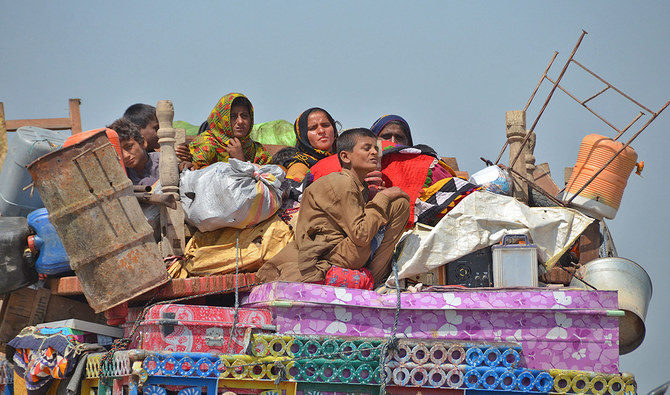
Displaced flood-affected families travel atop a tractor with their belongings near a makeshift camp at Dera Allah Yar in Jaffarabad district of Balochistan province on September 20, 2022. (AFP)
Short Url
Updated 25 September 2022
Follow

ADB to release 'significant' package to support Pakistan flood victims, damaged infrastructure

  • New package will be in addition to $3 million grant approved in August this year to support emergency relief efforts
  • Heavy monsoon rains across Pakistan have triggered flash floods, landslides, glacial lake outbursts, killing 1,559 people

KARACHI: The Asian Development Bank (ADB) said on Tuesday it was working to fast-track releasing a “significant relief and rehabilitation package” to support people, livelihoods, and infrastructure hit by recent floods in Pakistan.

The Asian lender’s new relief package will be in addition to a $3 million grant approved in August this year to support emergency relief efforts amid widespread floods.

Monsoon rains that began in mid-June across Pakistan have triggered flash floods, landslides, and glacial lake outbursts, killing 1,559 people across the country and affecting more than 33 million. The deluge has also destroyed 13,000 kilometers road network and around two million houses and 374 bridges, according to the National Disaster Management Authority (NDMA).  

Pakistani experts estimated the country will require more than $12 billion to rebuild damaged infrastructure alone. The planning minister has put flood damages at at least $30 billion.

“The bank is working on the relief package on a fast-track basis and more details would be shared after finalization of the package,” Mohammad Ismail Khan, a communications officer for the ADB mission in Pakistan, told Arab News.

“The bank plans to work with government and other international agencies in close coordination to help rebuild the lives and livelihoods of the people affected by the floods.”

In a statement on Tuesday, the Asian lender said the new relief packaged will “support people, livelihoods, and infrastructure immediately and in the long-term.”

"Short- & medium-term, we’ll use ongoing projects to: repair damaged infrastructure, including roads and irrigation infrastructure, [and] support the development & financial stability of the agriculture sector to boost food security," the statement said.

“We’re also processing countercyclical support to help the poor and vulnerable, especially women and children, weather the impacts of food prices and other external shocks,” the statement added. “Long-term, we’ll prioritize projects that support post-flood reconstruction and strengthen climate and disaster resilience.”

Pakistan has identified several priority needs, including food security, agriculture and livestock, health, water, sanitation, hygiene, shelter, and nonfood items, according to the ADB.


Pakistan to launch last 2025 anti-polio nationwide drive targeting 45 million children next week

Updated 3 sec ago
Follow

Pakistan to launch last 2025 anti-polio nationwide drive targeting 45 million children next week

  • Over 400,000 frontline health workers will participate in Dec. 15-21 nationwide polio vaccination campaign, say authorities
  • Pakistan is one of only two countries in the world, the other being Afghanistan, where wild poliovirus remains endemic

KARACHI: Pakistan will kick off the last nationwide anti-polio vaccination campaign of 2025 targeting 45 million children next week, the National Emergencies Operation Center (NEOC) said on Monday, urging parents to coordinate with health workers during the drive. 

The campaign takes place days after Pakistan launched a nationwide vaccination drive from Nov. 17-29 against measles, rubella and polio. Pakistan said it had targeted 22.9 million children across 89 high-risk districts in the country with oral polio vaccination drops during the drive. 

Over 400,000 health workers will perform their duties during the upcoming Dec. 15-21 nationwide polio vaccination campaign, the NEOC said in a statement. 

“Parents are urged to cooperate with polio workers and ensure their children are vaccinated,” the NEOC said. “Complete the routine immunization schedule for all children up to 15 months of age on time.”

Health authorities aim to vaccinate 23 million children in Punjab, 10.6 million in Sindh, over 7.2 million in Khyber Pakhtunkhwa, over 2.6 million in Balochistan, more than 460,000 in Islamabad, over 228,000 in Gilgit-Baltistan and more than 760,000 children in Pakistan-administered Kashmir during the seven-day campaign, it added. 

Pakistan is one of only two countries in the world where wild poliovirus remains endemic.

Polio is a highly infectious and incurable disease that can cause lifelong paralysis. The only effective protection is through repeated doses of the Oral Polio Vaccine for every child under five during each campaign, alongside timely completion of all routine immunizations.

Islamabad’s efforts to eliminate poliovirus have been hampered by parental refusals, widespread misinformation and repeated attacks on anti-polio workers by militant groups. In remote and volatile areas, vaccination teams often operate under police protection, though security personnel themselves have also been targeted and killed in attacks.