NASA’s InSight lander detects space rocks as they slam into Mars

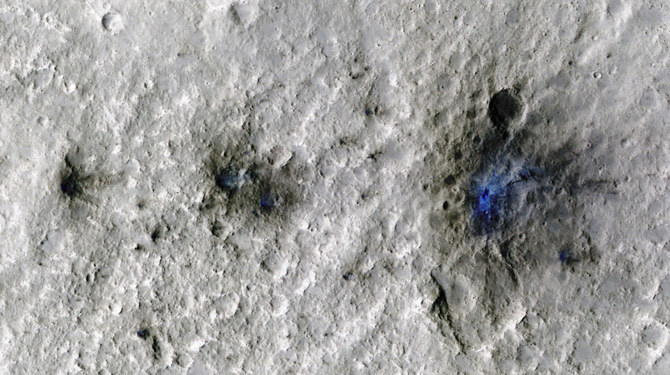
Craters formed by a September 5, 2021, meteoroid impact on Mars, the first to be detected by NASA’s InSight, are seen in an image taken by NASA’s Mars Reconnaissance Orbiter. (REUTERS)
Short Url
Updated 20 September 2022
Follow

NASA’s InSight lander detects space rocks as they slam into Mars

WASHINGTON: Mars, by virtue of its tenuous atmosphere and proximity to our solar system’s asteroid belt, is far more vulnerable than Earth to being struck by space rocks — one of the many differences between the two planetary neighbors.
Scientists are now gaining a fuller understanding of this Martian trait, with help from NASA’s robotic InSight lander. Researchers on Monday described how InSight detected seismic and acoustic waves from the impact of four meteorites and then calculated the location of the craters they left — the first such measurements anywhere other than Earth.
The researchers used observations from NASA’s Mars Reconnaissance Orbiter in space to confirm the crater locations.
“These seismic measurements give us a completely new tool for investigating Mars, or any other planet we can land a seismometer on,” said planetary geophysicist Bruce Banerdt of NASA’s Jet Propulsion Laboratory, the InSight mission’s principal investigator.
The space rocks InSight tracked — one landing in 2020 and the other three in 2021 — were relatively modest in size, estimated to weigh up to about 440 pounds (200 kg), with diameters of up to about 20 inches (50 cm) and leaving craters of up to about 24 feet (7.2 meters) wide. They landed between 53 miles (85 km) and 180 miles (290 km) from InSight’s location. One exploded into at least three pieces that each gouged their own craters.
“We can connect a known source type, location and size to what the seismic signal looks like. We can apply this information to better understand InSight’s entire catalog of seismic events, and use the results on other planets and moons, too,” said Brown University planetary scientist Ingrid Daubar, a co-author of the study published in the journal Nature Geoscience https://www.nature.com/articles/s41561-022-01014-0.
The researchers believe that now the seismic signature of such impacts has been discovered they expect to find more contained in InSight’s data, going back to 2018.
The three-legged InSight — its name is short for Interior Exploration Using Seismic Investigations, Geodesy and Heat Transport — landed in 2018 in a vast and relatively flat plain just north of the Martian equator called Elysium Planitia.
“The moon is also a target for future meteor impact detection,” said planetary scientist and study lead author Raphael Garcia of the University of Toulouse’s ISAE-SUPAERO institute of aeronautics and space.
“And it may be the same sensors will do it, because the spare sensors of InSight are currently integrated in the Farside Seismic Suite instrument for a flight to the moon in 2025,” Garcia added, referring to an instrument due to be placed near the lunar south pole on the side of the moon permanently facing away from Earth.
Mars is about twice as likely as Earth to have its atmosphere hit by a meteoroid — the name for a space rock before it strikes the surface. However, Earth has a much thicker atmosphere that protects the planet.
“So meteoroids usually break up and disintegrate in the Earth’s atmosphere, forming fireballs that only rarely reach the surface to form a crater. In comparison on Mars, hundreds of impact craters are forming somewhere on the planet’s surface every year,” Daubar said.
The Martian atmosphere is only about 1 percent as thick as Earth’s. The asteroid belt, an abundant source of space rocks, is located between Mars and Jupiter.
The scientific goals set for InSight ahead of the mission were to investigate the internal structure and processes of Mars, as well as studying seismic activity and meteorite impacts.
InSight’s seismometer instrument established that Mars is seismically active, detecting more than 1,300 marsquakes. In research published last year, seismic waves detected by InSight helped decipher the internal structure of Mars, including the first estimates of the size of its large liquid metal core, thickness of its crust, and nature of its mantle.


St. Francis relics go on public show for first time in Italy

Updated 22 February 2026
Follow

St. Francis relics go on public show for first time in Italy

Assisi, Italy: Saint Francis of Assisi’s skeleton is going on public display from Sunday for the first time for the 800th anniversary of his death, drawing hundreds of thousands of visitors.
Inside a nitrogen-filled plexiglass case with the Latin inscription “Corpus Sancti Francisci” (The Body of St. Francis), the remains are being shown in the Italian hill town’s Basilica of St. Francis of Assisi.
St. Francis, who died on October 3, 1226, founded the Franciscan order after renouncing his wealth and devoting his life to the poor.
Giulio Cesareo, director of communications for the Franciscan convent in Assisi said he hoped the display could be “a meaningful experience” for believers and non-believers alike.
Cesareo, a Franciscan friar, said the “damaged” and “consumed” state of the bones showed that St. Francis “gave himself completely” to his life’s work.
His remains, which will be on display until March 22, were transferred to the basilica built in the saint’s honor in 1230.
But it was only in 1818, after excavations carried out in utmost secrecy, that his tomb was rediscovered.
Apart from previous exhumations for inspection and scientific examination, the bones of Saint Francis have only been displayed once, in 1978, to a very limited public and for just one day.
Usually hidden from view, the transparent case containing the relics since 1978 was brought out on Saturday from the metal coffer in which it is kept, inside his stone tomb in the crypt of the basilica.
The case is itself inside another bullet-proof and anti-burglary glass case.
Surveillance cameras will operate 24 hours a day for added protection of the remains.
St. Francis is Italy’s patron saint and the 800th anniversary commemorations of his death will also see the restoration of an October 4 public holiday in his honor.
The holiday had been scrapped nearly 50 years ago for budget reasons.
Its revival is also a tribute to late pope Francis who took on the saint’s name.
Pope Francis died last year at the age of 88.

‘Not a movie set’

Reservations to see the saint’s remains already amount to “almost 400,000 (people) coming from all parts of the world, with of course a clear predominance from Italy,” said Marco Moroni, guardian of the Franciscan convent.
“But we also have Brazilians, North Americans, Africans,” he added.
During this rather quiet time of year, the basilica usually sees 1,000 visitors per day on weekdays, rising to 4,000 on weekends.
The Franciscans said they were expecting 15,000 visitors per day on weekdays and up to 19,000 on Saturdays and Sundays for the month-long display of the remains.
“From the very beginning, since the time of the catacombs, Christians have venerated the bones of martyrs, the relics of martyrs, and they have never really experienced it as something macabre,” Cesareo said.
What “Christians still venerate today, in 2026, in the relics of a saint is the presence of the Holy Spirit,” he said.
Another church in Assisi holds the remains of Carlo Acutis, an Italian teenager who died in 2006 and who was canonized in September by Pope Leo XIV.
Experts said the extended display of St. Francis’s remains should not affect their state of preservation.
“The display case is sealed, so there is no contact with the outside air. In reality, it remains in the same conditions as when it was in the tomb,” Cesareo said.
The light, which will remain subdued in the church, should also not have an effect.
“The basilica will not be lit up like a stadium,” Cesareo said. “This is not a movie set.”