

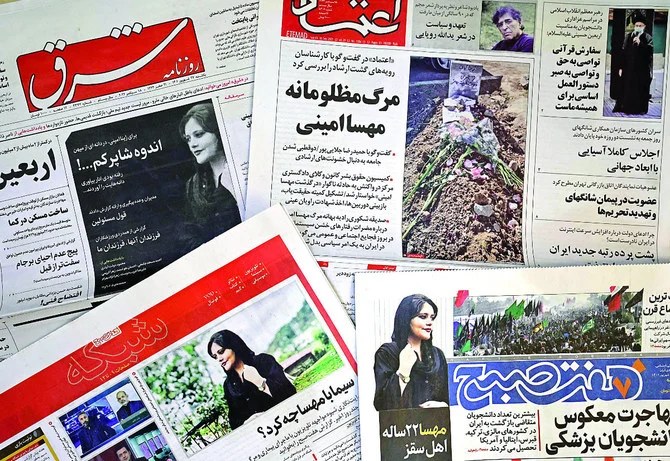
Fury grows in Iran over woman who died after hijab arrest

The death of Mahsa amini in the custody of iran’s morality police enforcing strict hijab rules has received wide coverage in newspapers and social media. (AFP)
Short Url
Updated 19 September 2022
Follow

Fury grows in Iran over woman who died after hijab arrest

  • Mahsa Amini, 22, fell into a coma and died following her arrest in Tehran by the morality police last week
  • Amini's death has drawn protests from Iranians angered over the treatment of women by security forces

TEHRAN: Iranian police called on Monday the death of Mahsa Amini an “unfortunate incident” that they do not want to see repeated, the semi-official Fars news agency reported.
Amini was a 22 year-old woman who fell into a coma and died following her arrest in Tehran by the morality police last week, sparking protests across the country by Iranians angered by the treatment of women by the country's security forces.
“Cowardly accusations have been levelled against the Iranian police. We will wait until the day of judgment but we cannot stop doing security work,” Greater Tehran Police Commander Hossein Rahimi added.

Protests persisted on Sunday and #MahsaAmini became one of the top hashtags ever on Persian-language Twitter as Iranians fumed over her death.

Amini, 22, died on Friday after falling into a coma following her arrest in Tehran earlier in the week in the custody of morality police enforcing strict hijab rules.

The death of Amini has reignited calls to rein in its actions against women suspected of violating the dress code.

The day after her funeral in Kurdistan, nearly all Iranian press dedicated their front pages to her story on Sunday.

“The nation has expressed its sorrow over Mahsa’s sad death,” stated the front page of ultra-conservative newspaper Javan.

Originally from the northwestern Kurdistan province, Amini was on a visit with her family to Tehran when she was detained on Tuesday.

Hundreds of protesters gathered on Sunday around the University of Tehran on Sunday, shouting “Woman, Life, Freedom,” according to online videos.

The #MahsaAmini hashtag has now reached 1.63 million mentions on Twitter.

There were also protests in Kurdistan on Saturday, including at the funeral in her hometown Saqez.

Police repressed the Saqez demonstrations, with videos posted online showing at least one man with a head injury.

In Saqez, some residents hurled stones at the governor’s office and chanted slogans against the authorities.

Behzad Rahimi, an MP for Saqez, said that a few people were wounded at the funeral.

“One of them was hospitalized in the Saqez Hospital after being hit in the intestines by ballbearings,” he said.

Kurdish rights group Hengaw said that 33 people were injured in Saqez.

As Iran reels from the woman’s death, the Sunday front page of financial newspaper Asia declared: “Dear Mahsa, your name will become a symbol.”

The police unit — responsible for enforcing Iran’s dress code for women — had already faced growing criticism in recent months over its excessive use of force.

“The people are shocked and outraged by what happened to Mahsa Amini,” reformist publication Etemad noted, stating that the country has suffered “multiple instances of violence by the morality police.”

The Jomhouri-e Eslami daily warned against “social fragmentation” triggered by the “violent behavior” of the unit’s officers President Ebrahim Raisi promised the family in a phone call that he would follow up the case, telling them “your daughter is like my own daughter and I feel like this incident happened to one of my own relatives.”

However, some of the more conservative media outlets sought to push back against the barrage of criticism.

The government daily Iran newspaper accused reformists of “exploiting public sentiments by using an unfortunate incident to incite the nation against the government and the president.”

One ultra-conservative newspaper, Kayhan, claimed that “the amount of rumors and lies spread in the wake of Mahsa’s death has risen considerably.”

“Nevertheless, the publication of images of this incident by the police has stopped opportunists from exploiting it,” the publication argued.


MSF and Oxfam among 37 aid groups Israel is banning from Gaza

Updated 5 sec ago
Follow

MSF and Oxfam among 37 aid groups Israel is banning from Gaza

  • NGOs say new rules from Thursday will have major impact on food and medical shipments to the territory
  • UN rights chief describes decision as 'outrageous,' EU says it will block 'life-saving' assistance from reaching Palestinians
JERUSALEM: Israel has said 37 aid organizations will be banned from operating in Gaza from Thursday unless they comply with guidelines requiring detailed information on Palestinian staff, drawing criticism from the United Nations and the European Union.
Several NGOs have told AFP the new rules will have a major impact on food and medical shipments to Gaza, at a time when humanitarian organizations say the amount of aid getting in is inadequate to the devastated territory’s needs.
Israel’s deadline for NGOs to provide the details expires at midnight on Wednesday.
“They refuse to provide lists of their Palestinian employees because they know, just as we know, that some of them are involved in terrorism or linked to Hamas,” spokesman for the Ministry of Diaspora Affairs and Combating Antisemitism, Gilad Zwick told AFP, naming 37 NGOs that had so far failed to meet the new requirements.
“I highly doubt that what they haven’t done for 10 months, they will suddenly do in less than 12 hours,” Zwick said. “We certainly won’t accept any cooperation that is just for show, simply to get an extension.”
The ministry had said in a statement on Wednesday that the move was part of Israel’s decision to “strengthen and update” regulations governing the activities of international NGOs in the Palestinian territory.
A fragile ceasefire has been in place in Gaza since October, following a deadly war waged by Israel in response to Hamas’s unprecedented attack on Israeli territory on October 7, 2023.
For Israel, it says the new regulation aims to prevent bodies it accuses of supporting terrorism from operating in the Palestinian territories.
On Tuesday, Israel specified that “acts of de-legitimising Israel” or denial of events surrounding Hamas’ October 7 attack would be “grounds for license withdrawal.”
Israel has singled out international medical charity Doctors Without Borders (MSF), alleging that it had two employees who were members of Palestinian militant groups Islamic Jihad and Hamas.
Apart from MSF, some of the 37 NGOs to be hit with the ban are the Norwegian Refugee Council, World Vision International, CARE and Oxfam, according to the list given by Zwick.

- ‘Guarantee access’ -

On Wednesday, the United Nations rights chief Volker Turk described Israel’s decision as “outrageous,” calling on states to urgently insist Israel shift course.
“Israel’s suspension of numerous aid agencies from Gaza is outrageous,” he said in a statement, warning that “such arbitrary suspensions make an already intolerable situation even worse for the people of Gaza.”
The European Union also warned that Israel’s decision would block “life-saving” assistance from reaching Gazans.
“The EU has been clear: the NGO registration law cannot be implemented in its current form,” EU humanitarian chief Hadja Lahbib posted on X.
“IHL (international humanitarian law) leaves no room for doubt: aid must reach those in need,” Lahbib wrote.
On Tuesday, the foreign ministers of ten countries, including France and the United Kingdom, had already urged Israel to “guarantee access” to aid in the Gaza Strip, where they said the humanitarian situation remains “catastrophic.”
In a territory with 2.2 million inhabitants, “1.3 million people still require urgent shelter support,” the ministers of Britain, Canada, Denmark, Finland, France, Iceland, Japan, Norway, Sweden and Switzerland said.
While a deal for a ceasefire that started on October 10 stipulated the entry of 600 trucks per day, only 100 to 300 are carrying humanitarian aid, according to NGOs and the United Nations.
COGAT, the Israeli defense ministry body responsible for Palestinian civilian affairs, said last week that on average 4,200 aid trucks enter Gaza weekly, which corresponds to around 600 daily.