

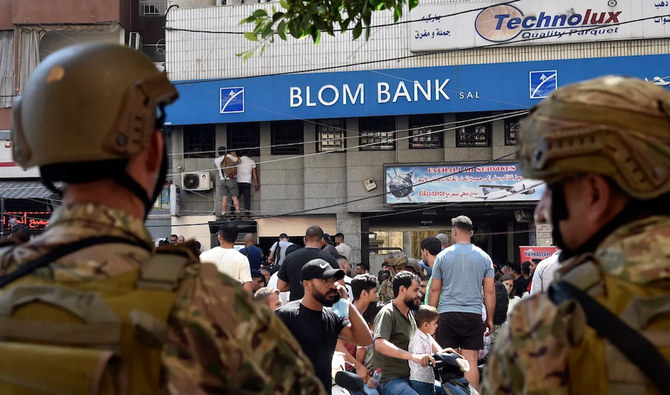

BEIRUT: Depositors wanting to recover withheld savings carried out hold-ups in at least five different banks across Lebanon on Friday.
The banks have been denying people access to their money for three years, with the government yet to establish a legal framework for the recovery of deposits, pushing depositors to retrieve their funds by force.
In Friday’s incidents, security forces negotiated with depositors, some of whom voluntarily headed to police stations to surrender after making sure their money safely reached relatives.
They followed events on Wednesday, when Sali Hafiz stormed her local bank with a toy gun and managed to recover part of her savings to help pay for her sister’s cancer treatment. The security forces issued an arrest warrant against her, but she remains at large.
Hassan Moghnieh, the head of the Lebanon’s Depositors Association, told Arab News: “It is an uprising of depositors who can no longer endure more than three years of having their savings withheld. Five banks were stormed on Friday, and there is news about more banks being stormed in Nabatiyeh in the south, Batroun, and Halba in the north.”
STORMING OF THE BANKS
Banks reportedly held up by depositors
• Byblos Bank in Ghazieh
• BLOM Bank at Beirut’s Tarik El-Jadida
• Bank Audi in Chiyah
• Banque Libano-Française branches at Kafaat and Hamra
• Lebanon & Gulf Bank at Ramlet El-Baida
• BLOM Bank in Concorde
• Fransabank in Beirut
• BankMed in Chehim in Mount Lebanon
Friday’s incidents prompted the bank association to hold an emergency meeting and decide to close banks for three days starting Monday.
Depositor Mohammed Reda Korkmaz and his son Ibrahim stormed the Byblos Bank branch in Ghazieh. The father held employees hostage, poured gasoline, and threatened to set the branch on fire if he did not get his money back.
Panic ensued at the bank for some time, and Korkomaz managed to retrieve $19,200 from his account and handed it over to someone who was waiting for him outside the bank.
It turned out that Korkmaz worked as a taxi driver, and he used a plastic pistol and a gasoline bottle to threaten employees. Later, he and his son surrendered, smiling to the security forces at the scene.
Abdel Rahman Sobra stormed the BLOM Bank branch in Tariq Al-Jdideh, one of the most popular and crowded neighborhoods in Beirut.
He claimed to have a gun in his pocket but did not use it to threaten employees.
He demanded to recover his withheld deposits, estimated at $165,000. Sobra said he was a businessman and is unable to pay his dues and cover his employees’ salaries.
A woman in her 80s later joined Sobra, asking to be allowed to withdraw her money as she needs to pay her medical bills.
Video footage from inside the bank showed that security forces entered to negotiate with Sobra but did not arrest him.
An armed depositor broke into the Bank of Lebanon and Gulf in Ramlet Al-Bayda, in the south of Beirut, carrying a hunting rifle. The depositor, identified as Jawad Sleem, is unemployed, according to his brother, who was waiting for him outside the bank.
Sleem used to work in real estate but became unemployed after the economic collapse in the country. He demanded $35,000 from his deposit of $50,000 and held five hostages inside the bank.
Armed with a gun, a depositor from Al-Moussawi family stormed the Libano-Française bank in Mrayjeh in one of Beirut’s southern suburbs, and forcibly took his entire deposit of $20,000.
A depositor who is a serving lieutenant in the Internal Security Forces broke into Bankmed in Chehime in Iklim El-Kharoub. It was said that he fired into the air.
Activist lawyer Haytham Azzo, known for defending civilians protesting in the streets and depositors breaking into banks, told Arab News that these depositors do not have criminal intentions, and only want their rightful property.
“This is the result of the state not addressing the frozen dollar deposits crisis as the economic crisis worsens. The state is turning normal civilians into criminals when they are not as such,” Azzo said.
Interior Minister Bassam Mawlawi called for an immediate meeting of the Central Security Council. “The law will be strictly enforced, however, I will not accept a confrontation between people and the security forces; There will be no gunfire or harsh treatment,” he said.
Mawlawi addressed depositors: “You cannot reclaim your rights in such a way as it harms the banking system and leads to the rest of the depositors losing their rights.”
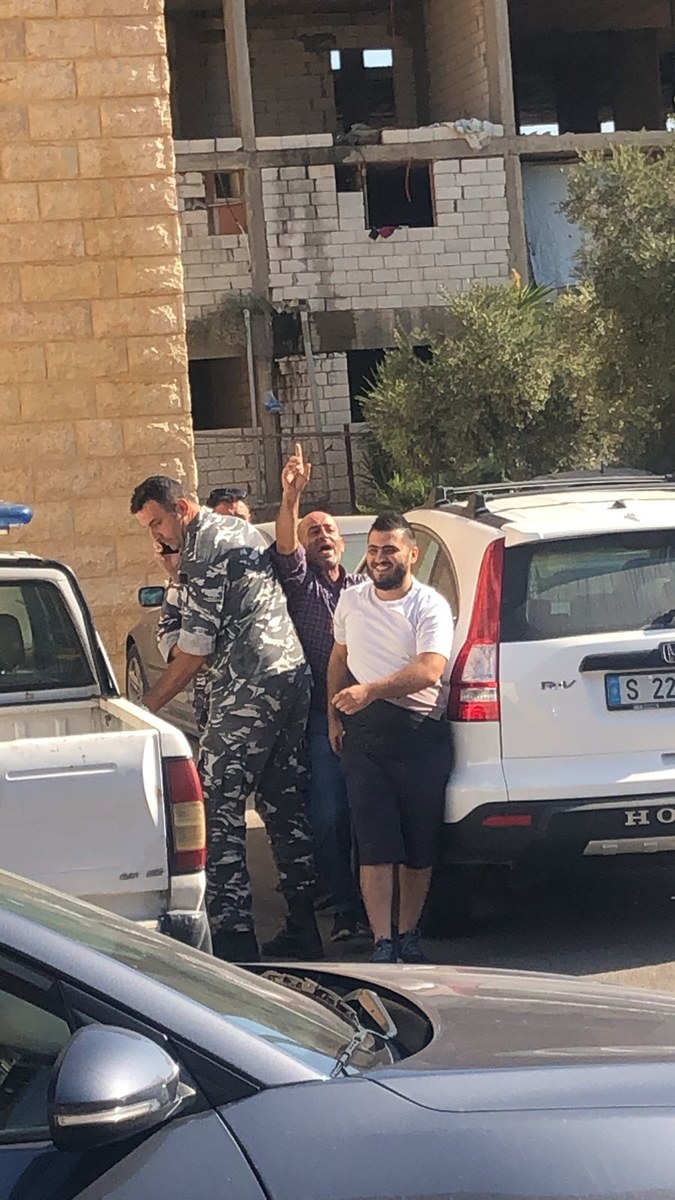
Above, the smiling suspects surrender to the police. (Twitter)
The bank association said its decision to suspend work came “after the repeated attacks on banks, especially the physical assaults on bank employees and their dignity.”
It also came “after taking into account the risks that the customers are facing inside the branches subjected to storming operations.”
The association stressed that “it wants to protect the interests of depositors” and that “violence was not and will not be a solution.”
Economic expert Jassem Ajaka told Arab News that storming banks is a “very dangerous indicator that the government has given up on its role, to the extent that people themselves are now reclaiming their rights.”
He said: “This is a warning for the government to approve the draft of the Capital Control Law, restructure banks and acknowledge public debt.”
President of the Lebanese Depositors Association Hassan Moghnieh said: “An increase in bank break-ins was expected,” adding “closing down banks will not address the crisis, since the break-ins will restart on the first day of banks reopening their doors.”
He warned of “massive social chaos” and denied that “any party was responsible for depositors’ uprising.”


