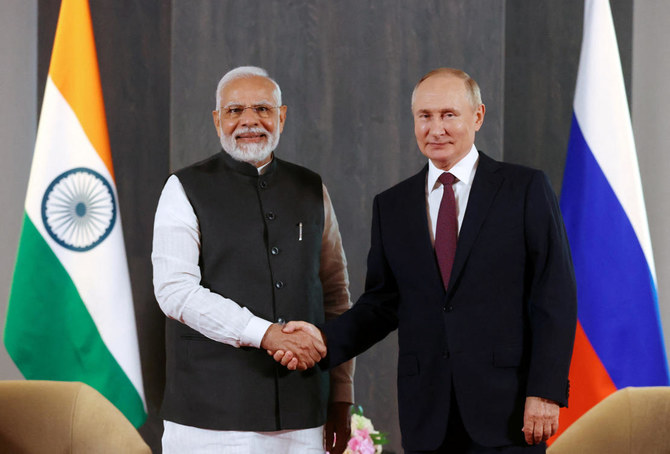
SAMARKAND, Uzbekistan: Indian Prime Minister Narendra Modi told Russian President Vladimir Putin that now was “not a time for war” on Friday on the sidelines of a regional summit.
New Delhi and Moscow have longstanding ties dating back to the Cold War, and Russia remains by far India’s biggest arms supplier.
But in their first face-to-face meeting since Moscow’s forces invaded Ukraine in February, Modi told Putin: “Excellency, I know today’s time is not a time for war.”
India has shied away from explicitly condemning Russia for the invasion, which sent the price of oil and other commodities soaring.
But he stressed the importance of “democracy and diplomacy and dialogue” in the meeting on the sidelines of the Shanghai Cooperation Organization (SCO) summit in the Uzbek city of Samarkand, footage showed on Indian public service broadcaster Doordashan.
They would discuss “how to move forward on the path of peace,” Modi added.
The SCO summit comes as Russian forces face major battlefield setbacks in Ukraine, and represented an opportunity for Putin to show his country had not been fully isolated despite Western efforts.
“I know your position on the conflict in Ukraine, your concerns... We will do our best to end this as soon as possible,” Putin told Modi.
But he added that Ukraine’s leadership had rejected negotiations “and stated that it wants to achieve its goals by military means, on the battlefield.”
On Thursday, Putin met with his Chinese counterpart Xi Jinping and acknowledged that his key ally Beijing also had “concerns” over the conflict.
New Delhi has long walked a tightrope in its relations with the West and Moscow — and the Russian invasion of Ukraine has highlighted the difficulty of that balancing act.
It has urged a cessation of hostilities but repeatedly brushed off calls from Washington to condemn Russia, despite India pursuing greater security ties with the United States.
Unusually, India is a member of both the SCO and the so-called Quad, a strategic bloc grouping it, the United States, Japan and Australia, and aimed at providing a more substantive counterweight to China’s rising military and economic power.
Former Indian ambassador to Russia Pankaj Saran described Modi’s comments as “quite frank” in saying that the Ukraine crisis “had caught the attention of the whole world and created problems for the developing world.”
“This was a fairly strong message to Russia,” he told Doordashan. “As a friend, his recommendation and India’s position is that this needs to be resolved only through dialogue and diplomacy.”
Putin visited New Delhi late last year, bear-hugging Modi and hailing India as a “great power” as the two men bolstered military and energy ties.
India is the world’s second largest importer of arms and according to the Business Standard, between 2016-20, 49.4 percent of its purchases were from Russia.
The Asian giant of 1.4 billion people is also a major consumer of Russian oil, ramping up discounted purchases in the wake of a Western embargo.


India’s Modi tells Putin now is ‘not a time for war’
https://arab.news/vn7un
India’s Modi tells Putin now is ‘not a time for war’

- Modi told Putin: "Excellency, I know today's time is not a time for war"
- India has shied away from explicitly condemning Russia for the invasion, which sent the price of oil and other commodities soaring


India, Arab League target $500bn in trade by 2030
- It was the first such gathering of India–Arab FMs since the forum’s inauguration in 2016
- India and Arab states agree to link their startup ecosystems, cooperate in the space sector
NEW DELHI: India and the Arab League have committed to doubling bilateral trade to $500 billion by 2030, as their top diplomats met in New Delhi for the India–Arab Foreign Ministers’ Meeting.
The foreign ministers’ forum is the highest mechanism guiding India’s partnership with the Arab world. It was established in March 2002, with an agreement to institutionalize dialogue between India and the League of Arab States, a regional bloc of 22 Arab countries from the Middle East and North Africa.
The New Delhi meeting on Saturday was the first gathering in a decade, following the inaugural forum in Bahrain in 2016.
India’s Foreign Minister S. Jaishankar said in his opening remarks that the forum was taking place amid a transformation in the global order.
“Nowhere is this more apparent than in West Asia or the Middle East, where the landscape itself has undergone a dramatic change in the last year,” he said. “This obviously impacts all of us, and India as a proximate region. To a considerable degree, its implications are relevant for India’s relationship with Arab nations as well.”
Jaishankar and his UAE counterpart co-chaired the talks, which aimed at producing a cooperation agenda for 2026-28.
“It currently covers energy, environment, agriculture, tourism, human resource development, culture and education, amongst others,” Jaishankar said.
“India looks forward to more contemporary dimensions of cooperation being included, such as digital, space, start-ups, innovation, etc.”
According to the “executive program” released by India’s Ministry of External Affairs, the roadmap agreed by India and the League outlined their planned collaboration, which included the target “to double trade between India and LAS to US$500 billion by 2030, from the current trade of US$240 billion.”
Under the roadmap, they also agreed to link their startup ecosystems by facilitating market access, joint projects, and investment opportunities — especially health tech, fintech, agritech, and green technologies — and strengthen cooperation in space with the establishment of an India–Arab Space Cooperation Working Group, of which the first meeting is scheduled for next year.
Over the past few years, there has been a growing momentum in Indo-Arab relations focused on economic, business, trade and investment ties between the regions that have some of the world’s youngest demographics, resulting in a “commonality of circumstances, visions and goals,” according to Muddassir Quamar, associate professor at the School of International Studies, Jawaharlal Nehru University.
“The focus of the summit meeting was on capitalizing on the economic opportunities … including in the field of energy security, sustainability, renewables, food and water security, environmental security, trade, investments, entrepreneurship, start-ups, technological innovations, educational cooperation, cultural cooperation, youth engagement, etc.,” Quamar told Arab News.
“A number of critical decisions have been taken for furthering future cooperation in this regard. In terms of opportunities, there is immense potential.”


