

Jordanian rescuers recover 10th body from rubble of collapsed apartment block

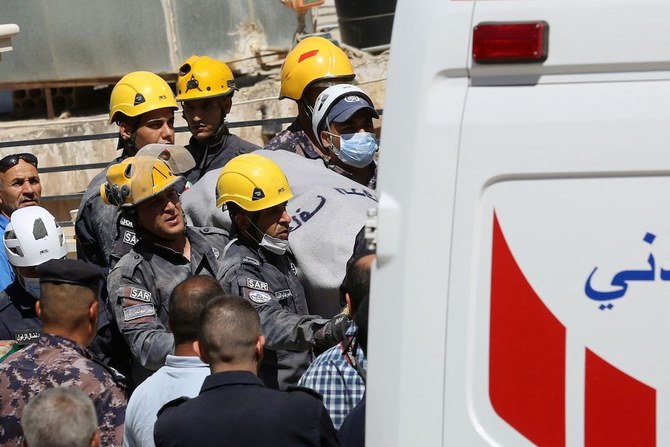
Jordanian first responders transport a body into an ambulance, after being pulled from the rubble of a collapsed building. (AFP)
Short Url
Updated 15 September 2022
Follow

Jordanian rescuers recover 10th body from rubble of collapsed apartment block

  • Search continues for survivors of tragedy in Amman’s El-Luweibdeh neighborhood
  • King Abdullah praises ‘professionalism’ of rescue teams

AMMAN: The death toll from the building collapse in Jordan’s capital Amman rose to 10 on Thursday after rescue teams recovered another body from the rubble.

The discovery was made as the search continues for survivors of the accident, the Public Security Department said. As well as the fatalities, 10 people were injured in the collapse.

Following his return from France on Wednesday, Jordan’s King Abdullah chaired a meeting at the National Center for Security and Crisis Management to keep abreast of the situation, the royal court said in a statement.

He urged that all those affected by the collapse of the residential building in Amman’s El-Luweibdeh neighborhood be provided with all necessary medical care and support, it said.

He also called for greater awareness of how to deal with old buildings, it added.

On a visit to the PSD on Thursday, the king praised the professionalism of the civil defense teams and stressed the need for more training and specialized equipment to deal with similar tragedies in the future, according to a separate statement from the royal court.

On Wednesday, Civil Defense Chief Hatem Jaber said that search and rescue operations would continue until all those believed to have been trapped were pulled out.

At least 25 people are thought to have been in the building when it collapsed on Tuesday. About 300 civil defense personnel are involved in the search and rescue mission.

Among those rescued so far are a five-month-old baby girl named Malak and a man in his 50s. The infant is currently being treated at the Luzmila Hospital in El-Luweibdeh, and is said to be in a fair condition.

Hussam Najdawi from the Greater Amman Municipality said the building that collapsed was nearly 50 years old, adding that the residents of four neighboring buildings had been evacuated as a safety precaution.

Technical teams from the municipality would assess the condition of several other old buildings in El-Luweibdeh, Najdawi said.

Although the GAM has been criticized for not taking care of old buildings it said it was not to blame for the collapse, which was the result of “irresponsible construction inside the property.”

GAM spokesperson Nasser Rahamneh told the government-owned Al-Mamlakah TV that the municipality’s job was organizational rather than technical.

The Jordanian Engineers Association said earlier it warned the GAM in 2017 about the deteriorating condition of several old buildings in Amman and called for urgent action to prevent them from collapsing.

Residents of the property that fell said its owner had been carrying out construction work on the ground floor which had weakened the support structure and caused cracks to appear in their apartments.

Local people told Arab News previously that developers had been building large residential units for foreign expatriates without “paying attention to the fact that the neighboring houses are very old and very fragile.”

El-Luweibdeh is a preferred neighborhood for expatriates in Jordan.

Following the collapse, the Amman prosecutor general opened an investigation into the incident and ordered the detention of the owner of the building, as well as its maintenance and technical contractors.


International law at ‘breaking point’ amid ‘epidemic’ of conflicts: Survey

Updated 4 sec ago
Follow

International law at ‘breaking point’ amid ‘epidemic’ of conflicts: Survey

  • Gaza war highlighted as one of the most concerning areas; atrocities in Sudan also noted
  • ‘Well over’ 100,000 civilians have been killed in past 18 months amid ‘rampant impunity’

LONDON: A new survey of 23 conflicts worldwide has said more than 100,000 civilians have been killed in the past 18 months, with adherence to international humanitarian law reaching “a critical breaking point.”

The “War Watch” survey highlighted the war in Gaza as one of the most concerning areas in an “epidemic” of violence, while also noting concerning levels of atrocities in Sudan.

Taken under the auspices of the Geneva Academy of International Humanitarian Law and Human Rights, the survey covers July 2024 to the end of 2025.

Lead author Stuart Casey-Maslen said: “Atrocity crimes are being repeated because past ones were tolerated. Our actions — or inaction — will determine whether international humanitarian law vanishes altogether.”

In Gaza, local authorities say 18,592 children and 12,400 women have been killed since Israel invaded the Palestinian enclave in October 2023. 

The report said Gaza’s overall population had declined by “about 254,000 people, a 10.6 percent decline compared with pre-conflict estimates,” making it one of the most deadly conflicts in the world. It noted that despite a ceasefire being agreed late last year, civilian casualties have continued.

In Sudan, after the fall of the city of El-Fasher to the Rapid Support Forces last October, widespread reports of survivors “being gang-raped by RSF fighters” — including in the presence of relatives — were recorded in numerous instances.

The survey said: “We do not know how many civilians have been killed in the conduct of hostilities during armed conflicts in 2024 and 2025, but we do know that the number is well over 100,000 in each of the two years.”

It added that “serious violations of international humanitarian law (IHL) were wrought … on a huge scale and with rampant impunity.” 

The report said IHL and the laws of armed conflict, established after the Second World War to protect civilians, must be upheld by every state under the Geneva Conventions “in all circumstances.”

It added: “Addressing widespread impunity for serious violations of international law should be treated as a policy priority.”

The report suggested several policy ideas to reduce the number of people suffering, including arms export bans for countries “where there is a clear risk that the arms or ammunition to be delivered will be used to commit or facilitate serious violations” of IHL.

It also proposed limiting the use of drones and artificial intelligence targeting in civilian areas, as well as unguided gravity bombs or inaccurate long-range artillery.

In addition, it called for “systematic prosecution of war crimes,” saying more political and financial support need to be given to the International Criminal Court by members of the international community.