

US: Russia spent $300m to covertly influence world politics

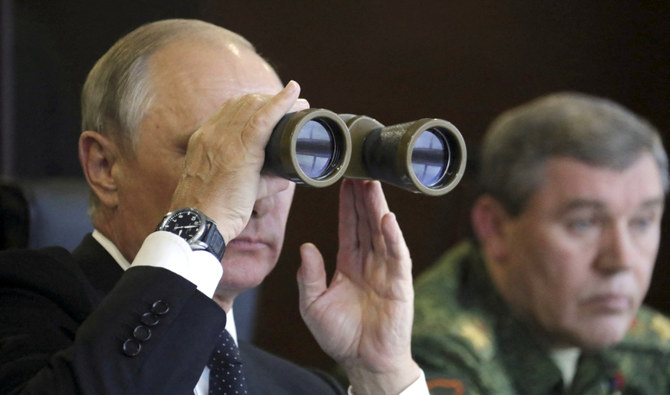
Russian President Vladimir Putin uses a pair of binoculars while watching the Zapad-2017 war games with Chief of the General Staff of Russian Armed Forces Valery Gerasimov seen nearby, in the Leningrad region, Russia Sept. 18, 2017. (REUTERS)
Short Url
Updated 14 September 2022
Follow

US: Russia spent $300m to covertly influence world politics

  • The State Department took the unusual step of releasing a diplomatic cable that was sent on Monday to many US embassies and consulates abroad, many of them in Europe, Africa and South Asia, laying out the concerns

WASHINGTON: Russia has covertly spent more than $300 million since 2014 to try to influence politicians and other officials in more than two dozen countries, the State Department alleges in a newly released cable.
The cable released Tuesday cites a new intelligence assessment of Russia’s global covert efforts to support policies and parties sympathetic to Moscow. The cable does not name specific Russian targets but says the US is providing classified information to select individual countries.
It’s the latest effort by the Biden administration to declassify intelligence about Moscow’s military and political aims, dating back to ultimately correct assessments that Russia would launch a new war against Ukraine. Many of President Joe Biden’s top national security officials have extensive experience countering Moscow and served in government when Russian President Vladimir Putin launched wide-ranging campaigns to influence the 2016 and 2020 US presidential elections.
A senior administration official declined to say how much money Russia is believed to have spent in Ukraine, where President Volodymyr Zelensky and his top deputies have long accused Putin of meddling in domestic politics. The official noted allegations of Russian influence in recent elections in Albania, Bosnia and Montenegro, all Eastern European countries that have faced historical pressure from Moscow.
Unlike declared efforts by foreign governments to lobby for preferred initiatives, Russia’s covert influence involved using front organizations to funnel money to preferred causes or politicians, the cable alleges. That includes think tanks in Europe and state-owned enterprises in Central America, Asia, the Middle East, and North Africa.
The US has in its history also covertly funded political groups and been responsible for efforts to topple or undermine foreign governments. The official, who briefed reporters on condition of anonymity under rules set by the administration, rejected comparisons between Russia’s activities and current US financing of media and political initiatives.
Putin was spending huge sums “in an attempt to manipulate democracies from the inside,” the official said.
State Department spokesman Ned Price called Russia’s covert funding an “assault on sovereignty.”
“It is an effort to chip away at the ability of people around the world to choose the governments that they see best fit to represent them, to represent their interests, and to represent their values,” he said.
Russia’s embassy in Washington did not immediately respond to a request for comment.
The State Department took the unusual step of releasing a diplomatic cable that was sent on Monday to many US embassies and consulates abroad, many of them in Europe, Africa and South Asia, laying out the concerns.
The cable, which was marked “sensitive” and not intended for foreign audiences but was not classified, contained a series of talking points that US diplomats were instructed to raise with their host governments regarding alleged Russian interference. Among steps diplomats were told to recommend include sanctions, travel bans, and exposure of covert financing.
According to the cable, intelligence officials believe Russia planned to transfer “at least hundreds of millions more” dollars in funding to sympathetic parties and officials around the world.
The cable does not say how intelligence officials came up with the total figure of $300 million. It also does not address concerns that Russia or other adversaries may again try to interfere in US politics.
The official briefing reporters noted that Biden had recently extended a national emergency declaration addressing the continued threat of foreign election interference.
“We’re promoting coordination with our democratic peers,” the official said. “And we’ll be exchanging lessons learned, all to advance our collective election security, but also our election security here at home.”
Josh Rudolph, a fellow at the German Marshall Fund’s Alliance for Securing Democracy who researches Russian and Chinese financial influence, compared the White House decision to release its new findings with its declassification of Russian plans and intentions in the Ukraine war.
“That made a lot of sense because it got the Ukrainians ready for their own defense and it helped rally the Europeans to build an international coalition,” Rudolph said. “This can have all of those same benefits but also defang the operation itself. If the target is voters, then what you mainly have to do is reach those voters and let them know what’s happening to them.”


Another construction crane collapse in Thailand kills 2 people a day after deadly train derailment

Updated 5 sec ago
Follow

Another construction crane collapse in Thailand kills 2 people a day after deadly train derailment

  • A construction crane has collapsed onto an elevated road near Bangkok, a day after another construction accident in northeastern Thailand killed 32 people
NAKHON RATCHASIMA, Thailand: A construction crane collapsed onto an elevated road near Bangkok, killing two people on Thursday, a day after another crane fell on a moving passenger train in northeastern Thailand and killed 32 people.
The work on an extension of the Rama 2 Road expressway — a major artery leading from Bangkok — has become notorious for construction accidents, some of them fatal.
The crane collapsed at part of the road project in Samut Sakhon province, trapping two vehicles in the wreckage, according to the government’s Public Relations Department.
Transport Minister Phiphat Ratchakitprakarn said on Thai TV Channel 7 that two people had died. It was unclear if anyone else had been trapped in the wreckage.
There was uncertainty about the number of victims because the site is still considered too dangerous for search teams to enter, said Suchart Tongteng, a rescue worker with the Ruamkatanyu Foundation.
“At this moment, we still can’t say whether another collapse could happen,” he said, citing dangling steel plates. “That’s why there are no rescue personnel inside the scene, only teams conducting on-site safety assessments.”
At the site of Wednesday’s train derailment, the search for survivors ended, Nakhon Ratchasima Gov. Anuphong Suksomnit said. Three passengers listed as missing were presumed to have gotten off the train earlier, but that was still being investigated.
Officials believed 171 people had been aboard the train’s three carriages, which were being removed from the scene Thursday.
The crane that fell, crushing part of the train, was a launching gantry crane, a mobile piece of equipment often used in building elevated roadways.
Police were still collecting evidence and interviewing witnesses and have not pressed charges, provincial Police Chief Narongsak Promta told reporters.
South Korea’s Foreign Ministry reported a South Korean man in his late 30s, was among the dead.
The high-speed rail project where the accident occurred is associated with the plan to connect China with Southeast Asia under Beijing’s Belt and Road Initiative.
In August 2024, a railway tunnel on the planned route, also in Nakhon Ratchasima, collapsed, killing three workers.
Anan Phonimdaeng, acting governor of the State Railway of Thailand, said the project’s contractor is Italian-Thai Development, with a Chinese company responsible for design and construction supervision.
A statement posted on the website of the company, also known as Italthai, expressed condolences to the victims and said the company would pay compensation to the families of the dead and hospitalization expenses for the injured.
Transport Minister Phiphat said Italthai was also the lead contractor on the highway project where Thursday’s accident took place, though several other companies are also involved.
The rail accident had already sparked outrage because Italthai was also the co-lead contractor for the State Audit Building in Bangkok that collapsed during construction last March during a major earthquake centered in Myanmar. The building’s collapse was the worst quake damage in Thailand and about 100 people were killed.
Twenty-three individuals and companies have been indicted, including Italthai’s president and the local director for the company China Railway No. 10, the project’s joint venture partner. The charges in the case include professional negligence and document forgery, and Thailand’s Department of Special Investigation has recommended more indictments.
The involvement of Chinese companies in both projects has also drawn attention, as has Italthai and Chinese companies’ involvement in the construction of several expressway extensions in and around Bangkok where several accidents, some fatal, have occurred.
In Beijing, Chinese Foreign Ministry spokesperson Mao Ning said Wednesday the government was aware of the rail accident and had expressed condolences.