


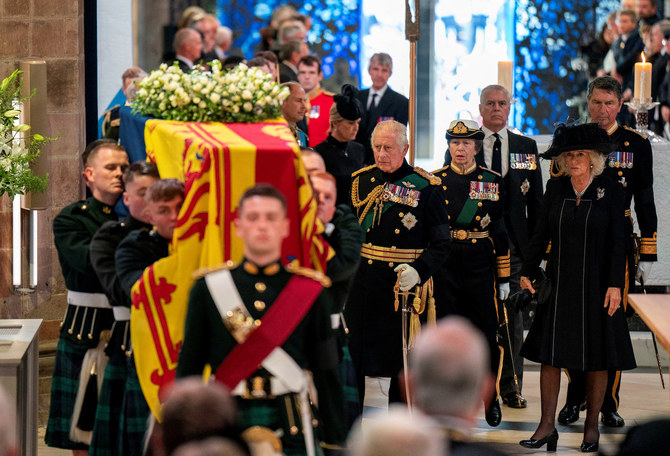

EDINBURGH, Scotland: As Queen Elizabeth II’s four children walked silently behind, a hearse carried her flag-draped coffin along a crowd-lined street in the Scottish capital Monday to a cathedral, where a service of thanksgiving hailed the late monarch as a “constant in all of our lives for over 70 years.”
Four days after the 96-year-old queen died at her beloved Balmoral Castle in the Scottish Highlands, a military bagpiper played as her oak coffin, draped in the royal standard, was borne from the Palace of Holyroodhouse in Edinburgh under late-summer sunshine.
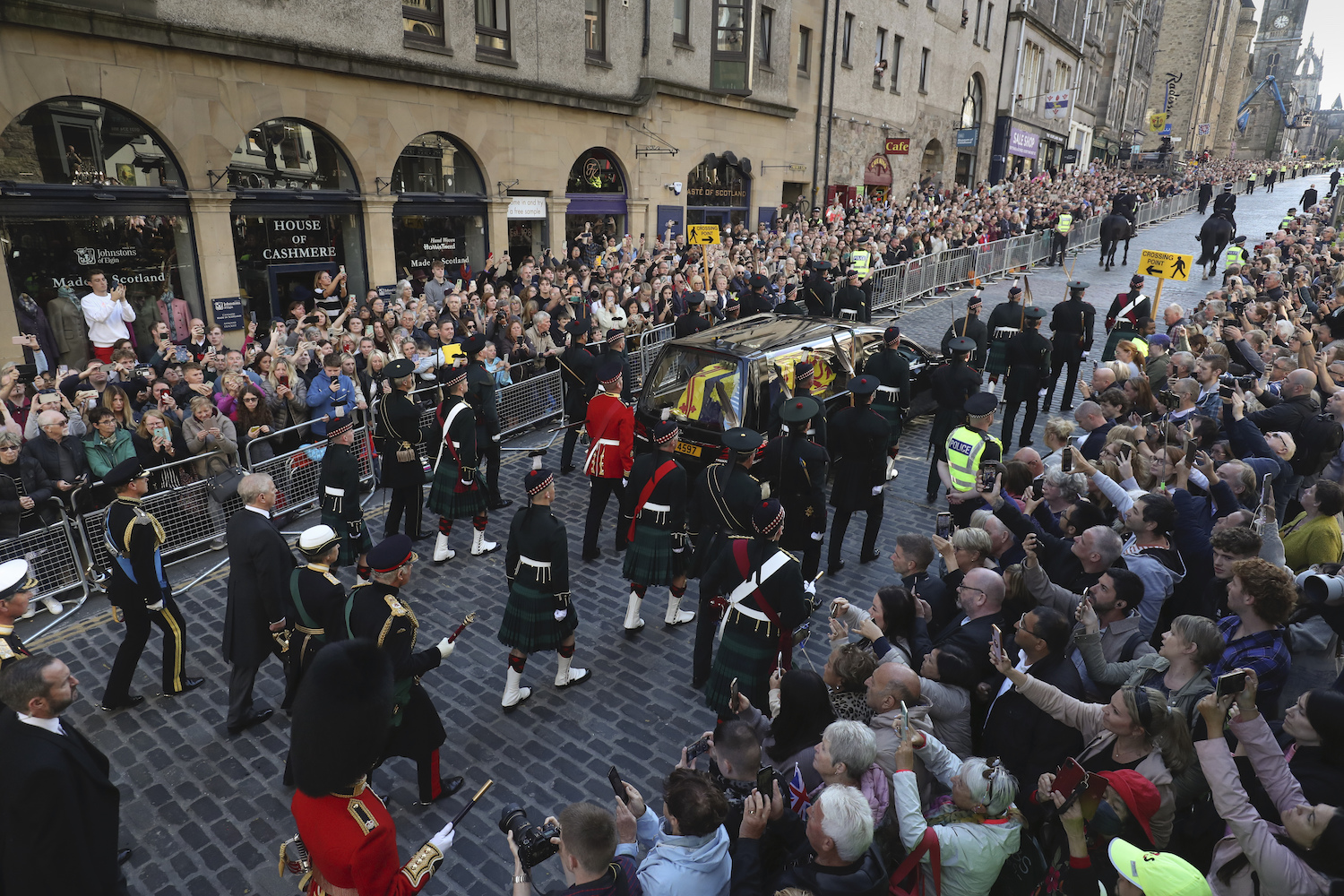
The procession with the coffin of Queen Elizabeth II, followed by King Charles III, Princess Anne, Prince Andrew and Prince Edward heads up the Royal Mile to St Giles' Cathedral in Edinburgh, Monday, Sept. 12, 2022. (AP)
King Charles III, dressed in army uniform, and Princess Anne, Prince Andrew and Prince Edward walked behind as the hearse traveled to St. Giles’ Cathedral, flanked by a bearer party of the Royal Regiment of Scotland and a detachment of The King’s Body Guard in Scotland, the Royal Company of Archers.
Once inside St. Giles, the coffin was placed on a wooden stand an topped with the golden Crown of Scotland, encrusted with 22 gems and 20 precious stones along with freshwater pearls from Scotland’s rivers.
“And so we gather to bid Scotland’s farewell to our late monarch, whose life of service to the nation and the world we celebrate. And whose love for Scotland was legendary,” said the Rev. Calum MacLeod.
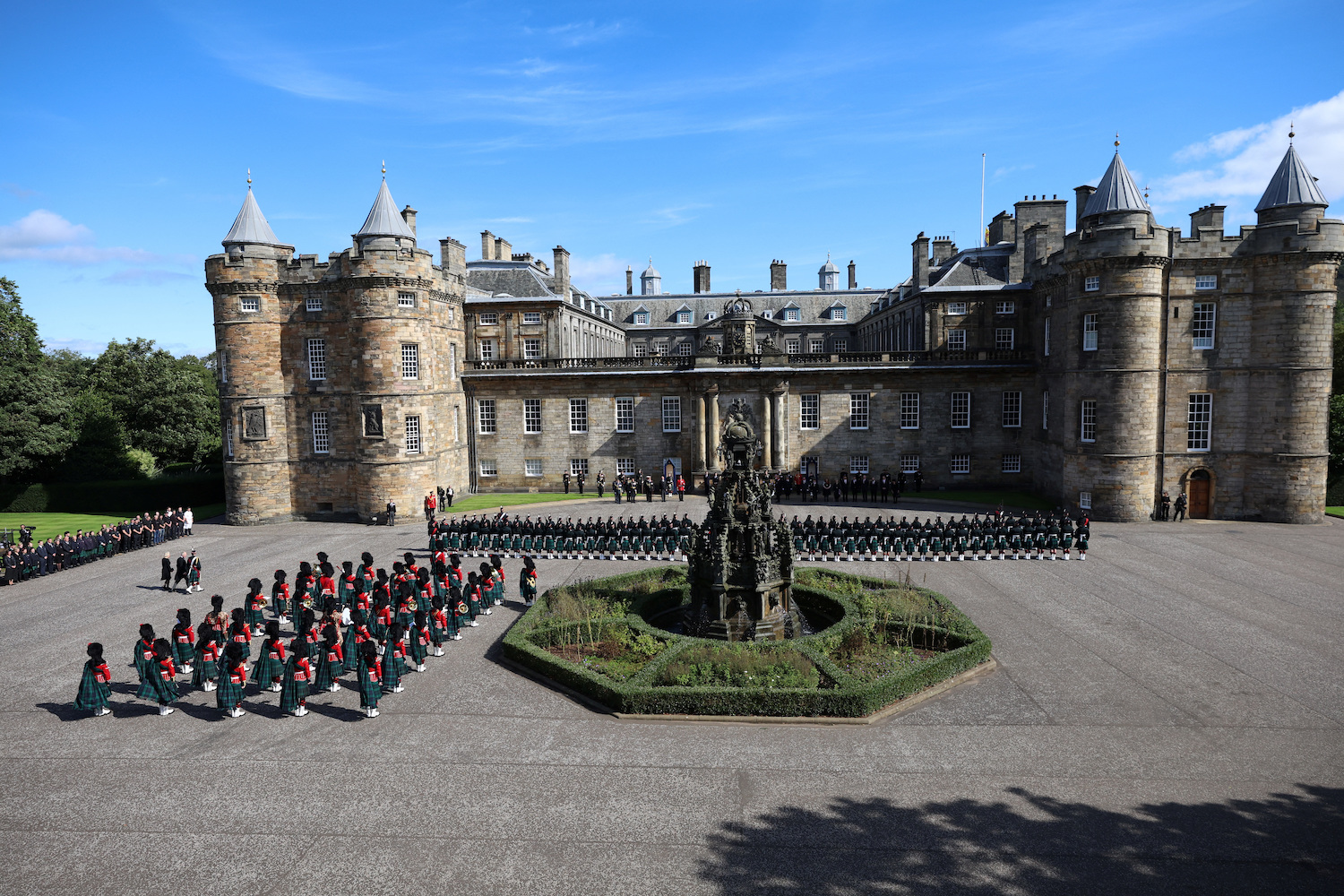
Britain's King Charles and Britain's Queen Camilla arrive at the Palace of Holyroodhouse, following the death of Britain's Queen Elizabeth, Edinburgh, Scotland, September 12, 2022. (Reuters)
Because the queen died at Balmoral, Scotland has been the focus of the world’s attention for the first part of Britain’s 10 days of national mourning. Scenes of large crowds lining the route that her coffin journeyed south have underscored the deep bond between the queen and Scotland, which persisted even as relations between the Conservative UK government in London and the pro-independence administration in Edinburgh have soured.
Opinion
This section contains relevant reference points, placed in (Opinion field)
In a homily, Church of Scotland Moderator Iain Greenshields said that “most of us cannot recall a time when she was not our monarch.
“Committed to the role she assumed in 1952 upon the death of her beloved father, she has been a constant in all of our lives for over 70 years,” he said. “She was determined to see her work as a form of service to others, and she maintained that steady course until the end of her life.
The coffin will remain at the cathedral until Tuesday so members of the public can pay their respects. Thousands lined the 0.7-mile (1 kilometer) route between palace and cathedral, some arriving hours ahead of the service to catch a glimpse of the coffin.
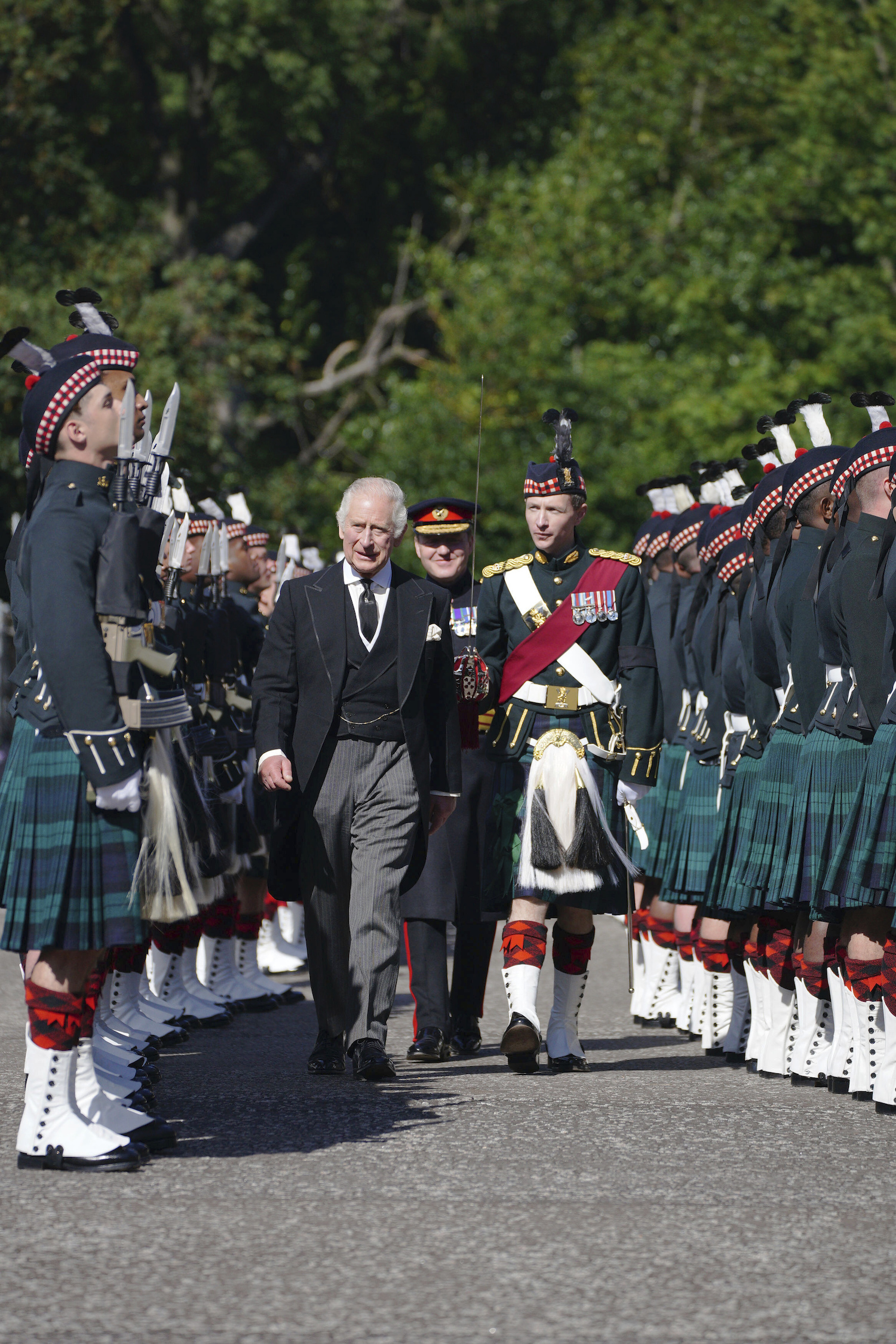
King Charles III inspects the Guard of Honour as he arrives to attend the Ceremony of the Keys, at the Palace of Holyroodhouse, Edinburgh, Monday, Sept. 12, 2022. (AP)
“I just wanted to be here, just to show … last respects. I cannot believe she is dead,” said Marilyn Mclear, a 70-year-old retired teacher. “I know she was 96, but I just cannot believe the queen’s dead.”
One man appeared to shout angrily at the passing hearse, while others called out: “God save the king!” But the procession was greeted mostly with a respectful silence under a blue sky flecked with white clouds.
Charles, Anne and Edward all wore military uniforms during the procession, but Andrew did not. The Royal Navy veteran was stripped of his honorary military titles and was removed as a working royal over his friendship with the notorious US sex offender Jeffrey Epstein.
Earlier, in London, Charles received condolences at Parliament and told lawmakers he would follow his late mother’s example of “selfless duty.”
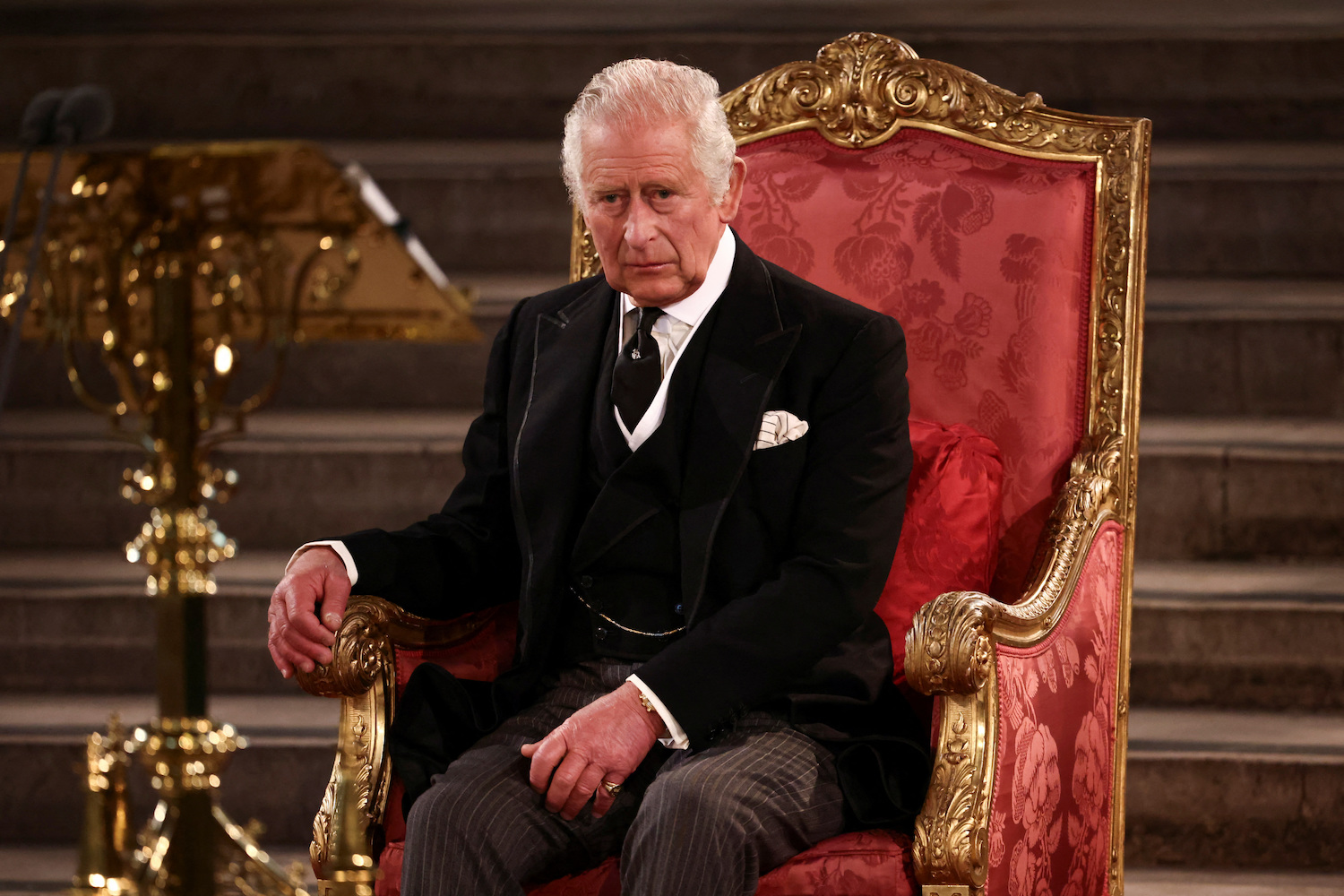
Britain's King Charles sits at Westminster Hall, following the death of Britain's Queen Elizabeth, in London, Britain, September 12, 2022. (Reuters)
The queen’s grandson, Prince Harry, hailed her as a “guiding compass” and praised her “unwavering grace and dignity.”
The government, meanwhile, announced the nation will observe a minute of silence on Sunday, the evening before the queen’s funeral. The “moment of reflection” will take place at 8 p.m. (1900 GMT, 3 p.m. EDT). People were encouraged to mark the silence at home or at community events.
Hundreds of lawmakers crowded into the 1,000-year-old Westminster Hall at the Houses of Parliament for the service, rich in pageantry, in which Parliament offered its condolences to the king. A trumpet fanfare greeted him and Camilla as they entered.
Charles told members of the House of Commons and House of Lords that he would follow his late mother in upholding “the precious principles of constitutional governance” that underpin the UK’s political system.
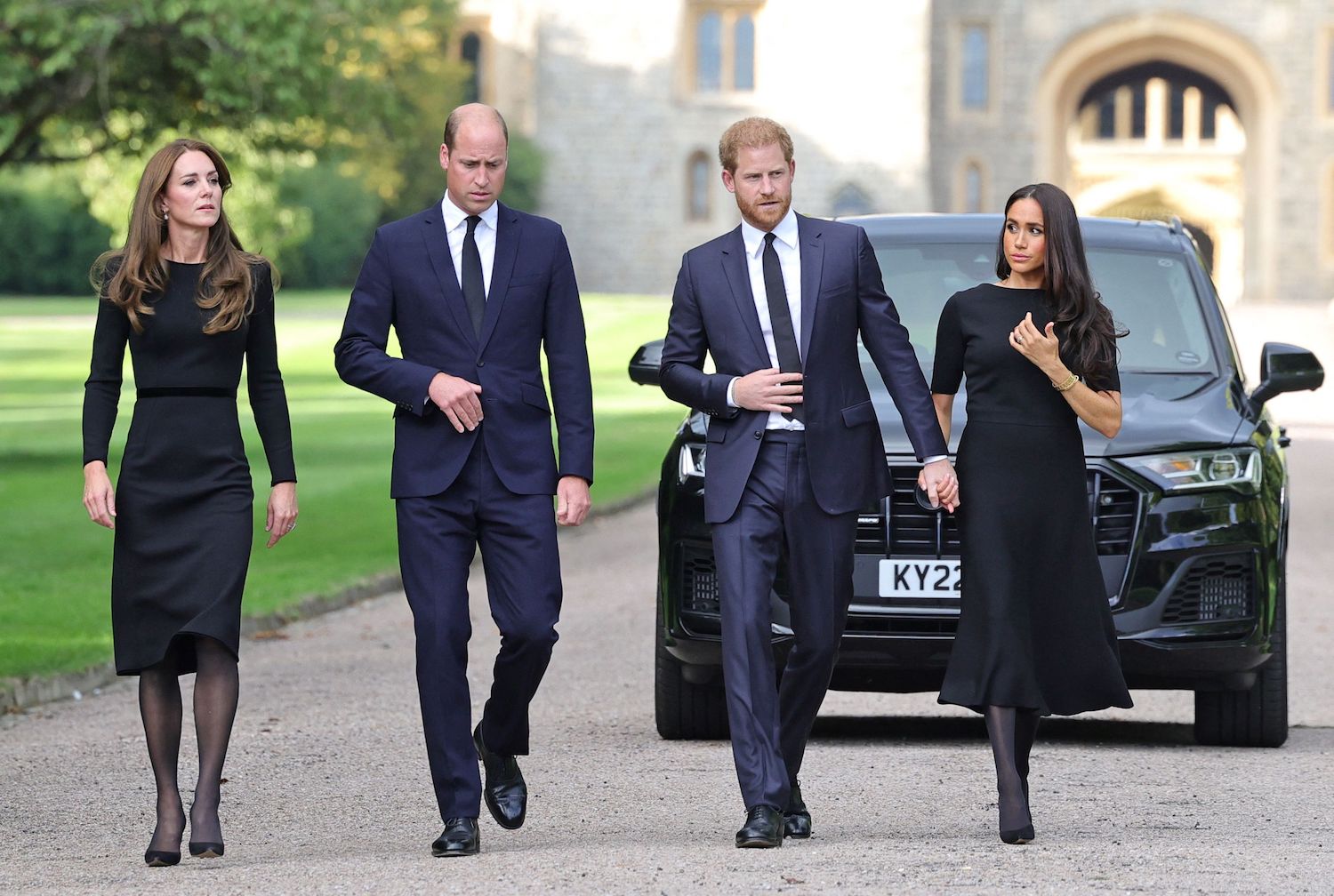
Britain's Catherine, Princess of Wales, Britain's Prince William, Prince of Wales, Britain's Prince Harry, Duke of Sussex, and Meghan, Duchess of Sussex on the long Walk at Windsor Castle on September 10, 2022, before meeting well-wishers. (AFP)
The hall, with its magnificent hammer-beam roof, is the oldest part of the parliamentary complex — a remnant of the medieval Palace of Westminster that once stood on the site.
“As I stand before you today, I cannot help but feel the weight of history which surrounds us and which reminds us of the vital parliamentary traditions to which members of both Houses dedicate yourselves, with such personal commitment for the betterment of us all,” Charles said.
The ceremony was held in Westminster Hall because monarchs are not allowed inside the House of Commons. That rule dates from the 17th century, when King Charles I tried to enter and arrest lawmakers. That confrontation between crown and Parliament led to a civil war which ended with the king being beheaded in 1649.
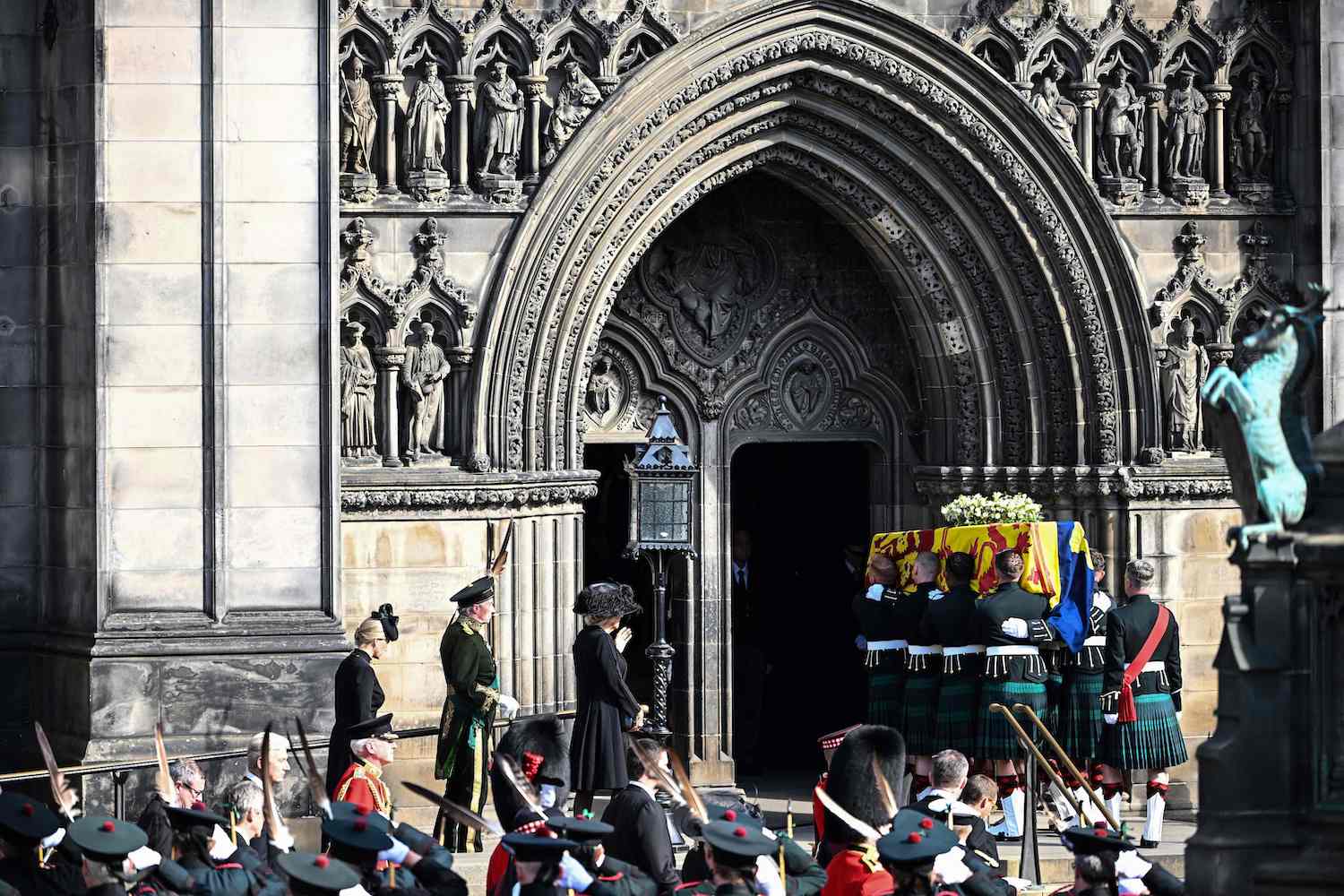
Pallbearers carry the coffin of Queen Elizabeth II into St Giles Cathedral, on September 12, 2022, where Queen Elizabeth II will lie at rest. (AFP)
Earlier Monday, a personal statement posted on Harry and his wife Meghan’s Archwell website said he cherished their times together “from my earliest childhood memories with you, to meeting you for the first time as my Commander-in-Chief, to the first moment you met my darling wife and hugged your beloved greatgrandchildren.”
Amid acrimony in the House of Windsor, Harry quit as a senior royal and moved to the US two years ago. On Saturday, there was a possible sign of a reconciliation as Harry and Meghan joined his brother Prince William and sister-in-law Catherine in meeting mourners outside Windsor Castle.
The queen’s coffin will be flown Tuesday to London, where it will lie in state at the Houses of Parliament Palace from Wednesday afternoon until the morning of the funeral on Sept. 19.
Authorities already have issued rules and guidelines for people wanting to pay their respects in London, with a long queue expected.
After visiting Scotland, Charles embarks on a tour of the other nations that make up the United Kingdom — he visits the Northern Ireland capital, Belfast, on Tuesday and Wales on Friday.
Harry’s statement ended on a poignant note alluding to the death last year of his grandfather, Prince Philip, saying that “We, too, smile knowing that you and grandpa are reunited now, and both together in peace.”


