

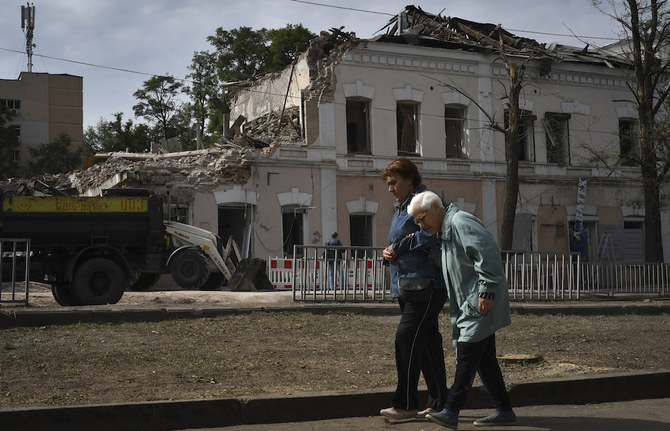

KHARKIV, Ukraine: Ukrainian troops reclaimed a wide swath of territory from Russia on Monday, pushing all the way back to the northeastern border in some places as part of a lightning advance that forced Moscow to make a hasty retreat from occupied land.
As blue-and-yellow Ukrainian flags fluttered over newly liberated towns, the Ukrainian military said its troops had freed more than 20 settlements in 24 hours. In recent days, Kyiv’s forces have captured territory at least twice the size of greater London, according to the British Defense Ministry.
After months of little discernible movement on the battlefield, the momentum has lifted Ukrainian morale and provoked rare public criticism of Russian President Vladimir Putin’s war. While Ukrainian cities began emerging from Russian occupation, a local leader alleged that the Kremlin’s troops had committed atrocities against civilians there similar to those in other places seized by Moscow.
“In some areas of the front, our defenders reached the state border with the Russian Federation,” said Oleh Syniehubov, governor of the northeastern Kharkiv region. Over the weekend, the Russian Defense Ministry said troops would be pulled from two areas in that region to regroup in the eastern region of Donetsk.
There were reports of chaos as Russian troops abruptly pulled out.
“The Russians were here in the morning. Then at noon, they suddenly started shouting wildly and began to run away, charging off in tanks and armored vehicles,” Dmytro Hrushchenko, a resident of recently liberated Zaliznychne, a small town near the eastern front line, told Sky News of the quick withdrawal.
Video taken by the Ukrainian military showed soldiers raising the Ukrainian flag over battle-damaged buildings. In one scene, a fighter wiped his boots on a Russian flag on the ground. Other videos showed Ukrainians inspecting the wreckage of Russian military vehicles, including tanks.
Efforts to disarm land mines were underway in the recaptured areas, along with a search for remaining Russian troops, Ukrainian military officials said.
It was not yet clear if the Ukrainian blitz could signal a turning point in the war, although some analysts cautioned that fighting would likely go on for months. Momentum has switched back and forth before, but rarely with such a big and sudden swing.
The mood was jubilant across the country.
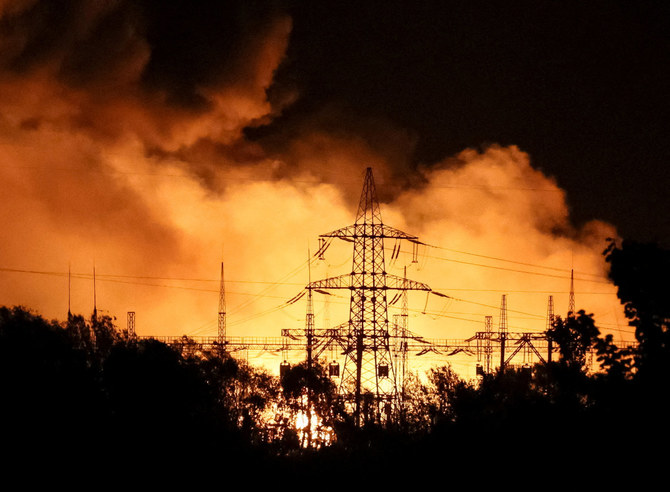
In Kharkiv, authorities hailed that power and water had been restored to about 80 percent of the region’s population following Russian attacks on infrastructure that knocked out electricity in many places across Ukraine.
“You are heroes!!!” Kharkiv Mayor Ihor Terekhov wrote on Telegram, referring to crews who restored utilities in Ukraine’s second-biggest city. “Thanks to everyone who did everything possible on this most difficult night for Kharkiv to normalize the life of the city as soon as possible.”
The buoyant mood was also captured by a defiant President Volodymyr Zelensky late Sunday on social media.
“Do you still think you can intimidate, break us, force us to make concessions?” Zelensky asked. “Cold, hunger, darkness and thirst for us are not as scary and deadly as your ‘friendship’ and brotherhood.’“
In the end, he exclaimed: “We will be with gas, lights, water and food … and WITHOUT you!”
Meanwhile, in Russia, there were some signs of disarray as Russian military bloggers and patriotic commentators chastised the Kremlin for failing to mobilize more forces and take stronger action against Ukraine.
Russia has continuously stopped short of calling its invasion a war, instead describing it as a “special military operation” and relying on on a limited contingent of volunteers instead of a mass mobilization that could spur civil discontent and protest.
Ramzan Kadyrov, the Moscow-backed leader of the Russian region of Chechnya, publicly criticized the Russian Defense Ministry for what he called “mistakes” that made the Ukrainian blitz possible.
Even more notable, such criticism seeped onto state-controlled Russian TV.
“People who convinced President Putin that the operation will be fast and effective ... these people really set up all of us,” Boris Nadezhdin, a former parliament member, said on a talk show on NTV television. “We’re now at the point where we have to understand that it’s absolutely impossible to defeat Ukraine using these resources and colonial war methods.”
Pro-Kremlin separatists reported that Ukrainian troops were approaching a key rail junction in the eastern Ukrainian Donetsk region.
Denis Pushilin, head of the self-proclaimed Donetsk People’s Republic, told Russian television that Ukrainian troops were mounting assaults on the town of Lyman, a rail hub captured by Russia in late May that offers access to bridges over the nearby Siversky Donets river.
Pushilin said that pro-Kremlin soldiers “are holding them back, and the situation, despite the fact that it remains difficult, remains controllable.”
The Donetsk region is one of two that make up Ukraine’s industrial heartland known as the Donbas, which continues to be a key target of Russia’s offensive.
Even amid Ukraine’s ebullience, the casualties kept mounting. Ukraine’s presidential office said Monday that at least four civilians were killed and 11 others wounded in a series of Russian attacks in nine regions of the country. The UN Human Rights Office said last week that 5,767 civilians have been killed so far.
Strikes in Kharkiv continued during daylight Monday when an administrative facility in the center of the city was hit by a missile, setting part of it on fire and killing one person, regional Police Chief Volodymyr Tymoahko said. Teams of firefighters battled flames licking the roof from the top floor as smoke billowed above the area.
In a reminder of the war’s toll, a council member in Izium — one of the areas where Russia said it has withdrawn troops — accused those forces of killing civilians and other committing atrocities.
“Russian troops committed crimes and tried to hide them,” Maksym Strelnikov said. His claims could not immediately be verified.
The Ukrainian military also claimed to have found evidence of human rights violations by Russian occupiers. It did not elaborate.
Izium was a major base for Russian forces in the Kharkiv region. The first Ukrainian flag was raised over the city on Saturday, according to Strelnikov, and more have popped up across the whole city. Residents, some wrapped in the country’s flag, happily greeted Ukrainian forces, offering them food.
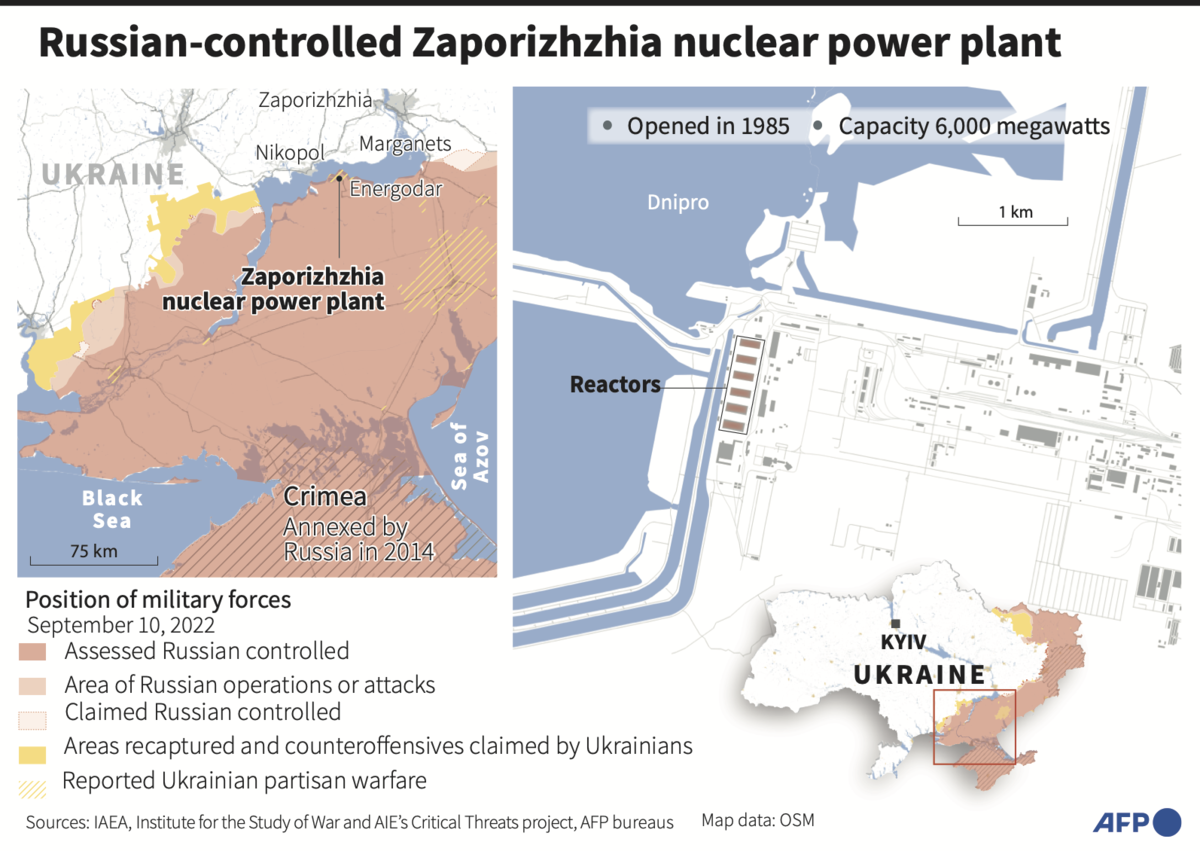
Ukraine said the Russians continued shelling Nikopol across the Dnieper River from the Zaporizhzhia power plant, damaging several buildings there and leaving Europe’s largest nuclear facility in a precarious position. The last operational reactor in that plant has been shut down in a bid to prevent a radiation disaster as fighting raged nearby.
The Washington-based Institute for the Study of War said Monday that Kyiv “will likely increasingly dictate the location and nature of the major fighting.”
The British Defense Ministry said the retreat would likely further deteriorate the trust Russian forces have in their commanders and put Moscow’s troops on the back foot.
Some analysts praised Ukraine’s initial move on the southern Kherson area for drawing the attention of enemy troops there, before pouncing on more depleted Russian lines in the northeast.
Even around Kherson, Russia is struggling to bring forces across the Dnieper to stop the Ukrainian offensive there, the British military said.


