Saudi Arabia’s desalination projects eye sustainability and energy

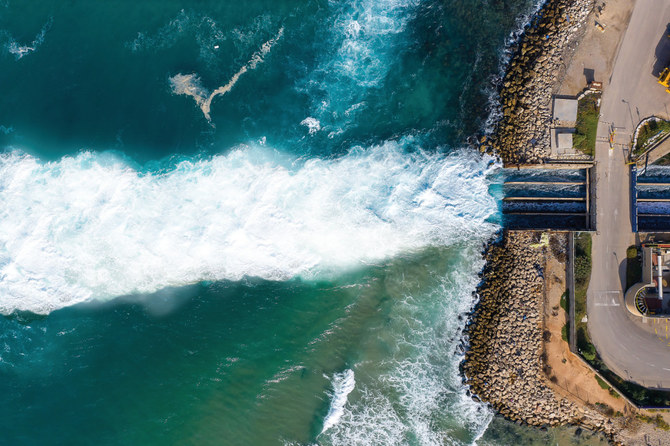
Developers in the Kingdom, however, aim to maintain their plants and operations in line with the country’s Vision 2030 goals and its leadership position in desalinated water production. (Shutterstock)
Short Url
Updated 11 September 2022
Follow

Saudi Arabia’s desalination projects eye sustainability and energy

  • KSA maintains its position as a world leader in desalinated water production

RIYADH: Saudi Arabia is leading the way with sustainable, energy-efficient desalination projects while maintaining its position as a world leader in desalinated water production.

The Middle East and North African region have some of the lowest water availability levels per capita among the world’s most water-scarce regions.

This makes the region heavily dependent on desalination, even though desalination directly impacts the issue of sustainability and renewable energy.

Developers in the Kingdom, however, aim to maintain their plants and operations in line with the country’s Vision 2030 goals and its leadership position in desalinated water production.

Saudi energy firm ACWA Power is moving away from thermal-powered systems and switching entirely to reverse osmosis plants to facilitate efficient power consumption, said Tariq Nada, the company’s vice president for water and technical services.

ACWA Power is the world’s largest private operator of water desalination plants, with a production capacity of 6.4 million cubic meters of desalinated water a day.

The company has a robust portfolio of 10 seawater reverse osmosis projects in the Kingdom and the Gulf Cooperation Council, in which some projects are partially powered by renewable energy.

The desalination industry has also strengthened with the advent of international companies in the Kingdom. Spain’s Acciona, a leader in renewable energy and infrastructure, is one example. The company has delivered two plants in the Kingdom.

It is currently building four more, producing more than 2.36 billion liters of drinking water daily, providing water for more than 8 million people in the country, which is about a quarter of the population.

Julio de la Rosa, Acciona’s business development director for water solutions in the Middle East, told Arab News that the company reduced the emissions associated with desalination by integrating solar energy at the plants and optimizing brine reuse. 

Acciona reduced the emissions associated with desalination by integrating solar energy at the plants and optimizing brine reuse.

Julio de la Rosa, Acciona’s business development director for water solutions in the Middle East

The execution of these projects is in alignment with the UN Sustainable Development Goals and the company’s vision of designing a better planet, Rosa said.

Each project designed and implemented by Acciona promotes sustainable development from all three perspectives: Environmental, economic and social.

Rosa said their technology enables them to deliver on their promise and mission to build sustainable water treatment in the Kingdom.

In the last few years, Acciona has developed several projects such as Tabuk 2, Buraydah 2, Madinah 3, independent water project Shuqaiq 3, SWRO Alkhobar phases 1 and 2 and Jubail 3B.

The Jubail 3B desalination plant will filter 570,000 cubic meters per day, enough to supply 2 million people in Riyadh and Qassim once it begins operation in 2024.

The plant will draw some of its power from a dedicated 61 megawatts photovoltaic facility, which Acciona will also build.

This facility will be the largest in-house solar plant for a desalination plant in the Kingdom. It will reduce the emissions associated with desalination and relieve power demand from the national grid.

In addition, the project includes storage tanks, an electricity substation, an overhead transmission line spanning 59km and associated marine works.


First EU–Saudi roundtable on critical raw materials reflects shared policy commitment

Updated 16 January 2026
Follow

First EU–Saudi roundtable on critical raw materials reflects shared policy commitment

RIYADH: The EU–Saudi Arabia Business and Investment Dialogue on Advancing Critical Raw Materials Value Chains, held in Riyadh as part of the Future Minerals Forum, brought together senior policymakers, industry leaders, and investors to advance strategic cooperation across critical raw materials value chains.

Organized under a Team Europe approach by the EU–GCC Cooperation on Green Transition Project, in coordination with the EU Delegation to Saudi Arabia, the European Chamber of Commerce in the Kingdom and in close cooperation with FMF, the dialogue provided a high-level platform to explore European actions under the EU Critical Raw Materials Act and ResourceEU alongside the Kingdom’s aspirations for minerals, industrial, and investment priorities.

This is in line with Saudi Vision 2030 and broader regional ambitions across the GCC, MENA, and Africa.

ResourceEU is the EU’s new strategic action plan, launched in late 2025, to secure a reliable supply of critical raw materials like lithium, rare earths, and cobalt, reducing dependency on single suppliers, such as China, by boosting domestic extraction, processing, recycling, stockpiling, and strategic partnerships with resource-rich nations.

The first ever EU–Saudi roundtable on critical raw materials was opened by the bloc’s Ambassador to the Kingdom, Christophe Farnaud, together with Saudi Deputy Minister for Mining Development Turki Al-Babtain, turning policy alignment into concrete cooperation.

Farnaud underlined the central role of international cooperation in the implementation of the EU’s critical raw materials policy framework.

“As the European Union advances the implementation of its Critical Raw Materials policy, international cooperation is indispensable to building secure, diversified, and sustainable value chains. Saudi Arabia is a key partner in this effort. This dialogue reflects our shared commitment to translate policy alignment into concrete business and investment cooperation that supports the green and digital transitions,” said the ambassador.

Discussions focused on strengthening resilient, diversified, and responsible CRM supply chains that are essential to the green and digital transitions.

Participants explored concrete opportunities for EU–Saudi cooperation across the full value chain, including exploration, mining, and processing and refining, as well as recycling, downstream manufacturing, and the mobilization of private investment and sustainable finance, underpinned by high environmental, social, and governance standards.

From the Saudi side, the dialogue was framed as a key contribution to the Kingdom’s industrial transformation and long-term economic diversification agenda under Vision 2030, with a strong focus on responsible resource development and global market integration.

“Developing globally competitive mineral hubs and sustainable value chains is a central pillar of Saudi Vision 2030 and the Kingdom’s industrial transformation. Our engagement with the European Union through this dialogue to strengthen upstream and downstream integration, attract high-quality investment, and advance responsible mining and processing. Enhanced cooperation with the EU, capitalizing on the demand dynamics of the EU Critical Raw Materials Act, will be key to delivering long-term value for both sides,” said Al-Babtain.

Valere Moutarlier, deputy director-general for European industry decarbonization, and directorate-general for the internal market, industry, entrepreneurship and SMEs at European Commission, said the EU Critical Raw Materials Act and ResourceEU provided a clear framework to strengthen Europe’s resilience while deepening its cooperation with international partners.

“Cooperation with Saudi Arabia is essential to advancing secure, sustainable, and diversified critical raw materials value chains. Dialogues such as this play a key role in translating policy ambitions into concrete industrial and investment cooperation,” she added.