GRAKOVE, Ukraine: Electric pylons toppled, cables strewn across the ground; gutted houses and roads dotted with craters — the village of Grakove in eastern Ukraine bears the scars of Ukraine’s bitter counter-offensive.
“It was frightening,” said 61-year-old Anatoli Vasiliev, recalling this week’s battle when Ukrainian troops recaptured Grakove from the Russians.
“There were bombings and explosions everywhere.”
Vasiliev stood in front of the local church, whose bell had been damaged by a projectile.
Some of the Russian soldiers “took phones, but I managed to keep mine by hiding it so I could communicate with my family,” he said.
Ukrainians have announced significant territorial gains in the eastern Kharkiv region.
President Volodymyr Zelensky said Friday 30 towns and cities had been recaptured there.
Among the debris scattered through Grakove — and in front of houses still inhabited — dogs and cats search for scraps of food.
Only about 30 of the village’s 800 pre-war inhabitants remain.
The road leading to Grakove from Ukraine’s second city Kharkiv, a regional hub, is lined with the skeletons of cars destroyed in explosions or crushed by tanks.
Disarmed mines are scattered around the side of the road, waiting to be picked up. A tow truck carries off a captured Russian military vehicle.
Traveling in the opposition direction are two armored cars taking troops to the front. Artillery fire echoes in the distance.
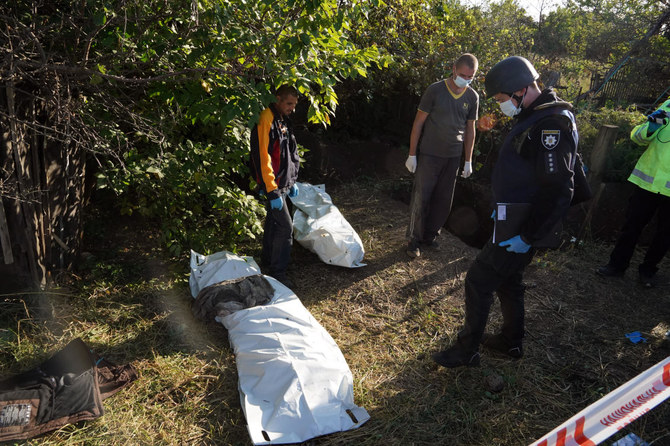
In the village, police and a team from the Kharkiv region’s prosecutors office exhume the bodies of two men aged in their thirties.
The officials here suspect a war crime: the remains show signs of torture and execution.
Village resident Sergiy Lutsay said Russian soldiers had forced him to bury the bodies at gunpoint.
“They came to my house. I was with my 70-year-old father,” he said.
“I was scared they would threaten him. They told me to come to dig a hole.”
This, he said, was soon after the Russian invasion began on February 24.
An official from the prosecutors’ office said the bodies would be sent for an medical examination to determine the cause of death.
Sergiy Bolvinov, deputy chief of police for the Kharkiv region, said Lutsay had told them that the victims “had wounds on the back of the head and their ears had been cut off.”
Lutsay did not confirm the details to journalists.
Ukraine has accused Russian forces of a string of war crimes in towns and villages outside Kyiv that its forces recaptured in March.
Ukraine reoccupied the territory when Moscow pulled back its forces after a failed bid to capture the capital at the start of the invasion.
“This is not the only evidence of atrocities committed by the Russians,” said Bolvinov.
“There are two other sites like this one in the village. We will be investigating them.”
Police warned journalists warned from straying off roads or investigating abandoned buildings because demining work was still under way.


![]()

‘Explosions everywhere’ as Ukraine forces recapture village
Short Url
https://arab.news/6wrcb
‘Explosions everywhere’ as Ukraine forces recapture village
- The village of Grakove in eastern Ukraine bears the scars of Kiev’s bitter counter-offensive


Latest updates





© 2026 SAUDI RESEARCH & PUBLISHING COMPANY, All Rights Reserved And subject to Terms of Use Agreement.