Gazans caught between hope and mistrust as Israel offers work

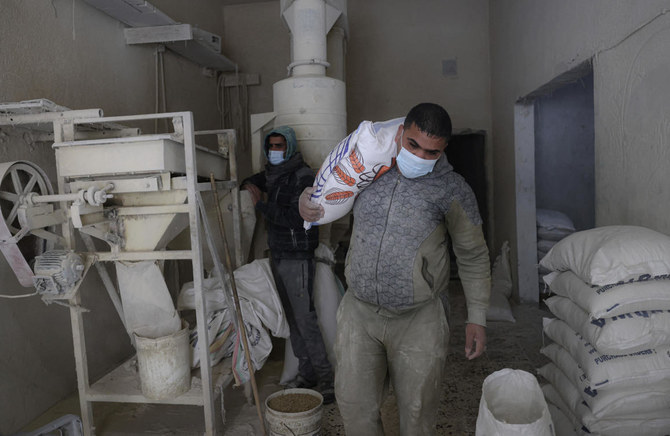
For those lucky enough to obtain a permit, a job in Israel can bring in 10 times what they could earn at home, a powerful incentive in an impoverished area where 2.3 million people live squeezed into a narrow coastal strip. (File/AFP)
Short Url
Updated 08 September 2022
Follow

Gazans caught between hope and mistrust as Israel offers work

  • Workers can earn 10 times what they make in Gaza
  • Some workers also complain that the permits do not give them many normal employment rights

GAZA: Days after the end of a brief bout of fighting last month, Gazan workers were already returning to work across the border under a permit scheme launched as part of Israel’s strategy of using economic inducements to help stabilize the volatile enclave.
For those lucky enough to obtain a permit, a job in Israel can bring in 10 times what they could earn at home, a powerful incentive in an impoverished area where 2.3 million people live squeezed into a narrow coastal strip.
“I have paid my debts, renovated the house and brought some things I had needed,” said Omar Abu Sidu, 31, who has been working in a car wash company in the southern Israeli town of Sderot for the past six months.
According to the World Bank, unemployment in Gaza runs at about 50 percent and more than half the population lives in poverty, exacerbated by repeated bursts of fighting and a years-long economic blockade imposed by both Israel and Egypt.
The application process for permits is often tangled up between offices run by the Islamist Hamas movement and the official Palestinian Authority, which lost control of Gaza in 2007 but which deals with Israeli authorities on the issue.
Some workers also complain that the permits do not give them many normal employment rights, including pensions and accident compensation insurance.
But that has done little to curb demand and the Hamas-run Labour Ministry in Gaza said it had received 100,000 applications for permits since March, when it began to be involved in the application process.
“It has made a big difference,” Abu Sidu said, who had arrived several hours early to go back across the Erez crossing into Israel, where he earns 350-400 shekels ($102-$117) a day, compared with the 40 shekels ($11.60) he was making in Gaza.
The permits were introduced as part of Israel’s twin strategy of enforcing military control while offering some economic benefits to reduce tensions following an 11-day war last year with Hamas, which controls Gaza.
UNCERTAINTY REMAINS
As well as the permits, which analysts say bring in around 7 million shekels ($2 million) a day into Gaza’s economy, Israel has also promised further loosening of economic restrictions, depending on positive signs from Hamas.
Aware of the economic benefits to Gazans but wary of being trapped into making concessions to what Palestinians see as the occupying power, Ehab Al-Ghsain, the Hamas-appointed deputy of the Labour Ministry said Israel’s demands “will not influence our political positions.”
Israeli officials say the permits have forced Gaza’s rulers in Hamas to face a choice between maintaining their fundamental opposition to Israel and giving Palestinians access to well-paying jobs.
“The leadership in Gaza must take a decision,” said Moshe Tetro, head of the Israeli military’s Coordination and Liaison Unit with Gaza. “Do they want civil and economic openness or devastation and destruction?“
Earlier this month, Prime Minister Yair Lapid, who faces a re-election battle in November, said the government may increase the number of permits to 20,000 from some 15,000 at present.
Any further increase would depend on Hamas agreeing to return the remains of missing Israeli soldiers believed to have been killed in Gaza.
For Gazans on the street, the political dispute leaves them exposed to both sudden and unpredictable border closures by Israel and an opaque and difficult-to-understand application process.
“I applied a year ago,” said Hussein Nabhan, a 33-year-old father of six. “Some people applied one or two months ago and they got permits, but we don’t have connections,” he said.
Both Hamas and the Palestinian Authority separately deny there are any bribes or the influence of connections in how people are selected to obtain the permits.
Even for those who navigate the process successfully, much uncertainty remains and while the benefits are welcome, workers are constantly aware that they can be withdrawn at any time.
Last month’s fighting between Israel and the militant Islamic Jihad faction was limited in scope and there was no full blown confrontation with Hamas. But after at least six bouts of conflict since Israel evacuated its forces from Gaza in 2005, there is constant awareness that things can change quickly.
“When there is an escalation, we fear we might not be issued permits again and that we would stop working. We’re on our toes all the time,” said Abu Sidu. ($1 = 3.4258 shekels)


Syrian military tells civilians to evacuate contested area east of Aleppo amid rising tensions

Updated 15 January 2026
Follow

Syrian military tells civilians to evacuate contested area east of Aleppo amid rising tensions

  • Syria’s military has announced it will open a “humanitarian corridor” for civilians to evacuate from an area in Aleppo province
  • This follows several days of intense clashes between government forces and the Kurdish-led Syrian Democratic Forces

DAMASCUS: Syria’s military said it would open a corridor Thursday for civilians to evacuate an area of Aleppo province that has seen a military buildup following intense clashes between government and Kurdish-led forces in Aleppo city.
The army’s announcement late Wednesday — which said civilians would be able to evacuate through the “humanitarian corridor” from 9 a.m. to 5 p.m. Thursday — appeared to signal plans for an offensive in the towns of Deir Hafer and Maskana and surrounding areas, about 60 kilometers (40 miles) east of Aleppo city.
The military called on the Kurdish-led Syrian Democratic Forces and other armed groups to withdraw to the other side of the the Euphrates River, to the east of the contested zone.
Syrian government troops have already sent troop reinforcements to the area after accusing the SDF of building up its own forces there, which the SDF denied. There have been limited exchanges of fire between the two sides, and the SDF has said that Turkish drones carried out strikes there.
The government has accused the SDF of launching drone strikes in Aleppo city, including one that hit the Aleppo governorate building on Saturday shortly after two Cabinet ministers and a local official held a news conference there.
The tensions in the Deir Hafer area come after several days of intense clashes last week in Aleppo city that ended with the evacuation of Kurdish fighters and government forces taking control of three contested neighborhoods. The fighting killed at least 23 people, wounded dozens more, and displaced tens of thousands.
The fighting broke out as negotiations have stalled between Damascus and the SDF, which controls large swaths of northeast Syria, over an agreement to integrate their forces and for the central government to take control of institutions including border crossings and oil fields in the northeast.
Some of the factions that make up the new Syrian army, which was formed after the fall of former President Bashar Assad in a rebel offensive in December 2024, were previously Turkiye-backed insurgent groups that have a long history of clashing with Kurdish forces.
The SDF for years has been the main US partner in Syria in fighting against the Daesh group, but Turkiye considers the SDF a terrorist organization because of its association with the Kurdistan Workers’ Party, or PKK, which has waged a long-running insurgency in Turkiye. A peace process is now underway.
Despite the long-running US support for the SDF, the Trump administration has also developed close ties with the government of interim Syrian President Ahmad Al-Sharaa and has pushed the Kurds to implement the integration deal. Washington has so far avoided publicly taking sides in the clashes in Aleppo.
The SDF in a statement warned of “dangerous repercussions on civilians, infrastructure, and vital facilities” in case of a further escalation and said Damascus bears “full responsibility for this escalation and all ensuing humanitarian and security repercussions in the region.”
Adm. Brad Cooper, commander of US Central Command, said in a statement Tuesday that the US is “closely monitoring” the situation and called for “all parties to exercise maximum restraint, avoid actions that could further escalate tensions, and prioritize the protection of civilians and critical infrastructure.” He called on the parties to “return to the negotiating table in good faith.”
Al-Sharaa blasts the SDF
In a televised interview aired Wednesday, Al-Sharaa praised the “courage of the Kurds” and said he would guarantee their rights and wants them to be part of the Syrian army, but he lashed out at the SDF.
He accused the group of not abiding by an agreement reached last year under which their forces were supposed to withdraw from neighborhoods they controlled in Aleppo city and of forcibly preventing civilians from leaving when the army opened a corridor for them to evacuate amid the recent clashes.
Al-Sharaa claimed that the SDF refused attempts by France and the US to mediate a ceasefire and withdrawal of Kurdish forces during the clashes due to an order from the PKK.
The interview was initially intended to air Tuesday on Shams TV, a broadcaster based in Irbil — the seat of northern Iraq’s semi-autonomous Kurdish region — but was canceled for what the station initially said were technical reasons.
Later the station’s manager said that the interview had been spiked out of fear of further inflaming tensions because of the hard line Al-Sharaa took against the SDF.
Syria’s state TV station instead aired clips from the interview on Wednesday. There was no immediate response from the SDF to Al-Sharaa’s comments.