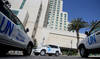
Albanian police search empty Iranian embassy after papers burned

1 / 2
Members of Albania’s police special unit enter the Iranian embassy on Sept. 8, 2022. (Reuters)
2 / 2
A car enters the Iranian Embassy in Tirana, Albania on Sept. 7, 2022. Tehran has strongly condemned Tirana’s decision to cut its diplomatic ties calling as ‘baseless claims’ Albania’s reasons for the move. (AP)
Short Url
Updated 08 September 2022
Follow

Albanian police search empty Iranian embassy after papers burned

  • Police entered the building after two cars with diplomatic plates had left
  • Albania cut diplomatic relations with Iran on Wednesday over a cyberattack

TIRANA: Albanian counter-terrorism police searched the empty Iranian embassy in Tirana on Thursday, hours after Iranian diplomats burned papers inside the premises following the severing of diplomatic ties over a cyberattack.

Albania cut diplomatic relations with Iran on Wednesday, when Prime Minister Edi Rama blamed the cyberattack, which took place in July, on the Islamic Republic, and gave its diplomats 24 hours to close the embassy and leave the country.

The police, wearing masks and helmets and carrying automatic rifles, entered the building — situated just 200 meters (yards) from Rama’s office — after two cars with diplomatic plates had left, a Reuters reporter saw.

Thirty minutes later, the police were still inside.

The same reporter earlier saw a man inside the embassy throwing papers into a rusty barrel, with flames illuminating the walls of the three-story building.

In a rare video address on Wednesday, Rama said the July cyberattack has “threatened to paralyze public services, erase digital systems and hack into state records, steal government intranet electronic communication and stir chaos and insecurity in the country.”

Washington, Albania’s closest ally, also blamed Iran for the attack and promised to “take further action to hold Iran accountable for actions that threaten the security of a US ally.”

Tehran condemned Tirana’s decision to cut ties, describing the reasons for the move as “baseless claims.”

Bilateral relations have been tense since 2014, when Albania accepted some 3,000 members of the exiled opposition group People’s Mujahideen Organization of Iran — also known by its Farsi name Mujahideen-e-Khalq — who have settled in a camp near Durres, the country’s main port.

Days after the July 15 cyberattack, Tirana-based media reported that hackers had published personal data of the opposition members that were saved in Albania’s state computers such as personal, social and security numbers, names and photos.

On Thursday morning, it appeared calm outside the embassy in Tirana located A black Audi with diplomatic car plates and darkened windows was seen going in and out as a police officer guarded the entrance.


African Union rejects ‘any recognition of Somaliland’ after Israel declaration

A man holds a flag of Somaliland in front of the Hargeisa War Memorial monument in Hargeisa on November 7, 2024. (AFP)
Updated 45 min 5 sec ago
Follow

African Union rejects ‘any recognition of Somaliland’ after Israel declaration

  • Egypt’s foreign ministry said its top diplomat had spoken with his counterparts from Turkiye, Somalia and Djibouti, who together condemned the move and emphasized “their full support for the unity, sovereignty and territorial integrity of Somalia”
  • Israel repeatedly hit targets in Yemen after the Gaza war broke out in October 2023, in response to Houthi attacks on Israel that the rebels said were in solidarity with Palestinians in the Gaza Strip

NAIROBI: The African Union on Friday said it “rejects any recognition of Somaliland” after Israel declared it viewed the breakaway Somali territory as a sovereign state.
In a statement issued by its head, Mahamoud Ali Youssouf, the AU called for African borders to be respected and said: “Any attempt to undermine the unity, sovereignty, and territorial integrity of Somalia... risks setting a dangerous precedent with far-reaching implications for peace and stability across the continent.”
The chief of the pan-African body, which counts Somalia as a member, said he “firmly rejects any initiative or action aimed at recognizing Somaliland as an independent entity” and stating that Somaliland “remains an integral part of the Federal Republic of Somalia.”

While, Somalia reacted angrily on Friday after Israel formally recognized its northern region of Somaliland as an “independent and sovereign state” — the first country to do so.
Somaliland, which declared independence from Somalia in 1991, has for decades pushed for international recognition, which has been the key priority for president Abdirahman Mohamed Abdullahi since he took office last year.
But a Somali foreign ministry statement warned that the decision was “deliberate attack” on its sovereignty that would undermine peace in the region. Several other countries also condemned Israel’s decision.
Israeli Prime Minister Benjamin Netanyahu’s office said he announced “the official recognition of the Republic of Somaliland as an independent and sovereign state,” making Israel the first country to do so.
“The declaration is in the spirit of the Abraham Accords,” Netanyahu’s office said, referring to several agreements between Israel and Arab countries brokered by US President Donald Trump during his first presidency to normalize ties with Israel.
It said Netanyahu had invited Abdullahi to visit.
Hailing Israel’s decision, Abdullahi said in a post on X that it marked the beginning of a “strategic partnership.”
“This is a historic moment as we warmly welcome” he said, affirming “Somaliland’s readiness to join the Abraham Accords,” he added.
In Hargeisa, the capital of Somaliland, crowds of people took to the streets to celebrate, many carrying the flag of the breakaway state, said sources.

- ‘Illegitimate actions’ -

Somalia’s foreign ministry said: “Illegitimate actions of this nature seriously undermine regional peace and stability, exacerbate political and security tensions, in the Horn of Africa, the Red Sea and Gulf of Aden, the Middle East and the wider region.”
Turkiye, a close ally of Somalia, also condemned the move.
“This initiative by Israel, which aligns with its expansionist policy... constitutes overt interference in Somalia’s domestic affairs,” it said in a foreign ministry statement.
Egypt’s foreign ministry said its top diplomat had spoken with his counterparts from Turkiye, Somalia and Djibouti, who together condemned the move and emphasized “their full support for the unity, sovereignty and territorial integrity of Somalia.”
In video showing Netanyahu speaking to Abdullahi by telephone, the Israeli leader said: “I want you to know that I am signing now as we speak Israel’s official recognition of the Somaliland,” adding that the new relationship would offer economic opportunities.
“I am very, very happy and I am very proud of this day and I want to wish you and the people of Somaliland the very, very best,” he said.
Netanyahu also said that he would communicate to Trump Abdullahi’s “willingness and desire to join the Abraham accords.”
A self-proclaimed republic, Somaliland enjoys a strategic position on the Gulf of Aden, has its own money, passports and army. But since its unilateral declaration of independence in 1991, it has grappled with decades of isolation.

- Strategic -

Analysts say matters of strategy were behind Israel’s drive to recognize Somaliland.
“Israel requires allies in the Red Sea region for many strategic reasons, among them the possibility of a future campaign against the Houthis,” said the Institute for National Security Studies in a paper last month, referring to Yemen’s Iran-backed rebels.
“Somaliland is an ideal candidate for such cooperation as it could offer Israel potential access to an operational area close to the conflict zone,” it said, adding there were also economic motives.
Israel repeatedly hit targets in Yemen after the Gaza war broke out in October 2023, in response to Houthi attacks on Israel that the rebels said were in solidarity with Palestinians in the Gaza Strip.
The Houthis have halted their attacks since a fragile truce began in Gaza in October.
Somaliland’s lack of international recognition has hampered access to foreign loans, aid and investment, and the territory remains deeply impoverished.
A deal between landlocked Ethiopia and Somaliland last year to lease a stretch of coastline for a port and military base enraged Somalia.
Israel has been trying to bolster relations with countries in the Middle East and Africa.
Historic agreements struck late in Trump’s first term in 2020 saw several countries including Muslim-majority United Arab Emirates and Morocco normalize relations with Israel, but wars that have stoked Arab anger, particularly in Gaza, have hampered recent efforts.