

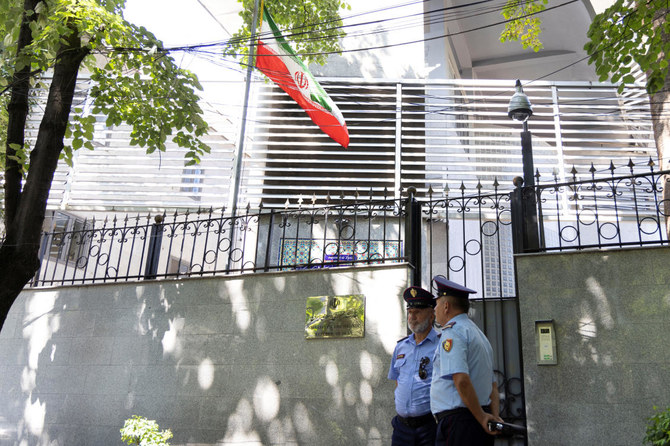
Albania cuts ties with Iran over ‘cyberattack’

Albania and Iran have been bitter foes for years. (Reuters)
Short Url
Updated 07 September 2022
Follow

Albania cuts ties with Iran over ‘cyberattack’

  • The country’s prime minister accused Iran of targeting the computer networks of Albanian institutions on July 15
  • Albania’s envoy to the UN informed the Security Council of the move, which he said was ‘fully proportionate’ to the gravity of Tehran’s actions

TIRANA: Albania broke diplomatic ties with Iran on Wednesday. Announcing the decision, Prime Minister Edi Rama said Iran had launched a massive cyberattack against the country during the summer.

“The Council of Ministers has decided on the severance of diplomatic relations with the Islamic Republic of Iran with immediate effect,” he said.

The prime minister accused Iran of targeting the computer networks of Albanian institutions on July 15 in an attempt to “paralyze public services and hack data and electronic communications from the government systems.”

He said: “The said attack failed its purpose. Damages may be considered minimal compared to the goals of the aggressor. All systems came back fully operational and there was no irreversible wiping of data.”

He added that Iranian diplomats and support staff would be given 24 hours to leave the country.

In a letter to the Security Council, Ferit Hoxha, Albania’s permanent representative to the UN, officially informed member states that his country has severed ties with Iran.

He described the move as “fully proportionate to the gravity and risk posed by a state-organized and sponsored cyberattack against a sovereign country that threatened to disrupt public services, erase digital systems, steal or wipe critical state records and other electronic communications, with the aim to affect the integrity of government infrastructure to the detriment of security, paralyze its institutions and vital activity, put in danger the lives of civilians and create chaos and insecurity in the country.”

The two countries have been bitter foes for years. Albania hosts Iranian opposition group the People’s Mujahedeen of Iran, after agreeing in 2013 to take in members of the exiled group at the request of Washington and the UN. Thousands of Iranians have settled in the Balkan country since then.

Following the collapse of its communist government in the early 1990s, Albania transformed itself into a steadfast ally of the US and the West, and officially joined NATO in 2009.

Iranian opposition groups in exile have accused Tehran of targeting their members and events. In 2018, Belgian police thwarted a planned terrorist attack on an Iranian opposition rally outside Paris. An Iranian diplomat was subsequently convicted of supplying explosives for the plot.

Albanian authorities have expelled a string of Iranian diplomats from the country over the years, including Tehran’s ambassador in December 2018.

(Ephrem Kossaify in New York contributed to this report.)


Only 4% women on ballot as Bangladesh prepares for post-Hasina vote

Updated 22 min 5 sec ago
Follow

Only 4% women on ballot as Bangladesh prepares for post-Hasina vote

  • Women PMs have ruled Bangladesh for over half of its independent history
  • For 2026 vote, only 20 out of 51 political parties nominated female candidates

DHAKA: As Bangladesh prepares for the first election since the ouster of its long-serving ex-prime minister Sheikh Hasina, only 4 percent of the registered candidates are women, as more than half of the political parties did not field female candidates.

The vote on Feb. 12 will bring in new leadership after an 18-month rule of the caretaker administration that took control following the student-led uprising that ended 15 years in power of Hasina’s Awami League party.

Nearly 128 million Bangladeshis will head to the polls, but while more than 62 million of them are women, the percentage of female candidates in the race is incomparably lower, despite last year’s consensus reached by political parties to have at least 5 percent women on their lists.

According to the Election Commission, among 1,981 candidates only 81 are women, in a country that in its 54 years of independence had for 32 years been led by women prime ministers — Hasina and her late rival Khaleda Zia.

According to Dr. Rasheda Rawnak Khan from the Department of Anthropology at Dhaka University, women’s political participation was neither reflected by the rule of Hasina nor Zia.

“Bangladesh has had women rulers, not women’s rule,” Khan told Arab News. “The structure of party politics in Bangladesh is deeply patriarchal.”

Only 20 out of 51 political parties nominated female candidates for the 2026 vote. Percentage-wise, the Bangladesh Socialist Party was leading with nine women, or 34 percent of its candidates.

The election’s main contender, the Bangladesh Nationalist Party, whose former leader Zia in 1991 became the second woman prime minister of a predominantly Muslim nation — after Pakistan’s Benazir Bhutto — was the party that last year put forward the 5 percent quota for women.

For the upcoming vote, however, it ended up nominating only 10 women, or 3.5 percent of its 288 candidates.

The second-largest party, Jamaat-e-Islami, has not nominated a single woman.

The 4 percent participation is lower than in the previous election in 2024, when it was slightly above 5 percent, but there was no decreasing trend. In 2019, the rate was 5.9 percent, and 4 percent in 2014.

“We have not seen any independent women’s political movement or institutional activities earlier, from where women could now participate in the election independently,” Khan said.

“Real political participation is different and difficult as well in this patriarchal society, where we need to establish internal party democracy, protection from political violence, ensure direct election, and cultural shifts around female leadership.”

While the 2024 student-led uprising featured a prominent presence of women activists, Election Commission data shows that this has not translated into their political participation, with very few women contesting the upcoming polls.

“In the student movement, women were recruited because they were useful, presentable for rallies and protests both on campus and in the field of political legitimacy. Women were kept at the forefront for exhibiting some sort of ‘inclusive’ images to the media and the people,” Khan said.

“To become a candidate in the general election, one needs to have a powerful mentor, money, muscle power, control over party people, activists, and locals. Within the male-dominated networks, it’s very difficult for women to get all these things.”