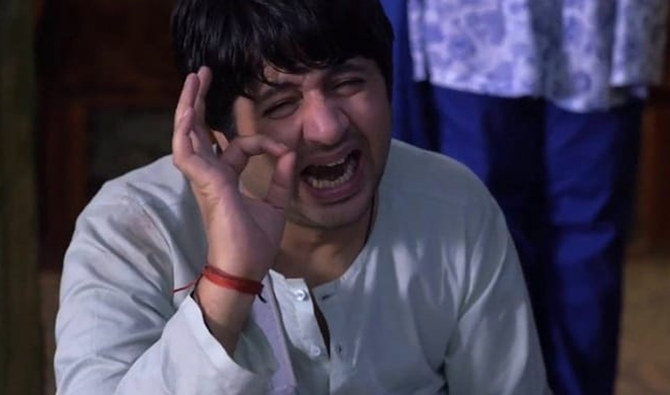

KARACHI: Pakistani drama serials need to be more responsible with the way they tackle sensitive subjects such as depression and mental health issues, Pakistani writers, critics and a psychologist said, criticizing the lack of research and sensitivity that goes into producing most television dramas in the South Asian country.
Mental health is a widely discussed topic in today’s world, with prominent activists and celebrities urging people to break the taboo and speak about it. Pakistani dramas are avidly watched by millions in the country, with some going on to become even stellar hits across the border in neighboring India.
Pakistani TV shows ‘Ranjha Ranjha Kardi’, ‘Ishq Zah e Naseeb’, ‘Saraab’, ‘Sabaat’, ‘Phaans’ and ‘Hum Kahan Kay Sachay Thay’ depicted mental health issues in recent years. However, most of them either made it look comical, lacked depth or ended up with misleading representations of the characters that have mental health issues.
Aamna Haider Isani, prominent drama critic and editor-in-chief of ‘Something Haute’— an entertainment news website— told Arab News on Monday that Pakistani dramas rarely represent a character with mental health issues in a responsible, let alone well-informed way.
“The issue is the superficiality with which characters with mental health issues are represented,” Isani said. “They are rarely diagnosed with a concrete or certified problem. All we know is that they’re ‘not normal’ which we know is not a term medically acceptable anymore,” she added.
“Doctors or therapists dealing with these characters are never competent and very poorly reflect on the problem and the solution the character needs,” she added. “There is rarely any, let enough research or insight into these characters.”
Isani said writers and directors must consult mental health professionals when writing such characters. “An unfair or inadequate representation can send out wrong, and very harmful messages,” she said.
Rida Bilal, a playwright who penned the recently concluded drama serial ‘Zakham’, told Arab News on Tuesday that in Pakistani dramas, a person who has depression does not “necessarily have to be locked in a room.”
“Sensitivity and relatability are very essential,” she said.
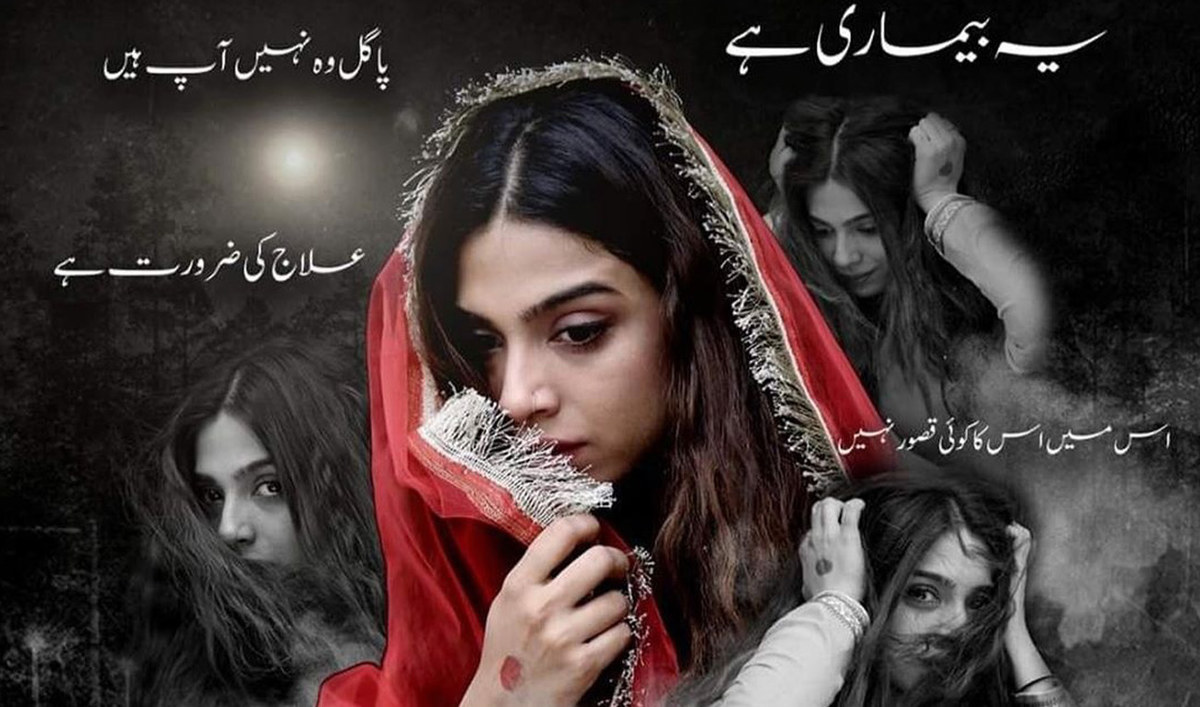
Actor Sonya Hussyn as Hoor, who has schizophrenia, in drama serial 'Saraab,' aired from August 2020 till March 2021. (HUM TV)
The playwright also pointed to production constraints that often deprive a serial of its rightful depiction. “There are constraints from production houses and TV channels. If they do not understand issues, what can a writer do,” she asked.
Bilal recalled how she was once turned down for writing a drama on postpartum depression. “The script has to penetrate through so many stages that it loses its essence most of the time,” she explained.
Rabia Mughni, founder and editor of ‘Fuchsia Magazine’ told Arab News on Monday that mental illness is handled poorly in Pakistani dramas. Very few dramas, including ‘Ranjha Ranjha Kardi’ and ‘Saraab’, paid specific attention to mental health issues, she said.
“Dramas introduce an issue but do not provide any solution to it,” she said. “The depiction of a counsellor/psychologist is so poor that it defeats the purpose at hand. Dramas incorporate domestic issues and extramarital affairs along with these themes that take away the limelight.”
Mughni said dramas should instead reflect on the relationship between characters with mental health issues and their surroundings.
Director Saife Hassan, psychologist Dr. Asha Bedar, playwright Bee Gul and others spoke at a zoom session titled ‘Do Pakistani TV dramas get it right when it comes to Mental Health?’ on August 31, moderated by Tasneem Ahmar, executive director of Uks Research Center.
Dr. Bedar said the way mental health issues are treated in Pakistani dramas reflects laziness, which ultimately results in inaccurate depiction. She said it isn’t difficult to rectify these issues.
She recalled a scene from a drama where a psychiatrist can be seen having coffee with his client at a café. “That is so basic, that it doesn’t require any research. You can ask any psychologist and they will tell you this isn’t how it works,” Dr. Bedar added.
“We show [in dramas] suicide to give a very convenient end; if nothing else is working, the villain commits suicide.”
Scriptwriter Gul lamented there was not always enough time to research a particular subject before making a drama, but admitted it was a huge responsibility on the writer’s part.
Gul wrote the script of the Yumna Zaidi-starrer ‘Dar Si Jati Hai Sila’ that very sensitively handled the subject of sexual harassment and its impact on the survivor. The drama tried to capture the protagonist’s fear without sensationalizing it.
“It is not the job of entertainment media to teach; my actual work is to project what’s going on in society. Do audiences have that questioning mind to ask if it’s right or wrong? My job is not to decide that,” Gul said.
Saife Hassan, who directed the recently concluded drama serial ‘Sang e Mah’ that depicted suicide, regretted the fact that TV shows were treated by media and production houses as merely a business and that one could not change their perspective.
“I am not concerned about ratings; most of my dramas including ‘Sang e Mah’ didn’t generate high ratings,” he shared. “A lot of people said we glamorized suicide in the drama. I understand suicide in ‘Sang e Mah’ was not because of a major mental illness, but we didn’t intend to glorify it either.”
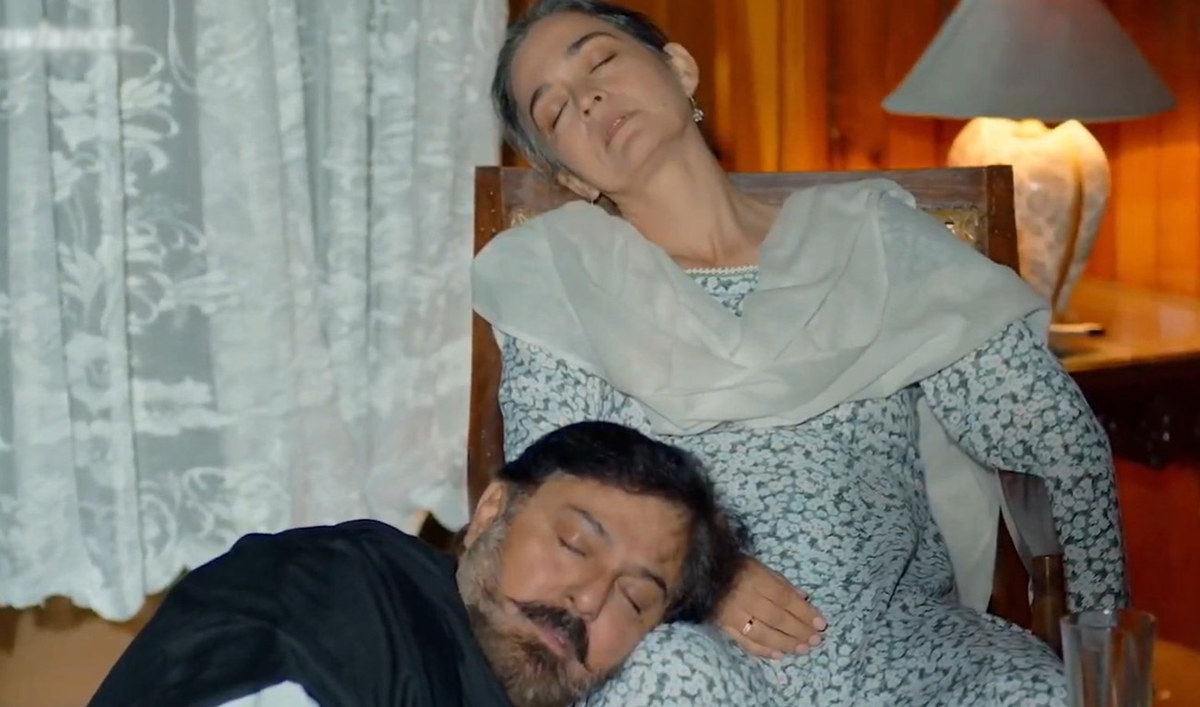
Haji Marjaan Khan (Nauman Ijaz) and Zarsangha (Samiya Mumtaz) commit suicide in the last episode of drama serial 'Sang e Mah,' aired on July 3, 2022. (Twitter/Telly Music)
Hassan was of the view that the onus was on the writers and content departments to be better trained at handling such scripts.
“They have mostly written digests in the past so I don’t think they have the awareness that someone who is suicidal is suffering from a mental illness after which he or she ends up taking their life,” he said. “They need to be educated on this.”