Russia requests ‘explanations’ from IAEA on Zaporizhzhia report

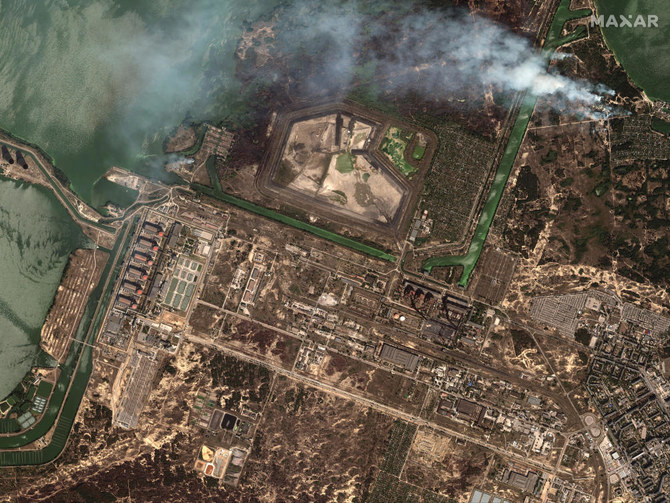
Both Kyiv and Moscow have accused each other of firing missiles at the power station, prompting fears of a Chornobyl-style nuclear disaster. (File/AFP)
Short Url
Updated 07 September 2022
Follow

Russia requests ‘explanations’ from IAEA on Zaporizhzhia report

  • The plant has been controlled by Russian forces since March but is still operated by Ukrainian staff
  • Russian Foreign Ministry spokeswoman Maria Zakharova accused the West of putting pressure on the IAEA mission to the plant

MOSCOW: Russia has requested “additional explanations” from the International Atomic Energy Agency (IAEA) on parts of its report on the Zaporizhzhia nuclear power plant in Ukraine, Foreign Minister Sergei Lavrov was quoted as saying on Wednesday.
The IAEA on Tuesday called for shelling near the power station to be halted and for a security zone around the plant to be established immediately in a report published after its long-awaited mission to Zaporizhzhia last week.
The plant has been controlled by Russian forces since March but is still operated by Ukrainian staff and connected to the Ukrainian power grid. Both Kyiv and Moscow have accused each other of firing missiles at the power station, prompting fears of a Chornobyl-style nuclear disaster .
Lavrov told the Interfax news agency that Moscow required more information about the IAEA’s findings and had sent a request to provide extra information.
“There is a need for additional explanations because there are a number of issues in the report. I will not list them now, but we have requested clarifications from the IAEA Director General,” Interfax cited Lavrov as saying.
Russian Foreign Ministry spokeswoman Maria Zakharova accused the West of putting pressure on the IAEA mission to the plant.
The RIA Novosti news agency quoted Zakharova as saying Russia had provided full data on the source of shelling to the IAEA and was questioning why the organization did not name Ukraine as the source of attacks on the nuclear power plant in its report.
She also said Ukraine was coordinating its attacks on the facility with the help of the United States and other Western states.
Ukraine denies attacking the plant and has accused Moscow of storing heavy weapons at the nuclear power station, a claim rejected by Russia.


US Treasury chief says retaliatory EU tariffs over Greenland ‘unwise’

Updated 4 sec ago
Follow

US Treasury chief says retaliatory EU tariffs over Greenland ‘unwise’

  • He said Trump wanted control of the autonomous Danish territory because he considers it a “strategic asset” and “we are not going to outsource our hemispheric security to anyone else.”

Davos: US Treasury Secretary Scott Bessent warned European nations on Monday against retaliatory tariffs over President Donald Trump’s threatened levies to obtain control of Greenland.
“I think it would be very unwise,” Bessent told reporters on the sidelines of the World Economic Forum in the Swiss ski resort of Davos.
He said Trump wanted control of the autonomous Danish territory because he considers it a “strategic asset” and “we are not going to outsource our hemispheric security to anyone else.”
Asked about Trump’s message to Norway’s prime minister, in which he appeared to link his Greenland push to not winning the Nobel Peace Prize, Bessent said: “I don’t know anything about the president’s letter to Norway.”
He added, however, that “I think it’s a complete canard that the president will be doing this because of the Nobel Prize.”
Trump said at the weekend that, from February 1, Britain, Denmark, Finland, France, Germany, the Netherlands, Norway and Sweden would be subject to a 10-percent tariff on all goods sent to the United States until Denmark agrees to cede Greenland.
The announcement has drawn angry charges of “blackmail” from the US allies, and Germany’s vice chancellor Lars Klingbeil said Monday that Europe was preparing countermeasures.
Asked later Monday on the chances for a deal that would not involve acquiring Greenland, Bessent said “I would just take President Trump at his word for now.”
“How did the US get the Panama Canal? We bought it from the French,” he told a small group of journalists including AFP.
“How did the US get the US Virgin Islands? We bought it from the Danes.”
Bessent reiterated in particular the island’s strategic importance as a source of rare earth minerals that are critical for a range of cutting-edge technologies.
Referring to Denmark, he said: “What if one day they were worried about antagonizing the Chinese? They’ve already allowed Chinese mining in Greenland, right?“