

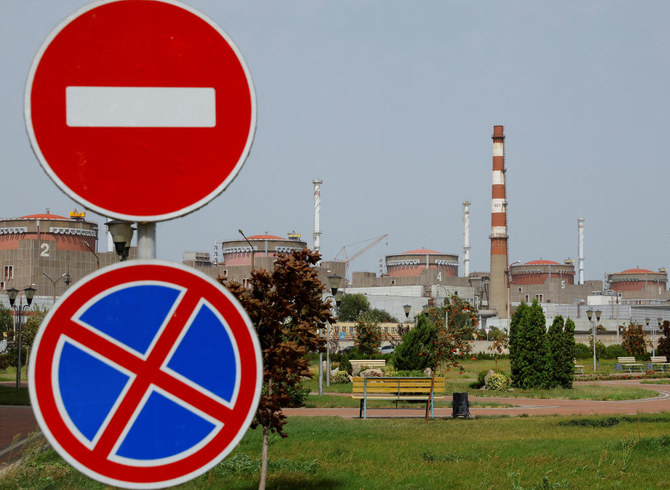
UN nuclear agency mission seeks to visit Zaporizhzhia plant amid concerns

Logistical issues are being worked out for the UN’s International Atomic Energy Agency team to come to the Zaporizhzhia plant. (Reuters)
Short Url
Updated 26 August 2022
Follow

UN nuclear agency mission seeks to visit Zaporizhzhia plant amid concerns

  • Fire damage to a transmission line at Europe’s largest nuclear plant caused a blackout across the region on Thursday
  • Heightens fears of a catastrophe in Ukraine, which is still haunted by the Chernobyl disaster in 1986

KYIV: A mission from the UN’s International Atomic Energy Agency is expected to visit the Zaporizhzhia nuclear power plant next week after it was temporarily knocked offline and more shelling was reported in the area overnight, Ukrainian officials said Friday.

Fire damage to a transmission line at Europe’s largest nuclear plant caused a blackout across the region on Thursday and heightened fears of a catastrophe in a country still haunted by the Chernobyl disaster in 1986.

Lana Zerkal, an adviser to Ukraine’s energy minister, told Ukrainian media on Thursday evening that logistical issues are being worked out for the IAEA team to come to the Zaporizhzhia plant, which has been occupied by Russian forces and run by Ukrainian workers since the early days of the 6-month-old war.

Zerkal accused Russia of trying to sabotage the visit. Ukraine has alleged that Russia is essentially holding the plant hostage, storing weapons there and launching attacks from around it, while Moscow accuses Ukraine of recklessly firing on the facility.

“Despite the fact that the Russians agreed for the mission to travel through the territory of Ukraine, they are now artificially creating all the conditions for the mission not to reach the facility, given the situation around it,” she said, offering no details.

There was no immediate comment from Moscow to the claims. The atomic agency’s head, Rafael Mariano Grossi, also said Thursday he hopes to send a team to the plant within days. Negotiations over how the team would access the plant are complicated but advancing, he said on France-24 television.

Meanwhile, Ukrainian officials said an area close to the plant came under a barrage of shelling overnight, amid mounting concerns that an armed conflict near a working atomic plant could cause more serious damage, even as Zaporizhzhia’s reactors are protected by reinforced concrete containment domes.

Dnipropetrovsk governor Valentyn Reznichenko said shelling in the city of Nikopol, which is across the Dnieper River from the Zaporizhzhia plant, damaged 10 houses, a school and a sanitorium, causing no casualties.

A power line also has been cut, leaving up to 1,000 local residents without electricity, he added. Nikopol has been under nearly constant Russian shelling since July 12, with eight people killed, 850 buildings damaged and over half the population of 100,000 fleeing the city.

On Thursday, the Zaporizhzhia plant was cut off from the electrical grid after fires damaged the last operating regular transmission line, according to Ukraine’s nuclear power agency, Energoatom.

Ukrainian President Volodymyr Zelensky blamed Russian shelling and said the plant’s emergency backup diesel generators had to be activated to supply power needed to run the plant. Zaporizhzhia’s Russian-installed regional governor, Yevgeny Balitsky, blamed the transmission-line damage on a Ukrainian attack.

It was not immediately clear whether the damaged line carried outgoing electricity or incoming power, needed for the reactors’ vital cooling systems. A loss of cooling could cause a nuclear meltdown.

As a result of the transmission-line damage, the two reactors still in use out of the plant’s six went offline, Balitsky said, but one was quickly restored, as was electricity to the region.

Many nuclear plants are designed to automatically shut down or at least reduce reactor output in the event of a loss of outgoing transmission lines. The IAEA said Ukraine informed it that the reactors’ emergency protection systems were triggered, and all safety systems remained operational.

The three regular transmission lines at the plant are out of service because of previous war damage. Ukraine cannot simply shut down its nuclear plants during the war because it is heavily reliant on them. Its 15 reactors at four stations provide about half of its electricity.

Elsewhere, two people were killed and six more injured over the past 24 hours in the eastern Donetsk region, Gov. Pavlo Kyrylenko said Friday. In the northeastern Sumy region, on the border with Russia, more than 100 munitions were fired over the past 24 hours, burning down a house, governor Dmytro Zhyvytsky said.


Somali president to Asharq Al-Awsat: Working with Saudi-led partners to void Israel’s Somaliland recognition

Updated 5 sec ago
Follow

Somali president to Asharq Al-Awsat: Working with Saudi-led partners to void Israel’s Somaliland recognition

  • Hassan Sheikh Mohamud unveils three-pronged diplomatic and legal strategy to defend Somalia’s sovereignty and territorial unity
  • Says Mogadishu coordinates with Saudi Arabia and Arab, African partners to counter what he calls a dangerous precedent

RIYADH: Somali President Hassan Sheikh Mohamud unveiled a three-pronged political and legal strategy to nullify what he described as Israeli recognition of the breakaway region of Somaliland, warning that such a move threatens Somalia’s sovereignty and regional stability.

Speaking to Asharq Al-Awsat, Mohamud said his government is acting in close coordination with partners led by Saudi Arabia to safeguard stability and shield the Horn of Africa from what he called “reckless escalation.”

Without naming specific countries, the Somali leader said some regional states may see the Israeli recognition as an opportunity to pursue “narrow, short-term interests at the expense of Somalia’s unity and regional stability.”

“I do not wish to name any particular country or countries,” he said. “But it is clear that some may view this recognition as a chance to achieve limited gains.”

Somali President Hassan Sheikh Mohamud visiting the country's soldiers in the frontline. (X)

He stressed that Somalia’s unity is a “red line,” adding that Mogadishu has taken firm positions to protect national sovereignty. “We warn against being misled by reckless Israeli adventurism,” he said.

Mohamud was referring to recognition announced by Israeli Prime Minister Benjamin Netanyahu of the self-declared Republic of Somaliland as an independent state.

“I affirm with the utmost clarity and firmness that any recognition of Somaliland as an independent state constitutes a blatant violation of the sovereignty and unity of the Federal Republic of Somalia,” he said.

He described the move as a grave breach of international law, the UN Charter, and African Union resolutions that uphold respect for inherited African borders.

On that basis, Somalia has adopted and will continue to pursue three parallel measures, he revealed.

The first involves immediate diplomatic action through the UN, African Union, and Organization of Islamic Cooperation to reject and legally and politically invalidate the recognition.

Mohamud said Somalia called for and secured a formal session at the UN Security Council to address what he termed a “flagrant Israeli violation” of Somalia’s sovereignty and territorial integrity.

The session, he said, marked a significant diplomatic victory for Mogadishu, particularly given Somalia’s current membership on the council.

He expressed “deep appreciation” for statements of solidarity and condemnation issued by the African Union, Arab League, OIC, Gulf Cooperation Council, Intergovernmental Authority on Development (IGAD), and the EU, among others.

The second step centers on coordinating a unified Arab, Islamic, and African position. Mohamud praised Saudi Arabia for being among the first to issue a clear statement rejecting any infringement on Somalia’s unity.

He said the Saudi position reflects the Kingdom’s longstanding commitment to state sovereignty and territorial integrity, reinforced by the Saudi cabinet’s “firm and principled” support for Somalia during what he described as a delicate moment.

The third step focuses on strengthening internal national dialogue to address political issues within the framework of a single Somali state, free from external interference or dictates.

Mohamud warned that if left unchecked, the recognition could set a “dangerous precedent and undermine regional and international peace and security.”

He said it could embolden separatist movements not only in the Horn of Africa but across Africa and the Arab world, citing developments in countries such as Sudan and Yemen as evidence of the high cost of state fragmentation.

“This concerns a vital global shipping artery and core Arab national security,” he said, referring to the Red Sea.

“Any political or security tension along Somalia’s coast will directly affect international trade and energy security.”

He added that instability would impact Red Sea littoral states, particularly Saudi Arabia, Egypt, Sudan, Eritrea, Yemen, and Jordan. “Preserving Somalia’s unity is a cornerstone of collective Red Sea security,” he said.

Mohamud argued that Israel’s objective goes beyond political recognition. 

“We believe the goal extends beyond a political gesture,” he told Asharq Al-Awsat. “It includes seeking a strategic foothold in the Horn of Africa near the Red Sea, enabling influence over the Bab Al-Mandeb Strait and threatening the national security of Red Sea states.”

He described the move as a test of Somali, Arab, and African resolve on issues of sovereignty and territorial unity, emphasizing that Somalia’s opposition to secession is a principled and enduring national stance supported widely in the Arab and African worlds, “foremost by Saudi Arabia.”

He rejected any attempt to turn Somalia into a battleground for regional or international rivalries. “We will not allow Somalia to become an arena for settling conflicts that do not serve our people’s interests or our region’s security,” he declared.

Regarding Saudi-Somali relations, Mohamud described the partnership as “deep-rooted and strategic, rooted in shared history, religion, and a common destiny.” Saudi Arabia, he said, “remains a central partner in supporting Somalia’s stability, reconstruction, development, and Red Sea security.”

He voiced admiration for Saudi Arabia’s Vision 2030 and the economic and development gains achieved under the leadership of Custodian of the Two Holy Mosques King Salman bin Abdulaziz and Prince Mohammed bin Salman, Crown Prince and Prime Minister.

Asked about the recent Saudi Cabinet decision rejecting any attempt to divide Somalia, Mohamud said the federal government received it with “great appreciation and relief.”

He said the position extends the Kingdom’s historic support for Somalia’s territorial unity and sovereignty, reinforces regional stability, and sends an important message to the international community on the need to respect state sovereignty and refrain from interference in internal affairs.