UN: 173 civilians killed in South Sudan clashes

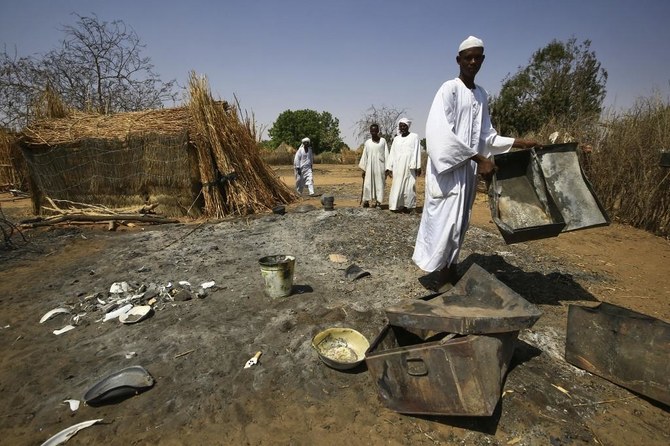
South Sudan has been wracked by instability since independence in 2011 and the civil war has the lives of almost 400,000 people. (AFP file photo)
Short Url
Updated 06 September 2022
Follow

UN: 173 civilians killed in South Sudan clashes

  • Violence caused 44,000 people to flee their homes across 26 villages, with a total of 131 cases of rape and gang-rape documented

JUBA: Scores of civilians were killed in political clashes in South Sudan between February and May this year, a UN report said Tuesday, with women and children subjected to brutal assaults, including gang rape.
The clashes between forces loyal to President Salva Kiir and his rival, Vice President Riek Machar, in oil-rich Unity State affected at least 28 villages across three counties, with 173 people killed and 37 women and children kidnapped.
“Many of the abductees were subjected to sexual violence, including girls as young as eight-years-old and a nine-year-old girl who was gang-raped to death,” the UN Mission in South Sudan (UNMISS) and the Office of the UN High Commissioner for Human Rights (OHCHR) said.
Both sides committed severe abuses, the report said, adding that pro-government forces and militias loyal to Kiir appeared to be “the main perpetrators of the human rights violations.”
The violence caused 44,000 people to flee their homes across 26 villages, with a total of 131 cases of rape and gang-rape documented.
South Sudan has been wracked by instability since independence in 2011 and is still struggling to draw a line under a civil war between pro-Kiir and pro-Machar fighters that claimed the lives of almost 400,000 people.
The joint report covered the period between 11 February and 31 May 2022, with researchers traveling to the pro-Machar strongholds of Koch, Leer, and Mayendit as well as surrounding areas to document the aftermath of the violence.
It said that there were “reasonable grounds to believe that these attacks were consistently premeditated and carried out with a degree of organization mainly by the joint Government forces and allied militias/groups operating in these areas.”
In a press statement accompanying the report’s release, Nicholas Haysom, the UN envoy to the country, said that “human rights violations were committed with impunity.”
“The government is duty-bound under international law to protect civilians, investigate allegations of human rights violations, and hold suspected perpetrators accountable,” he added.
The UN has regularly criticized South Sudan’s leadership for its role in stoking violence, cracking down on political freedoms and plundering public coffers.
It has also accused the government of rights violations amounting to war crimes over deadly attacks in the southwest last year.
Since the five-year civil war ended in 2018, the country’s lumbering peace process has run into multiple delays, with violence regularly breaking out between Kiir and Machar’s forces.
In July, the United States pulled out of two peace process monitoring organizations in South Sudan due to the government’s failure to meet reform milestones, citing a “lack of sustained progress.”


EU parliament approves 90-bn-euro loan for Ukraine amid US cuts

Updated 5 sec ago
Follow

EU parliament approves 90-bn-euro loan for Ukraine amid US cuts

  • awmakers voted by 458 to 140 in favor of the loan, intended to cover two-thirds of Ukraine’s financial needs for 2026 and 2027

The EU parliament on Wednesday approved a 90-billion-euro loan for Ukraine, providing a financial lifeline to cash-strapped Kyiv four years into Russia’s invasion.
Lawmakers voted by 458 to 140 in favor of the loan, intended to cover two-thirds of Ukraine’s financial needs for 2026 and 2027 and backed by the EU’s common budget — after plans to tap frozen Russian central bank assets fell by the wayside.

Military aid to Ukraine hit its lowest level in 2025 as the US pulled funding, leaving Europe almost alone in footing the bill and averting a complete collapse, the Kiel Institute said Wednesday.
Kyiv's allies allocated 36 billion euros ($42.9 billion) in military aid in 2025, down 14 percent from 41.1 billion euros the previous year, according to Kiel, which tracks military, financial and humanitarian assistance pledged and delivered to Ukraine since Russia's full-scale invasion.
Military aid in 2025 was even lower than in 2022, despite the invasion not taking place until February 24 that year.
US aid came to a complete halt with President Donald Trump's return to the White House in early 2025.
Washington provided roughly half of all military assistance between 2022 and 2024.
European countries have thus made a significant effort to plug the gap, increasing their collective allocation by 67 percent in 2025 compared with the 2022-2024 average.
Without that effort, the US cuts could have been even more damaging, the institute argued.
However, the think tank points to "growing disparities" among European contributors, with Northern and Western European countries accounting for around 95 percent of military aid.
The institute calculated that Northern European countries (Denmark, Estonia, Finland, Iceland, Latvia, Lithuania, Norway, and Sweden) provided 33 percent of European military aid in 2025, despite accounting for only eight percent of the combined GDP of European donor countries.
Southern Europe, which accounts for 19 percent of the combined GDP of European donors, contributed just three percent.
To help fill the gap left by the United States, NATO launched the PURL programme, under which European donors purchased US weapons for Ukraine, worth 3.7 billion euros in 2025.
Kiel called the initiative a "notable development", which had enabled the acquisition of Patriot air-defense batteries and HIMARS multiple-launch rocket systems.
European allies are also increasingly placing orders with Ukraine's own defence industry, following a trend started by Denmark in 2024.
War-torn Ukraine's defence production capacity has "grown by a factor of 35" since 2022, according to Kiel, but Kyiv lacks the funds to procure enough weapons to keep its factories working at full capacity.
Orders from 11 European donor countries helped bridge that gap last year.
In the second half of 2025, 22 percent of weapons purchases for Ukraine were procured domestically, a record high.