Iran president: No way back to nuclear deal if probe goes on

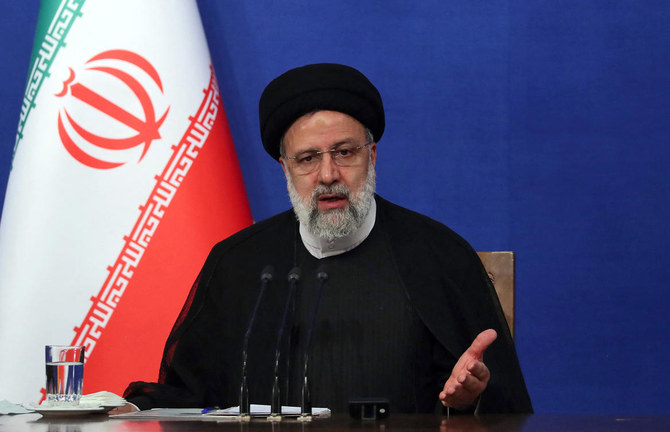
Despite the international attention on the nuclear deal as talks in Vienna hang in the balance, it took Iranian President Ebrahim Raisi over an hour to acknowledge ongoing negotiations. (File/AFP)
Short Url
Updated 29 August 2022
Follow

Iran president: No way back to nuclear deal if probe goes on

  • President Ebrahim Raisi issued threats against Israel
  • Tehran and Washington have traded written responses in recent weeks on the finer points of the roadmap

TEHRAN, Iran: Iran’s president warned Monday that any roadmap to restore Tehran’s tattered nuclear deal with world powers must see international inspectors end their probe on man-made uranium particles found at undeclared sites in the country.
In a rare news conference marking his first year in office, President Ebrahim Raisi also issued threats against Israel and tried to sound upbeat as Iran’s economy and rial currency has cratered under the weight of international sanctions.
Despite the international attention on the deal as talks in Vienna hang in the balance, it took Raisi well over an hour before fully acknowledging the ongoing negotiations. Tehran and Washington have traded written responses in recent weeks on the finer points of the roadmap, which would see sanctions lifted against Iran in exchange for it restricting its rapidly advancing nuclear program.
The International Atomic Energy Agency for years has sought for Iran to answer questions about man-made uranium particles found at undeclared sites. US intelligence agencies, Western nations and the IAEA have said Iran ran an organized nuclear weapons program until 2003. Iran long has denied ever seeking nuclear weapons.
As a member of the Nuclear Nonproliferation Treaty, Iran is obligated to explain the radioactive traces and to provide assurances that they are not being used as part of a nuclear weapons program. Iran found itself criticized by the IAEA’s Board of Governors in June over its failure to answer questions about the sites to the inspectors’ satisfaction.
Raisi mentioned the traces — referring to its as a “safeguards” issue using the IAEA’s language.
“Without settlement of safeguard issues, speaking about an agreement has no meaning,” Raisi said.
Under the 2015 nuclear deal, Tehran could enrich uranium to 3.67 percent, while maintaining a stockpile of uranium of 300 kilograms (660 pounds) under constant scrutiny of IAEA surveillance cameras and inspectors. Then-President Donald Trump unilaterally withdrew America from the accord in 2018, setting the stage for years of rising tensions.
As of the last public IAEA count, Iran has a stockpile of some 3,800 kilograms (8,370 pounds) of enriched uranium. More worrying for nonprofileration experts, Iran now enriches uranium up to 60 percent purity — a level it never reached before that is a short, technical step away from 90 percent. Those experts warn Iran has enough 60 percent-enriched uranium to reprocess into fuel for at least one nuclear bomb.
Amid the tensions, Israel is suspected in carrying out a series of attacks targeting Iranian nuclear sites, as well as a prominent scientist. On Monday, Raisi directly threatened Israel.
Raisi said if Israel decides to carry out its threats to destroy Iran’s nuclear program, “they will see if anything from the Zionist regime will remain or not.”


US condemns RSF drone attack on World Food Programme convoy in Sudan’s North Kordofan

Updated 42 min 27 sec ago
Follow

US condemns RSF drone attack on World Food Programme convoy in Sudan’s North Kordofan

  • Denise Brown, the UN Humanitarian Coordinator for Sudan, also expresses concern over the drone attack

WASHINGTON: The US has condemned a drone attack by Rapid Support Forces on an aid convoy in Sudan’s North Kordofan state that killed one person and injured three others.

“The United States condemns the recent drone attack on a World Food Program convoy in North Kordofan transporting food to famine-stricken people which killed one and wounded many others,” US Senior Adviser for Arab and African Affairs Massad Boulos wrote on X.

“Destroying food intended for people in need and killing humanitarian workers is sickening,” the US envoy wrote.

“The Trump Administration has zero tolerance for this destruction of life and of U.S.-funded assistance; we demand accountability and extend our condolences to all those affected by these inexcusable events and terrible war,” he added.

The Sudan Doctors Network said the convoy was struck by RSF drones in the Allah Karim area as it headed toward displaced people in El-Obeid, the state capital, Anadolu Agency reported.

The network described the attack as a “clear violation of international humanitarian law,” warning that it undermines efforts to deliver life-saving aid to civilians amid worsening humanitarian conditions across the country.

There was no immediate comment from the rebel group.


Denise Brown, the UN Humanitarian Coordinator for Sudan, in a statement also expressed concern over the drone attack which hit the aid trucks in North Kordofan.

“I am deeply concerned by a drone attack earlier today on trucks contracted by the World Food Programme (WFP) in North Kordofan, the aftermath of which I came across a few hours later, as I left the state capital, El Obeid.”

“The trucks were en route from Kosti to deliver life-saving food assistance to displaced families near El Obeid when they were struck, tragically killing at least one individual and injuring many more. The trucks caught fire, destroying food commodities intended for life-saving humanitarian response.”

Brown added that “Humanitarian personnel, assets and supplies must be protected at all times. Attacks on aid operations undermine efforts to reach people facing hunger and displacement.”

“Safe and unimpeded humanitarian access remains critical to ensure assistance reaches the most vulnerable people across Sudan.”

Since April 2023, the conflict between Sudan’s army and the paramilitary forces has killed tens of thousands, displaced 11 million and which the UN has described as one of the world’s worst humanitarian crises.

An alert issued by the Integrated Food Security Phase Classification (IPC), confirmed famine conditions in El-Fasher and Kadugli, the capital of South Kordofan, about 800 kilometers to the east.

The IPC said that 20 more areas in Sudan’s Darfur and neighboring Kordofan were at risk of famine.

Of Sudan’s 18 states, the RSF controls all five states in the western Darfur region, except for parts of North Darfur that remain under army control. The army holds most areas of the remaining 13 states across the south, north, east and center of the country, including the capital, Khartoum.

The conflict between the army and the RSF, which erupted in April 2023, has killed thousands of people and displaced millions.