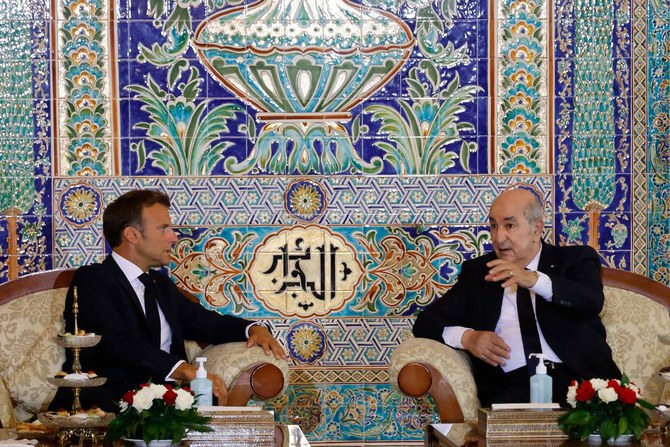
PARIS: French President Emmanuel Macron arrived in Algeria on Thursday for a three-day visit aimed at addressing two major challenges: boosting future economic relations and healing colonial-era wounds.
The visit comes less than a year after a monthslong diplomatic crisis between the two countries stirred up tensions 60 years after the North African country won its independence from France. The war in Ukraine has reinforced Algeria’s status as a key partner in providing gas to the European continent.
In recent years, Macron has made unprecedented steps to acknowledge torture and killings by French troops during Algeria’s 1954-62 war of independence, in a bid to improve the two countries’ still rancorous relations. Yet the series of symbolic gestures has fallen short of an apology from France for its actions during the war — a longstanding demand from Algeria.
Algerian President Abdelmajid Tebboune greeted Macron at the airport in Algiers. The two leaders, who wore masks as part of COVID-19 measures, shook hands and hugged each other before their countries’ national anthems were played.
They were to attend a ceremony at the Martyrs’ Memorial, which pays tribute to those who died during Algeria’s struggle for independence, before heading to the presidential El Mouradia palace for a meeting and dinner.
In a phone call with Tebboune on Saturday, Macron said the trip will help “deepen the bilateral relationship,” according to the Elysée palace. He expressed France’s support after deadly wildfires in eastern Algeria.
This is the second time Macron has been to Algeria as president. During a brief stop in December 2017, he called for a “partnership between equals.” Months before that, during a trip to Algiers as a presidential candidate, he called colonization a “crime against humanity.”
Macron, the first French president born after the end of Algeria’s brutal seven-year war of independence in 1962, has promised a reckoning of colonial-era wrongs. The country was occupied by France for 132 years.
In 2018, Macron recognized the responsibility of the French state in the 1957 death of a dissident in Algeria, Maurice Audin, admitting for the first time the military’s use of systematic torture during the war. He later made a key decision to speed up the declassification of secret documents related to the war, amid other gestures.
Macron will have a second meeting with Tebboune on Friday in the presence of the French army chief and defense and foreign ministers to discuss peace and stability in the region, after France completed the withdrawal of its troops from Mali earlier this month. Paris still maintains troops in the broader Sahel region, with the heart of the operation moved to Niger.
Coordination with Algerian authorities is crucial, as the country shares long borders in the Sahara with Mali, Libya and Niger, paths used by smugglers and extremists, the Elysee stressed.
No energy supply or other big trade contract is expected during Macron’s trip, but the focus will be on future economic relations.
Algeria’s status as a key gas supplier for Europe has been enhanced amid fears that Russia could cut off supplies. The North African country is the EU’s third-largest gas supplier, representing 8.2 percent of the 27-nation bloc’s imports in 2021.
Algiers has already started increasing its gas supplies to the continent, mostly via two pipelines that connect the country to Italy and Spain. It signed a $4 billion gas deal with US group Occidental Petroleum, Italian company Eni and French giant Total.
Political scientist Mohamed Saidj told the AP he considers this is the most important visit by a French president since 1975, because it comes after last year’s major diplomatic crisis.
Tensions between the two countries escalated following a French decision to slash the number of visas issued to people in North Africa, including Algeria, because governments there were refusing to take back migrants expelled from France.
Relations further worsened after Algeria recalled its ambassador to France citing alleged “irresponsible comments” attributed to Macron about Algeria’s pre-colonial history and post-colonial system of government. In retaliation, Algeria accused Paris of “genocide” during the colonial era.
Both countries agreed to resume cooperation in December.
The visa situation will be discussed during Macron’s trip, the Elysee said. There are several million Algerian citizens or people of Algerian descent in France.
Last year’s tensions spread a feeling of hostility toward France in Algeria, echoed by the authorities’ push to replace the French language at school and government by English.
The Elysee said Macron will also raise human rights issues, in a country where activists criticize an unjust system of governance that views dissidents as criminals and doesn’t allow freedom of speech.
The French president will go Friday to the Christian and Jewish cemetery of Saint-Eugene in Algiers. He will also visit the Great Mosque.
He will then head to Oran, the country’s second-largest city, where he will attend Saturday a show of breakdancing, which will become an Olympic sport in 2024 in Paris.


![]()

France’s Macron visits Algeria in bid to heal wounds
Short Url
https://arab.news/2k2mh
France’s Macron visits Algeria in bid to heal wounds
- The war in Ukraine has reinforced Algeria’s status as a key partner in providing gas to the European continent
- This is the second time Macron has been to Algeria as president


Latest updates



Recommended



© 2026 SAUDI RESEARCH & PUBLISHING COMPANY, All Rights Reserved And subject to Terms of Use Agreement.