

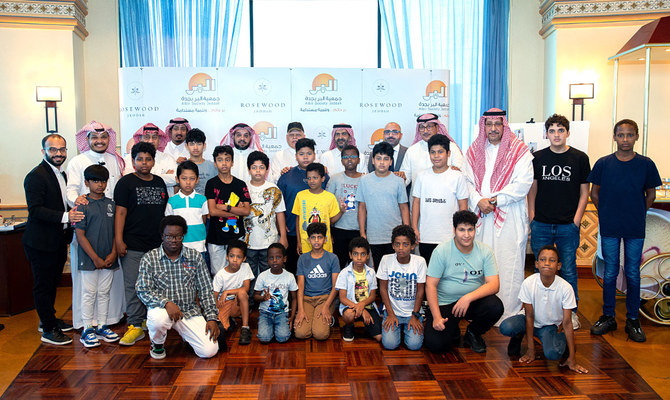
Rosewood Jeddah marks Humanitarian Day with orphans

Rosewood Jeddah hosted 30 orphans from Albir Society at its Habsburg restaurant, in an event organized to celebrate the achievements of the charitable society.
Short Url
Updated 24 August 2022
Follow

Rosewood Jeddah marks Humanitarian Day with orphans

In recognition of the World Humanitarian Day, marked every year on Aug. 19, Rosewood Jeddah hosted 30 orphans from Albir Society at its Habsburg restaurant, in an event organized to celebrate the achievements of the charitable society in providing opportunities and safety for these children.

During the event, Mazen Allam, managing director of Rosewood Jeddah, said: “Rosewood Jeddah has been actively involved in giving back to society for the past decade. As an institution, our aim is to grow our role and involvement in improving the lives of everyone in the community we belong to. It’s a great honor for us to celebrate World Humanitarian Day with Albir Society and their wonderful children.

“I would like to extend great thanks to their CEO Mohieddin Hakami, who not only made this possible but with the support of his team managed to help us organize all of this.”

Allam also highlighted Rosewood Jeddah’s plan to continue its support to Albir Society in the future.

This year, World Humanitarian Day has been themed “It Takes a Village,” shining a light on the thousands of volunteers, professionals and crisis-affected people who deliver urgent healthcare, shelter, food, protection, water and much more.

On a day where we are reminded to recognize our fellow brothers and sisters in the world, Rosewood Jeddah looked to support the orphaned children, donating 30 stationery kits to prepare them for studies and their journey back to school.

“Every child has the right to dream, and the right to opportunity. It gives us great pleasure to be able to support these kids in their return to school and to continue supporting them to aspire and reach their goals,” said Allam, as he reaffirmed Rosewood Jeddah’s commitment toward their social responsibility.

Albir Society is a charitable society under the supervision of the Ministry of Human Resources and Social Development in Saudi Arabia led by Makkah Governor Khalid bin Faisal as the honorary chairman. For more than a decade, Albir has provided aid and support to families in need, patients and orphans in the community and surrounding environment. Albir society continues to encourage the complementary relationship between the government, private sector, and charitable entities to direct their social responsibilities to charity work.

Meanwhile, the award-winning Rosewood Jeddah, situated on the Jeddah Corniche, is ideal for both business and leisure travelers. Running parallel to the Red Sea for more than 20 miles, the Corniche is within easy reach of key business, diplomatic, government, and designer shopping districts.


New energy vehicles drive next phase of mobility in Saudi Arabia

Updated 06 February 2026
Follow

New energy vehicles drive next phase of mobility in Saudi Arabia

Saudi Arabia stands at a defining moment in its mobility transformation. Under Vision 2030, the Kingdom is accelerating its transition toward cleaner, smarter and more connected transport systems.
New energy vehicles are at the center of this shift, offering a pathway to a more sustainable automotive ecosystem. Yet while consumer interest is rising rapidly, converting intent into everyday adoption will depend on how effectively the wider mobility system evolves alongside electric vehicles.
Recent nationwide research by Al-Futtaim highlights the strength of this momentum. More than 70 percent of Saudi residents surveyed are already familiar with NEVs, while nearly eight in 10 say they would consider purchasing one as their next vehicle. Most notably, 80 percent expect to buy an electric vehicle within the next three years, signaling that the transition is moving from aspiration to reality.
Despite this optimism, important barriers remain. Range anxiety continues to be the most frequently cited concern, alongside high purchase prices and long charging times. Practical considerations dominate purchasing decisions, with affordability and access to charging infrastructure outweighing environmental motivations. These findings underline a pressing reality: consumers will embrace NEVs at scale only when electric mobility feels as convenient, reliable and accessible as conventional driving.
For industry leaders, this represents both an opportunity and a responsibility. Jerome Saigot, managing director of Al-Futtaim BYD KSA, said: “Saudi Arabia is building the foundations for a future-ready mobility system under Vision 2030. The opportunity now is to connect the dots, bringing together vehicles, charging infrastructure, consumer education and service capability to unlock confident, large-scale adoption of new energy vehicles.”
Charging networks therefore play a central role in supporting adoption, but they are not the only requirement. NEV uptake is closely linked to how cities are planned, how people commute and how transport systems connect.
Emerging mobility models also point to a more connected future. High levels of openness to mobility-as-a-service, autonomous vehicles and shared transport indicate that Saudi consumers are receptive to innovation. However, these technologies will succeed only if they are embedded within systems that link vehicles, infrastructure, data and urban design.
Successful electric mobility ecosystems need to be built around coordinated rather than isolated initiatives. Electric vehicles perform best when supported by reliable charging, smart traffic management, efficient public transport and well-designed urban environments. In this context, NEVs benefit directly from parallel investment in rail, bus networks, digital platforms and active mobility infrastructure.
Encouragingly, public confidence in Saudi Arabia’s long-term mobility vision remains strong. More than 85 percent of respondents surveyed by Al-Futtaim believe the Kingdom is on track to lead in future mobility. Consumers also clearly identify priorities for continued progress, including expanding charging infrastructure, improving mass transportation and strengthening regulatory frameworks.
For policymakers, investors and industry players, the message is clear. The next phase of mobility transformation must focus on alignment: aligning infrastructure with consumer expectations, aligning innovation with everyday needs, and aligning public and private investment around shared outcomes.
Saudi Arabia’s mobility transition is no longer a distant ambition. It is unfolding now, shaped by confident consumers, ambitious institutions and accelerating technological change. By building connected systems that place people at their center, the Kingdom can ensure that electric mobility becomes a lasting part of its sustainable future.
To explore these insights and recommendations in more detail, download The Future of Mobility in Saudi Arabia.