

Venice Biennale to raise Saudi Arabia’s design profile

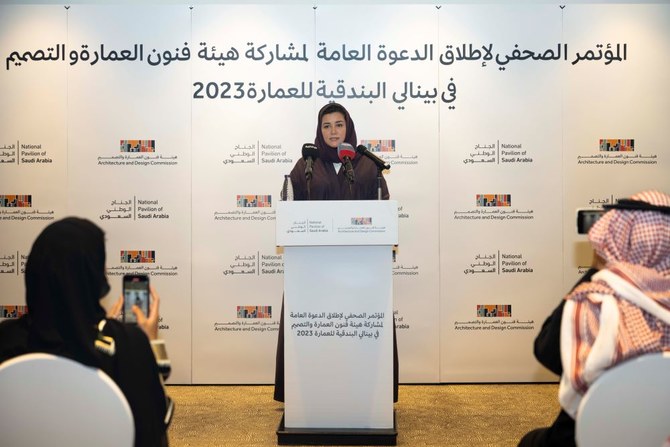
Commission CEO Sumaya Suleiman told a press conference that the Saudi pavilion will showcase local talents and skills in architecture and design.
Short Url
Updated 25 August 2022
Follow

Venice Biennale to raise Saudi Arabia’s design profile

  • Saudi commission invites architects, researchers to join ‘global dialogue’ 
  • Commission CEO Sumaya Suleiman: ‘We wish to put the Kingdom at the forefront of the global creative scene by giving opportunities to talents’ 

RIYADH: Saudi Arabia’s Architecture and Design Commission on Wednesday announced it will take part in the 18th edition of the Venice Biennale next year. 

The 2023 Venice Biennale International Architecture Exhibition will be held from May 20 to Nov. 26 under the theme “The Laboratory of The Future.”

Commission CEO Sumaya Suleiman told a press conference that the Saudi pavilion will showcase local talents and skills in architecture and design.

“This version of the biennale seeks architectural solutions to contemporary social and human issues, especially since the architect’s nature urges him to continue searching for solutions and innovations,” she said.

Suleiman said that the commission wants to open participation to all architects, researchers and specialists in an bid to discover and support talent, as well as promote equal and optimum opportunities.

Previously, the Kingdom has taken part in two editions of the biennale.

The first was in 2018 under the theme “Freespace,” which related to urban planning and its impact on social life.

Interactions between people, societies and places were an essential part of the Kingdom’s first national pavilion, Suleiman said.

The second participation in 2021 — under the theme “How Will We Live Together?” — explored life in a post-pandemic world.

Feedback from critics for both was positive, Suleiman said.

The Kingdom’s participation in the biennale is important because “we are talking about a dialogue on a global scale and on a global platform,” she added.

Suleiman described participation in the biennale as a “positive outcome consistent with the strategic direction of the commission.”

She added: “We wish to put the Kingdom at the forefront of the global creative scene by giving opportunities to talents, and access to international platforms and the biennale is one of the largest.” 

Architects, specialists and researchers in the Kingdom can apply through https://engage.moc.gov.sa/venicebiennale/ 

Entries close on Sept. 25, 2022.


Art Cairo part of a ‘long-term cultural project,’ founder says

Updated 25 January 2026
Follow

Art Cairo part of a ‘long-term cultural project,’ founder says

CAIRO: As Art Cairo 2026 draws to a close, its founder Mohammed Younis is keen to set the fair apart from its regional counterparts — and also asserts that the annual event is part of a “long-term cultural project.”

The fair, which took place at the Grand Egyptian Museum and wrapped up on Jan. 26, boasted a distinctly Arab flavor, in terms of galleries, artists and the themes of the artworks on show.

Younis says that is all part of a conscious curatorial effort.

“Art Cairo stands apart from other art fairs in the region as the only platform dedicated exclusively and intentionally to Arab art … While many regional fairs present a broad, globalized perspective, Art Cairo emerges from a different vision — one rooted in presenting Arab art from within,” Younis told Arab News.

Across the fair, depictions of golden age icons such as 1950s superstar Mohamed Mohamed Fawzy by painter Adel El-Siwi jostled for attention alongside ancient iconography and pop culture references from the Arab world.

Abu Dhabi’s Salwa Zeidan Gallery, for example, exhibited work by up-and-coming Egyptian artist Passant Kirdy.

“My work focuses on Egyptian heritage in general, including pharaonic and Islamic art. These influences are always present in what I create. This symbol you’re looking at is a pharaonic scarab …  I’m very attached to this symbol,” she told Arab News.

The Arab focus of the curation is part of an effort to bill Art Cairo as a “long-term cultural project,” Younis noted.

“Ultimately, Art Cairo is not simply an art fair; it is a long-term cultural project. It exists to support Arab artists, contribute to building a sustainable art market, and articulate an authentic Arab narrative within the regional and international art landscape.”