

CIA finds no evidence for Israeli ‘terror’ label for Palestinian rights groups 

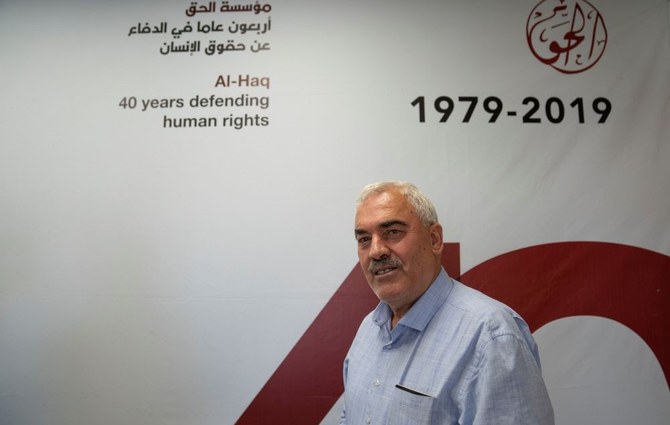
Shawan Jabarin, general director of Al-Haq, a Palestinian human rights organization in the West Bank, talks to reporters in his office, which was raided by Israeli forces, Ramallah, Aug. 18, 2022. (AP Photo)
Short Url
Updated 22 August 2022
Follow

CIA finds no evidence for Israeli ‘terror’ label for Palestinian rights groups 

  • Israeli soldiers raided offices of 6 human rights organizations amid intelligence controversy
  • Human Rights Watch: ‘The US should very clearly call on the Israeli government to reverse these designations’

LONDON: The CIA could not find any evidence to support Israel’s claim that six prominent Palestinian rights groups were “terrorist organizations,” intelligence sources told The Guardian. 

Last October, the Israeli government labeled the following groups as terror-related: Addameer Prisoner Support and Human Rights Association, Al-Haq, the Bisan Center for Research and Development, Defense for Children International — Palestine, the Union of Agricultural Work Committees, and the Union of Palestinian Women Committees.

Israel claimed that these outfits were fronts for the Popular Front for the Liberation of Palestine, a left-wing Palestinian political party that has a paramilitary wing.

Two sources told The Guardian that Israel shared intelligence with American partners about the decision to designate the groups as terror-related, but in its own assessments, the CIA did not find any evidence supporting the Israeli position. 

The CIA report “doesn’t say that the groups are guilty of anything,” one source, who has knowledge of the CIA assessment, told The Guardian.

The second source confirmed that the assessment was classified to high levels of security protection. 

The US has not publicly criticized Israel’s assessment, but Washington’s security apparatus has not listed any of the six groups as terror outfits. No other Western intelligence organizations have shared Israel’s assessment.

Omar Shakir, Israel/Palestine director at Human Rights Watch, told The Guardian that “the US should very clearly call on the Israeli government to reverse these designations, and to allow these organizations to continue their vital work.” 

He added: “The reality here is that the US has for too long turned a blind eye, and in some cases even green lighted, quite serious Israeli government abuse. 

“The position toward the Palestinian human rights organizations highlights a much larger failing in US government policy on the Israeli-Palestinian issue, and puts the US squarely out of touch with the consensus in the human rights movement.”

The lack of support from foreign governments on its designation has not prevented Israel from continuing to target the six groups.

On Thursday, the Israeli military raided the West Bank offices of all of the designated outfits. Soldiers took property from the charities and sealed off office doors. 

US State Department spokesman Ned Price confirmed after the raids that Washington had assessed Israel’s evidence for the designations.

“What happened last year is the Israeli government designated these organizations,” he said. “We have not followed through with any designations, nor have we changed our approach to these organizations.”

Price did not answer questions from The Guardian about the CIA’s assessments on the Israeli decision. The CIA also did not respond to the newspaper’s questions.

Comments from the two sources come after nine EU countries issued a joint statement last month on the designation, saying: “No substantial information was received from Israel that would justify reviewing our policy toward the six Palestinian NGOs.”

Also last month, 22 Democrats in the US Congress sent a letter to Secretary of State Antony Blinken and Avril Haines, director of national intelligence, urging Washington to stand up to Israel over the report. 

They said: “A reported lack of evidence to support this decision raises concerns that it may be a deeply repressive measure, designed to criminalize and silence prominent and essential Palestinian human rights organizations.”


Syrian foreign minister: National interest and the welfare of the people top priority

Updated 13 sec ago
Follow

Syrian foreign minister: National interest and the welfare of the people top priority

  • Hassan Al-Shaibani highlights reconstruction efforts, internal reforms during Munich discussion

MUNICH: The Syrian Arab Republic Foreign Minister Asaad Hassan Al-Shaibani spoke on the sidelines of the Munich Security Conference about the country’s ongoing recovery, internal reforms, and the impact of Israeli military actions.

“We are satisfied with the achievements we have made, but we continue striving to deliver the best for our people,” Al-Shaibani said.

“We will not tire or give up and will work day and night to build the Syria we aspire to, together with our citizens.”

In the Syrian Arab News Agency report the minister stressed that the Syrian state had not shirked its responsibility for what happened in Sweida and other areas, noting that “the national interest and the welfare of the people have always been our top priority.”

He emphasized that the diversity in Syria is a source of strength.

We live in a country exhausted by war and by the mismanagement inherited from the deposed regime.

Foreign Minister, Asaad Hassan Al-Shaibani

“We share national interests, including the unity and territorial integrity of the country, and we operate within the framework of the law,” he added.

Al-Shaibani highlighted progress in rebuilding state institutions and restoring trust between the government and the public.

“We live in a country exhausted by war and by the mismanagement inherited from the deposed regime,” he said. “Syrian society remains fragmented, both inside the country and abroad, and continues to face humanitarian and infrastructure challenges.”

He emphasized that efforts to unify the country include consolidating state control over weapons, a principle established after the revolution’s victory.

The minister also highlighted the role of Syrian citizens in the recovery process.

“What we rely on is our people, who possess determination and ambition,” he said, adding that “lifting sanctions is the key to reconstruction.”

He noted that there are still displacement camps in the country and that many refugees continue to live abroad.

Turning to external issues, he expressed concern over Israeli military activity.

“Since Dec. 8, 2024, Syria has faced more than 1,000 airstrikes, the occupation of new areas in southern Syria, and over 500 ground incursions,” he said, adding that the Syrian state has pursued a realistic approach toward Israel, prioritizing reconstruction and national recovery.

He noted, however, that the policy might not have been acceptable to Israel, which “continues to seek regional conflicts.”

Al-Shaibani emphasized that negotiations should result in Israel withdrawing from the areas it occupied after Dec. 8, respecting Syrian sovereignty and airspace.

Syria’s deputy interior minister met with Germany’s interior minister on the sidelines of the Munich Security Conference.

They discussed security developments and prospects for cooperation, according to a statement from the interior ministry.

Maj. Gen. Abdulkader Al-Tahhan held talks with German Interior Minister Alexander Dobrindt during the annual conference.

The Syrian Interior Ministry said the meeting included a review of current developments in Syria and their impact on security and humanitarian issues.

It added that both sides stressed the importance of coordination and information-sharing in support of regional and international stability.

The statement said the officials also discussed possible cooperation between the two interior ministries, including training, capacity-building and the exchange of expertise.
