UN requests international support for Palestinian rights groups falsely labeled ‘terrorists’ by Israel

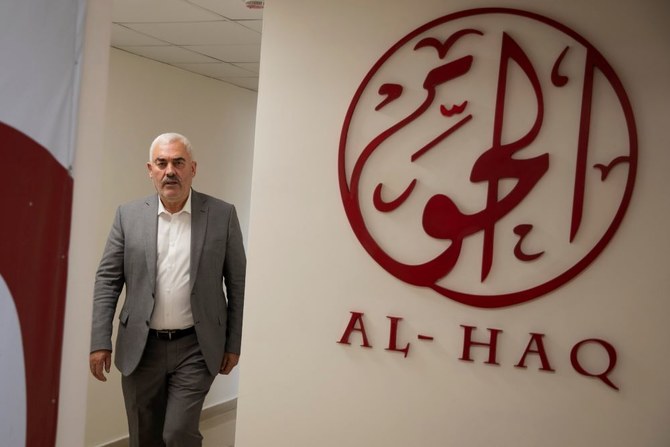
Shawan Jabarin, director of the Al-Haq human rights group, at the organization’s offices in the West Bank city of Ramallah, Oct. 23, 2021. (AP Photo)
Short Url
Updated 28 April 2022
Follow

UN requests international support for Palestinian rights groups falsely labeled ‘terrorists’ by Israel

  • UN officials criticized Israel for failing to provide any credible evidence against the organizations after banning them
  • Shawan Jabarin, director of Ramallah-based Al-Haq, called the appeal against the ban ‘an important message from professional bodies that enjoy international respect’

RAMALLAH: Officials at the United Nations have urged the international community to acknowledge the lack of evidence against the six Palestinian human rights organizations that Israel sanctioned and designated as “terrorist groups” in October 2021, and called on governments worldwide to resume funding those organizations.

The six groups are Al-Haq; Addameer Prisoners’ Support and Human Rights Association; Defense for Children International — Palestine; Bisan Center for Research and Development; the Union of Palestinian Women’s Committees; and the Union of Agricultural Work Committees.

The officials criticized Israel for failing to provide any credible evidence against the organizations after banning them. They also expressed concern that Israel is abusing anti-terror laws to target and persecute Palestinian human rights and civil society organizations.

Shawan Jabarin, director of Ramallah-based Al-Haq, called the appeal against the ban “an important message from professional bodies that enjoy international respect. Although it is not binding, it reveals the falsehood of the Israeli occupation narrative.”

He told Arab News that Israel’s decision was political, not legal, and that countries’ response to it was determined by their relationship with Israel.

Jabarin believes that Israel is angered by the activities of Palestinian civil rights groups, including Al-Haq, which he said confronts Israel at international forums and exposes the crimes committed by the Israeli military and politicians against the Palestinians, including war crimes punishable under international law.

“It was easier for Israel to make a political decision and consider us a terrorist organization after it tried for 15 years to dry up our financial resources, attack our computers, and put pressure on our funders to stop their support,” said Jabarin.

Palestinian human rights institutions, including Al-Haq, played an essential role in preparing cases for the International Criminal Court to prosecute Israeli war crimes.

Al-Haq pursued foreign companies that invested in Israeli settlements and forced them to withdraw those investments, which they were told were in violation of international law.

Ghassan Al-Khatib, a Palestinian political analyst, told Arab News: “Israel has a problem with the work of Palestinian human rights institutions because they have recently succeeded in embarrassing Israel internationally over the issues of arresting children and torture. (It wants to) silence these voices that (turn) international public opinion against it.”

Al-Khatib said the harassment and persecution of these organizations has given their work and activities greater credibility internationally, especially after Israel failed to deliver on its promise to provide evidence linking the organizations to terrorism.

Sahar Francis, director of Addameer Prisoners’ Support and Human Rights Association, which defends jailed Palestinians, told Arab News: “At first, Israel claimed that it had a secret file that proves the six institutions’ relationship with terrorism, but the world told Israel that a secret file cannot be used against human rights institutions and that evidence must be presented.

“We call on countries that have stopped supporting Palestinian institutions due to false Israeli accusations to resume support,” he continued.

Francis claimed that most countries have continued supporting the six institutions, except for those in the European Union.


Hamas official says group in final stage of choosing new chief

The official said the race for Hamas’s leadership is now between Khaled Meshaal (L) and Khalil Al-Hayya (R). (File/AFP)
Updated 51 min 30 sec ago
Follow

Hamas official says group in final stage of choosing new chief

  • Hayya, 65, a Gaza native and Hamas’s chief negotiator in ceasefire talks, has held senior roles since at least 2006
  • Meshaal, who led the political bureau from 2004 to 2017, has never lived in Gaza

CAIRO: A senior Hamas official told AFP on Sunday that the Palestinian movement was in the final phase of selecting a new leader, with two prominent figures competing for the position.
Hamas recently completed the formation of a new Shoura Council, a consultative body largely composed of religious scholars, as well as a new political bureau.
Members of the council are elected every four years by representatives from Hamas’s three branches: the Gaza Strip, the occupied West Bank and the movement’s external leadership.
Hamas prisoners in Israeli jails are also eligible to vote.
The council subsequently elects the political bureau, which in turn selects the head of the movement.
“The movement has completed its internal elections in the three regions and has reached the final stage of selecting the head of the political bureau,” the official said, speaking on condition of anonymity as he was not authorized to speak publicly.
He added that the race for the group’s leadership is now between Khaled Meshaal and Khalil Al-Hayya.
A second Hamas source confirmed the development within the organization, which fought a devastating war with Israel following its October 7, 2023 attack.
Hayya, 65, a Gaza native and Hamas’s chief negotiator in ceasefire talks, has held senior roles since at least 2006, according to the US-based NGO the Counter Extremism Project (CEP).
Meshaal, who led the political bureau from 2004 to 2017, has never lived in Gaza. He was born in the West Bank in 1956.
He joined Hamas in Kuwait and later lived in Jordan, Syria and Qatar. The CEP says he oversaw Hamas’s evolution into a political-military hybrid.
He currently heads the movement’s diaspora office.
Last month, a Hamas source told AFP that Hayya enjoys backing from the group’s armed wing, the Ezzedine Al-Qassem Brigades.
After Israel killed former Hamas leader Ismail Haniyeh in Tehran in July 2024, the group chose its then-Gaza chief Yahya Sinwar as his successor.
Israel accused Sinwar of masterminding the October 7 attack.
He too was killed by Israeli forces in the southern Gaza city of Rafah, three months after Haniyeh’s assassination.
Hamas then opted for an interim five-member leadership committee based in Qatar, postponing the appointment of a single leader until elections, given the risk of the new chief being targeted by Israel.