
JAKARTA: Indonesian coffee producers are eyeing the potential of boosting exports to the Middle East, as they say interest from the region has risen in recent years.
Indonesia is the fourth-largest coffee-producing country in the world and Asia’s second biggest, accounting for about 7 percent of global coffee output. In 2021, the Southeast Asian nation exported about 384 thousand metric tons worth almost $850 million, according to the Central Statistics Agency.
Egypt was the second-biggest export destination for Indonesian coffee last year, just behind the US. The Association of Indonesian Coffee Exporters and Industries said that exports to the Middle East region have been growing in the past decade.
“The Middle East market potential will always continue to grow for medium and premium quality coffee,” Moelyono Soesilo, head of specialty and industry at the association, told Arab News on Saturday.
Interest in Indonesian coffee has grown in the region because of global coffee trends and the rise of modern cafes across the world, Soesilo said, but also as more Indonesian travelers visit the Middle East.
“Many Indonesian citizens travel to the Middle East and they would bring Indonesian coffee products there, automatically and indirectly introducing it to the people in the region,” Soesilo said.
Husin Bagis, Indonesian ambassador to the UAE, told Arab News there was potential for Indonesian coffee products to gain traction in the region and beyond, as long as producers match the competitive pricing.
“It’s very possible because from Dubai, it usually works as a hub for Africa, Middle East, and Europe,” Bagis said.
Bagis said that with the wide-ranging economic pact Indonesia signed with the UAE earlier this year in July, more exports of Indonesian goods, including coffee, should be expected.
“President Joko Widodo wants to boost all exports,” Bagis said. “And (coffee) is one of our pride.”
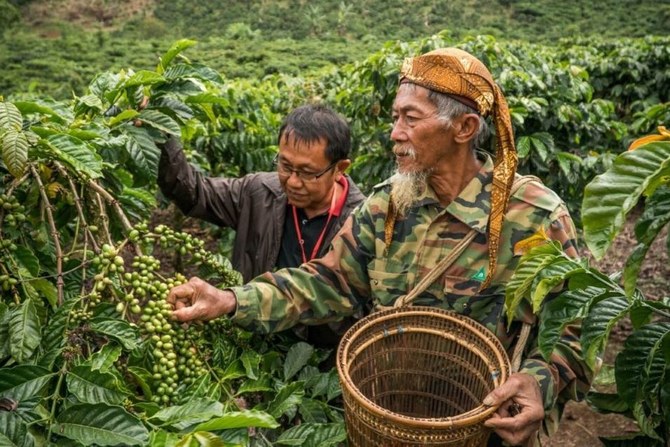
Indonesian coffees have been gaining more interest worldwide in recent years, and is known for its full-bodied, rich taste and long finish. Cultivation of the beans takes place across its many islands, including Java, Sumatra, and Sulawesi.
Before the COVID-19 pandemic hit, Indonesian coffee exporters had planned on participating in exhibits in the Middle East to showcase their products, the Indonesian Coffee Exporters Association told Arab News.
“Before the COVID pandemic we had a lot of plans to expand our networks in the Middle East,” said the association’s chairman, Hutama Sugandhi.
“I think it’s a big market because in Egypt, among some of our exporters, the purchase volume has only continued to increase,” he said.
Hariyanto, a coffee exporter from East Java province, said he is focused on maintaining a consistent quality for his products.
“I will keep going where the profit is best and continue to chase it, and I see a match in Egypt with what I produce, so it’s my duty to maintain the quality,” Hariyanto said.
Suradi, a Jakarta-based coffee bean seller who has been in the business since 2000, said there was “extraordinary potential in the Middle East” for Indonesian coffee.
“It’s up to us whether we can tap on this potential or not,” Suradi said. “For every coffee business, as long as we are consistent with the quality, coffee will never die.”