

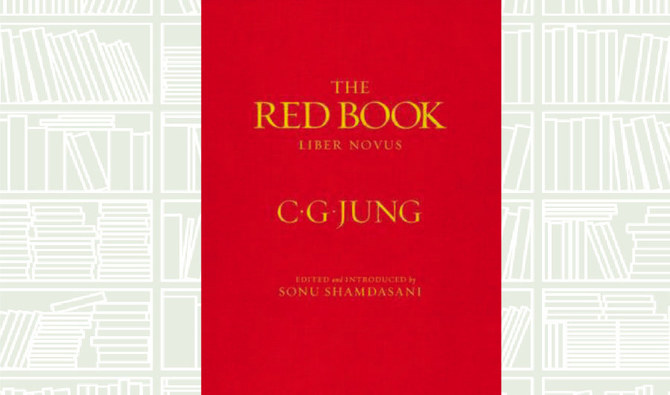

“The Red Book Liber Novus: A Reader’s Edition” is a manuscript written by Swiss psychiatrist Carl Jung.
The work is a collection of Jung’s notes compiled between 1914 and 1930 that was made public in 2009 by his heirs, and edited by Suno Shamdasani in 2012.
The book includes a facsimile reproduction of some of Jung’s original handwritten notes.
Jung was a close friend of psychiatrist Sigmund Freud, but the relationship ended over differences of opinion.
“The Red Book” came to life after his break from Freud, where Jung highlights the earliest accounts of his theories on the collective unconscious and individuation.
In it, Jung describes the self-experimentation phase as his “most difficult experiment” where he began deciphering his strange dreams through analytical psychology.
The folio manuscript is divided into two parts: “Liber Primus” and “Liber Secundus” or the first and second book respectively.
Throughout the publication, Jung puts his experience into context by using analogies from history to deconstruct the unconscious mind.
The first part contains 11 chapters in which Jung expresses himself as a flawed human with more questions than answers. “Liber Primus” is a discovery of his soul and its relationship with God and the Universe.
The second part holds 21 chapters in which Jung discusses his encounter with a demon that resides within his soul.
In response to Sigmund Freud’s founding of psychoanalysis, Jung founded analytical psychology, a practice that delves into the patients’ unconscious mind with the aim to treat various mental illnesses and personality disorders.
His influence spanned numerous fields such as psychiatry, anthropology, religion, archeology and literature.


