

Saudi banks increase loans by $77.1bn in Q2

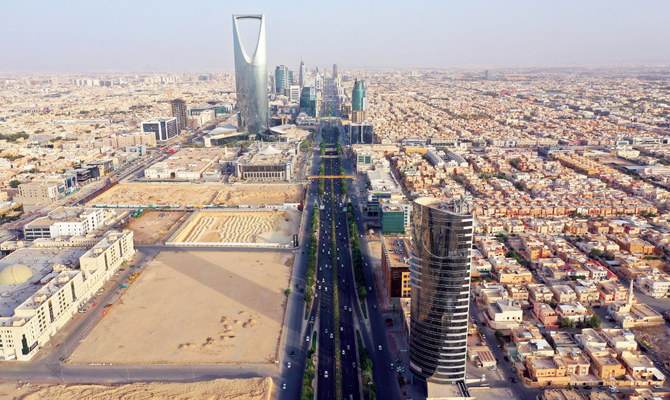
The data showed that the value of Saudi banks’ aggregate loan portfolio totaled SR2.24 trillion at the end of the second quarter of 2022, up 14.8 percent from the year before and up 4 percent from the previous quarter. (Shutterstock)
Short Url
Updated 14 August 2022
Follow

Saudi banks increase loans by $77.1bn in Q2

  • Kingdom is moving toward Vision 2030 by developing the trade sector and ensuring its sustainability

CAIRO: Saudi Arabia’s bank loan portfolio rose by SR289 billion ($77.1 billion) in the second quarter of this year from the same quarter a year ago, according to a recent statistical bulletin released by the Saudi Central Bank, also known as SAMA.

Bank loans totaled SR2.42 trillion at the end of the second quarter of 2022, up from SR1.95 trillion in the second quarter of 2021, showed the SAMA report.

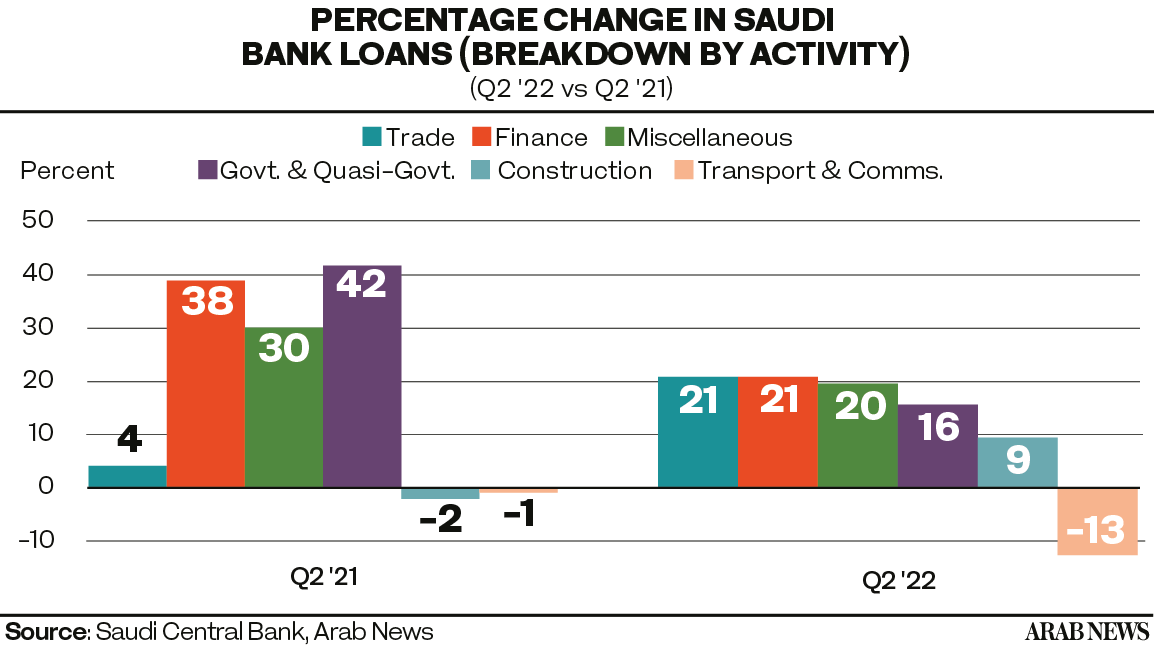
The SR289 billion increase was led by an SR191.1 billion growth in miscellaneous activities. Its share increased by 2 percentage points to 52 percent in the second quarter of 2022.

The data showed that the value of Saudi banks’ aggregate loan portfolio totaled SR2.24 trillion at the end of the second quarter of 2022, up 14.8 percent from the year before and up 4 percent from the previous quarter.
The annual growth in bank loans dropped to a negative in 2017 and remained below zero until the third quarter of 2018. However, bank loans have been seeing an upward trend ever since, according to the SAMA report.

From the third quarter of 2018 until the end of 2019, the value of Saudi bank loans grew at an average rate of 3.7 percent year on year; between 2020 and the second quarter of this year, it grew at an average rate of 14.8 percent year on year.

The dominating segment in the Kingdom’s loans was miscellaneous economic activity, which acquired 52 percent of the total loans this quarter.

Commerce came in second, holding 17.2 percent of total loans in the country, recording SR385.7 billion in the second quarter, showed the data.

The Ministry of Commerce in the Kingdom has been moving toward the Saudi Vision 2030 by developing the trade sector and ensuring its sustainability, according to the Kingdom’s Unified National Platform.

The platform stated: “The Ministry of Commerce’s mission focuses on improving the business environment in Saudi Arabia through enacting, developing and supervising the implementation of flexible and fair trade policies and regulations.”

Even though total bank loans expanded this quarter, two economic activities saw a quarterly decline in bank credit in the second quarter of this year: manufacturing and processing and transport and communication.

Bank loans to transport and communication fell by SR6.2 billion in the second quarter of 2022 from the same quarter the previous year.

Compared to the previous quarter, the sector dropped from 2.1 percent of total loans in the first quarter to 1.9 percent, showed the SAMA bulletin.

Bank loans given to manufacturing and processing fell by SR4 billion in the second quarter of 2022 from the same quarter the previous year.

The data showed that the sector dropped from 7.2 percent of total loans in the first quarter to 6.9 percent compared to the previous quarter.


GCC debt markets poised for major growth in 2026, led by record sukuk issuance: Fitch

Updated 21 January 2026
Follow

GCC debt markets poised for major growth in 2026, led by record sukuk issuance: Fitch

RIYADH: The Gulf Cooperation Council's debt capital market is set to exceed $1.25 trillion in 2026 as project funding and government initiatives fuel a 13.6 percent expansion, according to Fitch Ratings.

The region is set to remain one of the largest sources of US dollar debt and sukuk issuance among emerging markets , according to the agency, which also flagged cross-sector economic diversification, refinancing needs, and funding for deficits as drivers behind the growth.

The Gulf’s debt capital markets — which stood at $1.1 trillion at the end of the third quarter of 2025 — have evolved from primarily sovereign funding tools into increasingly sophisticated financing means, serving governments, banks, and corporates alike.

As diversification agendas accelerate and refinancing cycles intensify, regional issuers have become regular participants in global debt markets, strengthening the GCC’s role in emerging-market capital flows.

The report noted that the market is expected to be further supported by forecasted lower oil prices, averaging $63 per barrel in 2026 and 2027, and anticipated US Federal Reserve rate cuts to 3.25 percent and 3 percent in those respective years.

Bashar Al-Natoor, Fitch’s global head of Islamic Finance, highlighted the market’s resilience and the rising dominance of sukuk. “Most GCC issuers continued to maintain strong market access in 2025 and so far in 2026 despite global and regional shocks,” he stated, adding: “Sukuk funding share in the GCC DCM outstanding expanded to over 40 percent, the highest to date.”

The analysis noted the high credit quality of the region’s Islamic debt. “About 84 percent of Fitch-rated GCC sukuk are investment-grade, and 90 percent of issuers are on Stable Outlooks,” Al-Natoor added. “While there were no defaults or falling angels, there were rising stars with many Omani sukuk upgraded following the sovereign upgrade.”

In 2025, GCC nations accounted for 35 percent of all emerging market US dollar debt issuance, excluding China. Growth in US dollar sukuk issuance notably outpaced that of conventional bonds. The region’s total outstanding DCM grew by over 14 percent year on year to $1.1 trillion.

The market remains fragmented, with Saudi Arabia and the UAE hosting the most developed ecosystems.

Notably, Kuwait issued $11.25 billion in sovereign bonds, its first such issuance in eight years, while Oman’s DCM is expected to grow more conservatively as the country focuses on deleveraging. “Digitally native notes emerged in Qatar and the UAE,” the report said.

Fitch identified several risks to the outlook, including exposure to oil-price and interest-rate volatility, geopolitical tensions, and evolving Shariah compliance requirements for sukuk. 

Despite this, issuers are increasingly diversifying their funding through private credit, syndicated financing, and certificates of deposit.