KABUL: For most teenage girls in Afghanistan, it’s been a year since they set foot in a classroom. With no sign the ruling Taliban will allow them back to school, some are trying to find ways to keep education from stalling for a generation of young women.
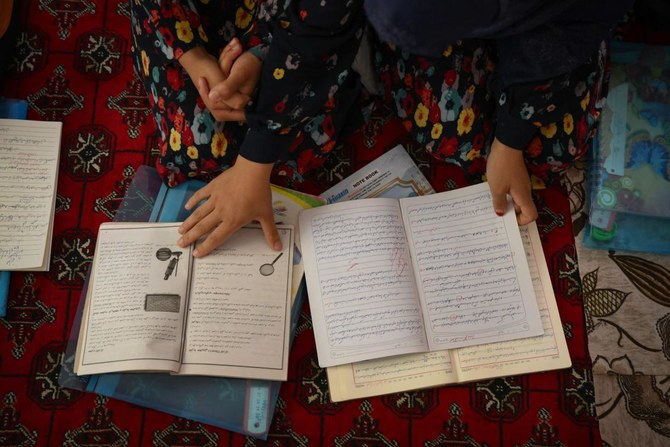
At a house in Kabul, dozens gathered on a recent day for classes in an informal school set up by Sodaba Nazhand. She and her sister teach English, science and math to girls who should be in secondary school.
“When the Taliban wanted to take away the rights of education and the rights of work from women, I wanted to stand against their decision by teaching these girls,” Nazhand said.
Hers is one of a number of underground schools in operation since the Taliban took over the country a year ago and banned girls from continuing their education past the sixth grade. While the Taliban have permitted women to continue attending universities, this exception will become irrelevant when there are no more girls graduating from high schools.
“There is no way to fill this gap, and this situation is very sad and concerning,” Nazhand said.
The relief agency Save the Children interviewed nearly 1,700 boys and girls between the ages of 9 and 17 in seven provinces to assess the impact of the education restrictions.
The survey, conducted in May and June and released Wednesday, found that more than 45 percent of girls are not going to school, compared with 20 percent of boys. It also found that 26 percent of girls are showing signs of depression, compared with 16 percent of boys.
Nearly the entire population of Afghanistan was thrown into poverty and millions were left unable to feed their families when the world cut off financing in response to the Taliban takeover.
Teachers, parents and experts all warn that the country’s multiple crises, including the devastating collapse of the economy, are proving especially damaging to girls. The Taliban have restricted women’s work, encouraged them to stay at home and issued dress codes requiring them to cover their faces, except for their eyes, though the codes are not always enforced.
The international community is demanding that the Taliban open schools for all girls, and the US and EU have created plans to pay salaries directly to Afghanistan’s teachers, keeping the sector going without putting the funds through the Taliban.
But the question of girls’ education appears to have been tangled in behind-the-scenes differences among the Taliban. Some in the movement support returning girls to school — whether because they see no religious objection to it or because they want to improve ties with the world. Others, especially rural, tribal elders who make up the backbone of the movement, staunchly oppose it.
During their first time ruling Afghanistan in the 1990s, the Taliban imposed much stricter restrictions on women, banning school for all girls, barring women from work and requiring them to wear an all-encompassing burka if they went outside.
In the 20 years after the Taliban were driven from power in 2001, an entire generation of women returned to school and work, particularly in urban areas. Seemingly acknowledging those changes, the Taliban reassured Afghans when they seized control again last year that they would not return to the heavy hand of the past.
Officials have publicly insisted that they will allow teen girls back into school, but say time is needed to set up logistics for strict gender segregation to ensure an “Islamic framework.”
Hopes were raised in March: Just before the new school year was to begin, the Taliban Education Ministry proclaimed everyone would be allowed back. But on March 23, the day of the reopening, the decision was suddenly reversed, surprising even ministry officials. It appeared that at the last minute, the Taliban’s supreme leader, Mullah Haibatullah Akhundzada, bowed to the opposition.
Underground schools present an alternative, though with limitations.
A month after the Taliban takeover, Nazhand started teaching street children to read with informal outdoor classes in a park in her neighborhood. Women who couldn’t read or write joined them, she said.
Some time later, a benefactor who saw her in the park rented a house for her to hold classes in, and bought tables and chairs. Once she was operating inside, Nazhand included teen girls who were no longer allowed to go to public school.
Now there are about 250 students, including 50 or 60 schoolgirls above sixth grade.
“I am not only teaching them school subjects, but also trying to teach them how to fight and stand for their rights,” Nazhand said.
The Taliban haven’t changed from their first time in power in the late 1990s, she said. “These are the same Taliban, but we shouldn’t be the same women of those years. We must struggle: by writing, by raising our voice, by any way possible.”
Nazhand’s school, and others like it, are technically illegal under the Taliban’s current restrictions, but so far they haven’t shut hers down. At least one other person operating a school declined to speak to reporters, however, fearing possible repercussions.
Despite her unwavering commitment, Nazhand worries about her school’s future. Her benefactor paid for six months’ rent on the house, but he died recently, and she doesn’t have any way to keep paying for rent or supplies.
For students, the underground schools are a lifeline.
“It is so hard when you can’t go to school,” said one of them, Dunya Arbabzada. “Whenever I pass by my school and see the closed door ... it’s so upsetting for me.”


![]()

Afghan girls face uncertain future one year after Taliban school ban
Short Url
https://arab.news/pptjp
Afghan girls face uncertain future one year after Taliban school ban
- Some are trying to find ways to keep education from stalling for a generation of young women
- Underground schools present an alternative, though with limitations


Latest updates


© 2026 SAUDI RESEARCH & PUBLISHING COMPANY, All Rights Reserved And subject to Terms of Use Agreement.