

‘Not bad!’: Swimming between continents in Istanbul

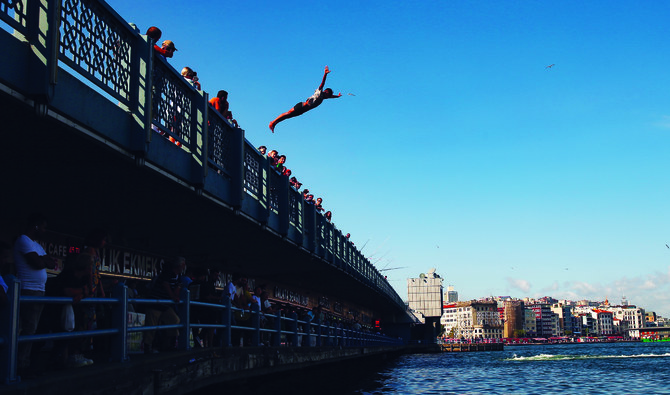
A youth jumps from the Galata Bridge into the Golden Horn leading to the Bosphorus Strait separating Europe and Asia in Istanbul. (AP)
Short Url
Updated 10 August 2022
Follow

‘Not bad!’: Swimming between continents in Istanbul

  • The bustling megalopolis between two continents and two seas does not immediately bring to mind images of a beach resort

ISTANBUL: Every morning, his skin bronzed by the sun, pensioner Metin Cakmakci rushes to grab a deckchair under a parasol on his local beach on the Asian side of Istanbul.

“A sea like this for a gigantic city such as Istanbul — it’s not bad,” the 74-year-old smiles, pointing to the crystal-clear water facing the Princes’ Islands on the Sea of Marmara.

Istanbul, a bustling megalopolis of 16 million people between two continents and two seas, does not immediately bring to mind images of a beach resort.

But just like the locals of New York, Beirut and a handful of other global cities, Istanbulites can swim all summer long and return home on the metro with sand trapped under their sandals and salt layering their skin.

“In the old days, you could access the water anywhere,” Cakmakci reminisces.

“Now, of course, you have buildings everywhere. The coastline has changed. We all now live on top of each other, in a way.”

Istanbul officials have added a hundred extra sun loungers to Cakmakci’s beach, creating room for 300 people under 170 parasols just 25 minutes’ walk from the pensioner’s home.

This year, attendance has shot up, says Sezgin Kocak, who oversees maintenance at the beach.

A large part of the spike stems from an economic crisis that has seen consumer prices soar by 80 percent in one year.

“A lot of people can’t afford to get out of Istanbul anymore,” explains Canan Civan, a bikini-clad bather in her sixties.

“But even if I had the money, I wouldn’t go anywhere else,” she adds.

“Instead of spending 10 days on holiday, I’d rather come here every day for three months.”

Istanbul has 85 accessible beaches or bathing spots between the Black Sea in the north, the Sea of Marmara in the south and the Bosphorus Strait in between.

Public or private, some attract a more traditional clientele who cover themselves up in veils, while others come out in bikinis, merrily exposing their skin.

Like Turkish society itself, the two often share the same space.

At other times, an invisible demarcation line appears. One such line is in the Sile neighborhood, where the Black Sea meets the northern edge of the Bosphorus Strait — the stretch of water dividing Turkey between its European and its Asian halves.

On the bikini side, Eren Bizmi is trying to start up a volleyball game with some friends from work.

“Istanbulites know you can find a beach 35, 40 minutes from the center,” the 32-year-old real estate agent says. He declares the Black Sea is best because it is “less salty” than the Sea of Marmara.

“And I can work at the same time,” adds Sema Basaran, the only woman in the volleyball game.

“If a client calls, I can go and show them a house and come back,” the 22-year-old grins.

No one mentions the two mines that washed up in this area earlier this year — a haunting reminder of the war pitting Ukraine against its Russian invaders on the far side of the Black Sea.

Finally, there are the bathers of the Bosphorus, who swim between Europe and Asia under the serene gaze of the city’s grand palaces.


UN humanitarian chief’s fresh funding call as Sudan crisis passes 1,000 days amid famine, mass displacement

Updated 6 sec ago
Follow

UN humanitarian chief’s fresh funding call as Sudan crisis passes 1,000 days amid famine, mass displacement

  • ‘Today we are signaling that the international community will work together to bring this suffering to an end,’ Tom Fletcher tells fundraising event in Washington
  • Sudan is a central pillar of the UN’s global humanitarian plan for 2026, which aims to save 87m lives worldwide, he adds

NEW YORK CITY: The UN on Tuesday launched a renewed appeal for funding and the political backing to address what it described as the catastrophic humanitarian crisis in Sudan, which has now been locked in civil war for more than 1,000 days.

Speaking at a fundraising event for Sudan in Washington, organized by the US Institute for Peace, the UN under-secretary-general for humanitarian affairs, Tom Fletcher, said the scale of the suffering in Sudan had reached intolerable levels marked by famine, mass displacement and widespread sexual violence against women and girls.

“The horrific humanitarian crisis in Sudan has endured more than 1,000 days — too long,” he said. “Too many days of famine, of brutal atrocities, of lives uprooted and destroyed.”

The global community was now united in its desire to halt the suffering and ensure life-saving aid reaches those most in need, Fletcher said.

“Today we are signaling that the international community will work together to bring this suffering to an end,” he added.

Sudan is a central pillar of the UN’s global humanitarian plan for 2026, which aims to save 87 million lives worldwide, Fletcher explained as he thanked donors, including the US, the EU and the UAE, for stepping forward.

“Sudan is the most important component of that plan,” he said, noting that humanitarian operations there have been chronically underfunded and plagued by danger. “We have lost hundreds of colleagues in Sudan, colleagues of incredible courage.”

The UN plans to provide food, medicine, water and sanitation services to more than 14 million people across Sudan this year, as well as protection for vulnerable groups, Fletcher said.

He stressed that funding alone would not be sufficient, however, and called for stronger measures to protect civilians and aid workers, secure humanitarian access and support a temporary truce between the warring factions.

“The money is not enough,” he said. “We need the air assets, the security, the medical support for our teams, and the mediation work that has to underpin the access.”

The UN will work, through the Sudan Humanitarian Initiative, with the so-called “Quad” group of international partners (the US, Egypt, Saudi Arabia and the UAE) and others to identify priority areas for urgent action and remove obstacles to the delivery of aid, Fletcher said.

He added that the UN seeks visible progress toward a humanitarian truce in Sudan within the next few weeks, and called for those guilty of any violations in the country to be held accountable.

“We have set a target date of the beginning of Ramadan to make visible progress on this work,” Fletcher said. Ramadan is expected to begin on or around Feb. 17 this year.

Quoting UN Secretary-General Antonio Guterres, he added that the urgency of ending the conflict was growing as the third anniversary of its outbreak on April 15, 2023, approaches.

“The guns must fall silent and a path to peace must be charted,” Fletcher said, adding that the UN fully supports efforts to secure a humanitarian truce and rapidly scale up aid across Sudan.

“Today, we’re saying, ‘Enough.’ Let today be the signal that the world is uniting in solidarity for practical impact.”