Libyan armed groups clash in Tripoli: reports

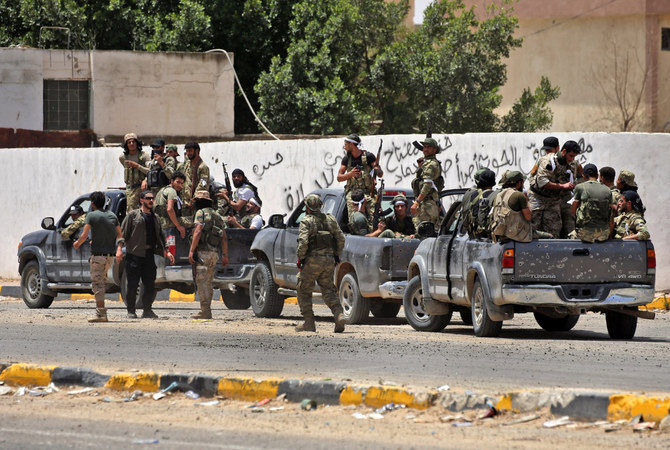
In this June 4, 2020 photo, fighters loyal to the UN-recognized Libyan Government of National Accord (GNA) deploy along a road in Tripoli. (AFP)
Short Url
Updated 06 August 2022
Follow

Libyan armed groups clash in Tripoli: reports

  • Saturday’s clashes were between armed groups loyal to PM Abdulhamid Dbeibah and his rival Fathi Bashagha
  • Tensions have been rising for months in Libya as two prime ministers vie for power

TRIPOLI: Clashes between armed groups erupted overnight in Tripoli, according to local media reports, the latest violence to hit the Libyan capital.
Gunfire and explosions were overhead around 1 a.m.  Saturday (2300 GMT) in the city.
The fighting, with light and heavy weapons, occurred in the El Jebs district in the city’s south, media reports said.
Tensions have been rising for months in Libya as two prime ministers vie for power, raising fears of renewed conflict two years after a landmark truce ended a ruinous attempt by eastern military chief Khalifa Haftar to seize Tripoli by force.
Saturday’s clashes were between armed groups loyal to Prime Minister Abdulhamid Dbeibah, head of the unity government based in Tripoli, and others following his rival Fathi Bashagha, named in February as prime minister by a parliament based in Libya’s east after he made a pact with Haftar.
The fighting ended when another group called the 444 Brigade intervened to mediate, according to Libyan media. There were no immediate reports of casualties.
Bashagha has failed in his attempts to oust Dbeibah, who has repeatedly asserted he will only hand over power to an elected government.
Tensions between armed groups loyal to the rival leaders have increased in recent months in Tripoli. On July 22, fighting in the heart of the city left 16 dead and about 50 wounded.
Dbeibah’s Government of National Unity was appointed as part of a United Nations-backed peace process to end more than a decade of violence in the North African country.
The transitional government had a mandate to lead the country to elections last December, but they never took place due to divisions over the rules and the presence of controversial candidates.
Libya has been gripped by insecurity since a NATO-backed uprising toppled and killed dictator Muammar Qaddafi in 2011, leaving a power vacuum armed groups have been wrangling for years to fill.


Hezbollah chief accuses Israel of ignoring ceasefire agreement

Updated 57 min 34 sec ago
Follow

Hezbollah chief accuses Israel of ignoring ceasefire agreement

  • Naim Qassem says moves to disarm his group in Lebanon are an 'Israeli-American plan'
  • Lebanese military is expected to complete Hezbollah’s disarmament south of Litani River as part of ceasefire

BEIRUT: Hezbollah leader Naim Qassem on Sunday said moves to disarm the group in Lebanon are an “Israeli-American plan,” accusing Israel of failing to abide by a ceasefire agreement sealed last year.
Under heavy US pressure and fears of expanded Israeli strikes, the Lebanese military is expected to complete Hezbollah’s disarmament south of the Litani River — located about 30 kilometers (19 miles) from the border with Israel — by the end of the year.
It will then tackle disarming the Iran-backed movement in the rest of the country.
“Disarmament is an Israeli-American plan,” Qassem said.
“To demand exclusive arms control while Israel is committing aggression and America is imposing its will on Lebanon, stripping it of its power, means that you are not working in Lebanon’s interest, but rather in the interest of what Israel wants.”
Despite a November 2024 ceasefire that was supposed to end more than a year of hostilities between Israel and the Iran-backed Hezbollah group, Israel has kept up strikes on Lebanon and has maintained troops in five areas it deems strategic.
According to the agreement, Hezbollah was required to pull its forces north of the Litani River and have its military infrastructure in the vacated area dismantled.
Israel has questioned the Lebanese military’s effectiveness and has accused Hezbollah of rearming, while the group itself has rejected calls to surrender its weapons.
“The deployment of the Lebanese army south of the Litani River was required only if Israel had adhered to its commitments... to halting the aggression, withdrawing, releasing prisoners, and having reconstruction commence,” Qassem said in a televised address.
“With the Israeli enemy not implementing any of the steps of the agreement... Lebanon is no longer required to take any action on any level before the Israelis commit to what they are obligated to do.”
Lebanese army chief Rodolphe Haykal told a military meeting on Tuesday “the army is in the process of finishing the first phase of its plan.”
He said the army is carefully planning “for the subsequent phases” of disarmament.