NEW DELHI: According to Forrest Gump, life is like a box of chocolates because “you never know what you’re going to get.” Now, an Indian remake of the movie has been hit by boycott calls over years-old comments by its Muslim star Aamir Khan.
It is the latest example of how Bollywood actors, particularly minority Muslims like Khan, are feeling increased pressure under Hindu nationalist Prime Minister Modi.
“Laal Singh Chaddha,” an Indian spin on the 1994 Hollywood hit with Tom Hanks, is expected to be one of India’s biggest films of 2022.
This is due in large part to its main star, 57-year-old Khan, one of the Indian industry’s most bankable actors with past blockbusters like “3 Idiots” (2009) and “Dangal” (2016).
But ahead of the August 11 release, the Internet is awash with clips from a 2015 interview when Khan expressed a growing “sense of fear” and that he and his then-wife discussed leaving India.
“She fears for her child. She fears about what the atmosphere around us will be. She feels scared to open the newspapers every day,” he said.
More than 200,000 tweets, many from supporters of Modi’s BJP party, have been shared since last month calling for people to spurn the movie with the hashtag #BoycottLaalSinghChaddha.
“Aamir Khan married two Hindu Women, yet named his kids Junaid, Azad & Ira. (Hindu co-star) Kareena (Kapoor) married a Muslim & promptly named her kids Taimur & Jehangir,” said one tweet, referring to the children’s typical Muslim names.
“That’s enough reasons to boycott Lal Singh Chaddha, basically a production from Bollywood’s Love Jihad club. #BoycottLaalSinghChaddha,” it added, using a derogatory term coined by Hindu nationalists who accuse Muslim men of marrying Hindu women and forcing them to convert.
Nicknamed “Mr Perfectionist,” Khan has been credited with pushing films beyond Bollywood’s traditional fare of song and dance into social and cultural issues.
He also hosted a TV chat show — “Satyamev Jayate” — that discussed touchy themes like rape, domestic violence and corruption.
The furor over his new film — which adapts Hanks’ famous line to say that “life is like a golgappa,” an Indian snack — is such that this week Khan stressed his patriotism, a key tenet of the Modi government.
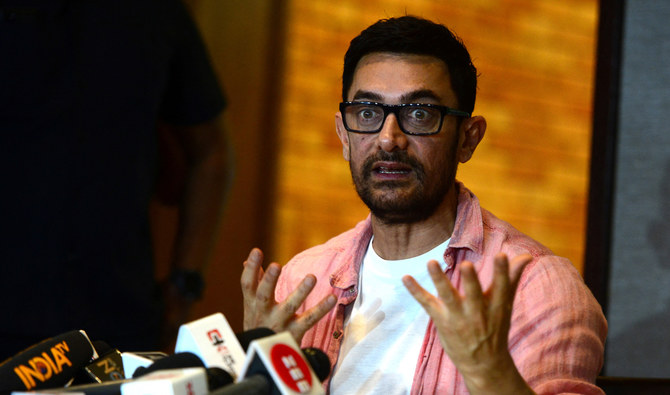
“I feel sad that some of the people... believe that I am someone who doesn’t like India,” he told local media.
“That’s not the case. Please don’t boycott my film. Please watch my film.”
Films have long sparked controversy — as well as violence — in the movie-mad country of 1.4 billion people.
But the heat being felt by Khan, one of a clutch of Muslim megastars in the industry along with Shah Rukh Khan and Salman Khan, mirrors growing intolerance, marginalization and vilification of the minority, commentators say.
“There is no doubt that Aamir is being targeted by those spreading hatred toward Muslims,” one commentator, who wished to remain anonymous for fear of becoming a target himself, told AFP.
Modi’s Bharatiya Janata Party (BJP) owes its origins to Rashtriya Swayamsevak Sangh (RSS), a militaristic group espousing “Hindutva,” or making India an exclusively Hindu state.
Lynchings of Muslims by Hindu mobs over so-called cow protection — a sacred animal for many Hindus — and other hate crimes have sown fear in the 200- million-strong Muslim population.
Social media is full of misinformation claiming that Muslims will soon outnumber Hindus — due to inter-religious marriages — or that the minority is a treasonous fifth column backed by Pakistan.
Critics say that the world’s most prolific film industry and its stars have been gradually changing their output to fit the government narrative since Modi came to power in 2014.
In 2019, the hagiographic “PM Narendra Modi” was too much even for the Election Commission, which delayed its release until after a vote that year.
There has been a recent string of military-themed movies that have been nationalistic, all-guns-blazing stories of heroics by soldiers and police — usually Hindus — against enemies outside and within India.
This year’s “The Kashmir Files,” about the fleeing of Hindus from Muslim-majority Kashmir in 1989-90, saw incidents of people in cinemas calling for revenge killings of Muslims.
Film critic and author Anna MM Vetticad said the methods to “subordinate India’s Muslims and Christians to the majority community... include demonizing these minorities, and constantly demanding proof of their patriotism.”
But little is expected to change.
“India’s tragedy is that a majority in Bollywood... are apathetic, opportunistic or afraid,” Vetticad told AFP.


![]()

Hindu nationalists push boycott of Bollywood ‘Forrest Gump’ remake
Short Url
https://arab.news/w5k4g
Hindu nationalists push boycott of Bollywood ‘Forrest Gump’ remake
- Latest example of Bollywood actors, particularly minority Muslims, feeling increased pressure under Hindu nationalist PM Modi
- “Laal Singh Chaddha,” Indian spin on 1994 Hollywood hit with Tom Hanks, expected to be one of India’s biggest films of 2022
Latest updates


Recommended


© 2026 SAUDI RESEARCH & PUBLISHING COMPANY, All Rights Reserved And subject to Terms of Use Agreement.