

Yemeni army officer killed in clashes with Houthis

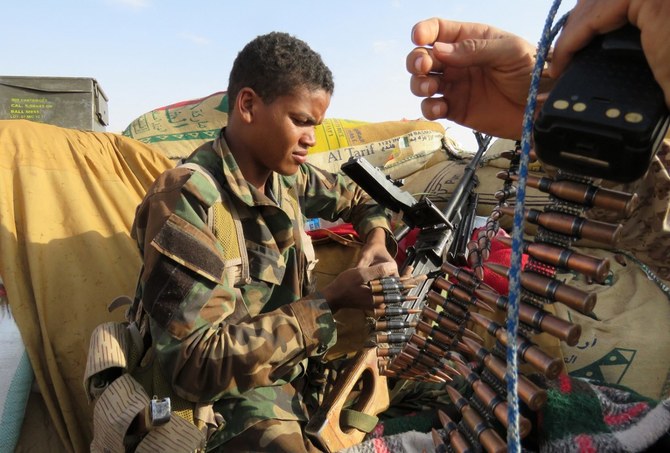
Local media reports and officials said that the Yemeni military leader was killed outside the city of Marib while pushing back a Houthi attack. (AFP file photo)
Short Url
Updated 03 August 2022
Follow

Yemeni army officer killed in clashes with Houthis

A Yemeni army officer was killed in clashes with Iran-backed Houthis as the warring sides agreed to renew a two-month truce expiring on Tuesday.

Local media reports and officials said that Abdullah Al-Akara Al-Jahami, a military leader on the Marib battlefield and the security chief of Serwah district in Marib province, was killed outside the city of Marib while pushing back a Houthi attack.

“This truce extension includes a commitment from the parties to intensify negotiations to reach an expanded truce agreement as soon as possible,” special envoy for Yemen Hans Grundberg said in a statement.

“In the coming weeks, I will intensify my engagements with the parties to ensure the full implementation of all the parties’ obligations in the truce,” Grundberg added.

The latest escalation in fighting came as a group of Omani mediators left Sanaa after meeting the Houthi movement’s leader, Abdul Malik Al-Houthi, and the head of the Supreme Political Council, Mahdi Al-Mashat.

According to the militia, talks focused on reinforcing the humanitarian and military truce, paying public servants and proposals for ending the war, but there was no mention of any significant outcome.

Local and international aid organizations, as well as foreign diplomats, said that the level of violence has fallen significantly in Yemen during the truce, as thousands of Yemenis traveled on commercial flights from Houthi-held Sanaa to Cairo and Amman.

Fuel ships that docked at Hodeidah port delivered urgently needed supplies to hospitals and businesses in Houthi-controlled areas.

Meanwhile, the Yemeni Landmine Monitor said that since April 2, the first day of the truce, 168 civilians have been killed or wounded by land mines or unexploded ordnance planted by the militia.

Fifty-seven civilians, including 28 children and four women, have been killed and 111, including 47 children and eight women, wounded by Houthi land mines in the past four months, mainly in Hodeidah, Taiz, Hajjah, Al-Bayda, Saada and other areas.

Thousands of mines planted by the Houthis have also threatened farms, ruined or damaged properties, and prevented thousands of internally displaced people from returning to their homes.


UN rights chief Shocked by ‘unbearable’ Darfur atrocities

Updated 18 January 2026
Follow

UN rights chief Shocked by ‘unbearable’ Darfur atrocities

  • Mediation efforts have failed to produce a ceasefire, even after international outrage intensified last year with reports of mass killings, rape, and abductions during the RSF’s takeover of El-Fasher in Darfur

PORT SUDAN: Nearly three years of war have put the Sudanese people through “hell,” the UN’s rights chief said on Sunday, blasting the vast sums spent on advanced weaponry at the expense of humanitarian aid and the recruitment of child soldiers.
Since April 2023, Sudan has been gripped by a conflict between the army and the paramilitary Rapid Support Forces that has left tens of thousands of people dead and around 11 million displaced.
Speaking in Port Sudan during his first wartime visit, UN Human Rights commissioner Volker Turk said the population had endured “horror and hell,” calling it “despicable” that funds that “should be used to alleviate the suffering of the population” are instead spent on advanced weapons, particularly drones.
More than 21 million people are facing acute food insecurity, and two-thirds of Sudan’s population is in urgent need of humanitarian aid, according to the UN.
In addition to the world’s largest hunger and displacement crisis, Sudan is also facing “the increasing militarization of society by all parties to the conflict, including through the arming of civilians and recruitment and use of children,” Turk added.
He said he had heard testimony of “unbearable” atrocities from survivors of attacks in Darfur, and warned of similar crimes unfolding in the Kordofan region — the current epicenter of the fighting.
Testimony of these atrocities must be heard by “the commanders of this conflict and those who are arming, funding and profiting from this war,” he said.
Mediation efforts have failed to produce a ceasefire, even after international outrage intensified last year with reports of mass killings, rape, and abductions during the RSF’s takeover of El-Fasher in Darfur.
“We must ensure that the perpetrators of these horrific violations face justice regardless of the affiliation,” Turk said on Sunday, adding that repeated attacks on civilian infrastructure could constitute “war crimes.”
He called on both sides to “cease intolerable attacks against civilian objects that are indispensable to the civilian population, including markets, health facilities, schools and shelters.”
Turk again warned on Sunday that crimes similar to those seen in El-Fasher could recur in volatile Kordofan, where the RSF has advanced, besieging and attacking several key cities.
Hundreds of thousands face starvation across the region, where more than 65,000 people have been displaced since October, according to the latest UN figures.