

A look at the missile that killed Al-Qaeda leader Ayman Al-Zawahri

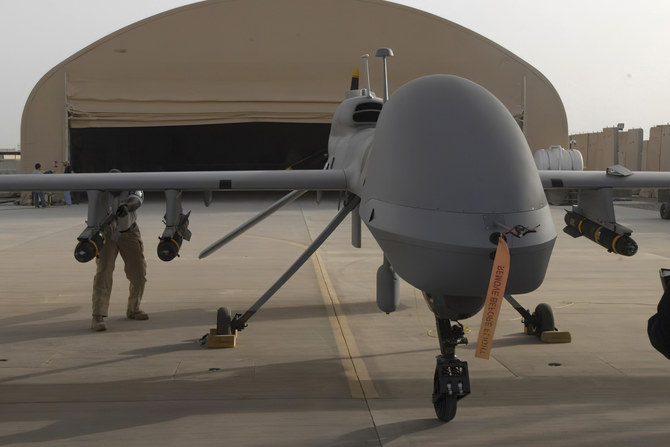
In this image provided by the U.S. Army, contactors from General Atomics load Hellfire missiles onto an MQ-1C Gray Eagle at Camp Taji, Iraq, on Feb. 27, 2011. (AP/File)
Short Url
Updated 03 August 2022
Follow

A look at the missile that killed Al-Qaeda leader Ayman Al-Zawahri

  • US carefully chose to use a type of Hellfire missile that greatly minimized the chance of other casualties
  • Likely highly secretive Hellfire R9X, know by various nicknames like “knife bomb” or “flying Ginsu,” was used

WASHINGTON: For a year, US officials have been saying that taking out a terrorist threat in Afghanistan with no American troops on the ground would be difficult but not impossible. Last weekend, the US did just that — killing Al-Qaeda leader Ayman Al-Zawahri with a CIA drone strike.

Other high-profile airstrikes in the past had inadvertently killed innocent civilians. In this case, the US carefully chose to use a type of Hellfire missile that greatly minimized the chance of other casualties. Although US officials have not publicly confirmed which variant of the Hellfire was used, experts and others familiar with counterterrorism operations said a likely option was the highly secretive Hellfire R9X — know by various nicknames, including the “knife bomb” or the “flying Ginsu.”

That potential use of the R9X, said Klon Kitchen, senior fellow at the American Enterprise Institute and a former intelligence analyst, suggests the US wanted to kill Al-Zawahri with “limited likelihood of collateral death and destruction and for other relevant political reasons.”

A look at the Hellfire, and how Al-Zawahri likely was killed:

WHAT IS A HELLFIRE MISSILE?

Originally designed as an anti-tank missile in the 1980s, the Hellfire has been used by military and intelligence agencies over the last two decades to strike targets in Iraq, Afghanistan, Yemen and elsewhere.

The precision-guided missiles can be mounted on helicopters and unmanned drones and are used widely in combat around the world. More than 100,000 Hellfire missiles have been sold to the US and other countries, according to Ryan Brobst, an analyst at the Foundation for the Defense of Democracies, a Washington think tank.

“It can do enough damage to destroy most targets such as vehicles and buildings while not doing enough damage to level city blocks and cause significant civilian casualties,” Brobst said.

The US military has routinely used Hellfire missiles to kill high-value targets, including a senior Al-Qaeda leader in Syria last year, and Al-Qaeda propagandist Anwar Al-Awlaki in Yemen in 2011.

WHAT KILLED AL-ZAWAHRI?

The US had multiple options for the attack. It could have used a traditional Hellfire, a bomb dropped from an manned aircraft, or a far more risky assault by ground forces. US Navy SEALs, for example, flew into Pakistan on helicopters and took out Osama bin Laden in a raid.

In this case, the CIA opted for a drone strike. And while the CIA generally doesn’t confirm its counterterrorism missions and closely guards information about strikes it conducts, US government officials have said that two Hellfire missiles were fired at the balcony of the building where Al-Zawahri was living in Kabul.

Online images of the building show damage to the balcony, where the US says Al-Zawahri was, but the rest of the house is standing and not badly damaged.

Unlike other models of the Hellfire, the R9X doesn’t carry an explosive payload. Instead, it has a series of six rotating blades that emerge on its final approach to a target, Kitchen said. “One of their utilities is in opening up vehicles and other obstructions to get to the target without having to use an explosive warhead,” he said.

AVOIDING CIVILIAN CASUALTIES

US officials and experts made clear this week that avoiding civilian casualties was a crucial element in the choice of weapon.

Less than a year ago, a US drone strike — using a more conventional Hellfire missile — struck a white Toyota Corolla sedan in a Kabul neighborhood and killed 10 civilians around and near the car, including seven children. In the midst of the chaotic US military withdrawal from Afghanistan, American forces believed there were explosives in the car and that it posed an imminent threat to troops on the ground. It was, military leaders said, a “tragic mistake”

One former US official said the likely choice of an R9X is an example of the administration’s effort to find ways to minimize collateral damage and prevent the loss of innocent life. That missile is a very accurate weapon that strikes in a very small area, said the official, who spoke on condition of anonymity to discuss counterterrorism operations.

An administration official said Monday that the US investigated the construction of the house where Al-Zawahri was staying in order to ensure that the operation could be done without threatening the structural integrity of the building and also minimizing the risks of killing civilians, including members of his family who were in other parts of the house.

The choice of missile is ultimately one part of reducing the possibility of killing civilians or causing other collateral damage.

“I would say this is by far a lower-risk option,” said Tom Karako, an expert on missile defense at the Washington-based Center for Strategic and International Studies. Using the Hellfire, he said, “reflects a high degree of caution as opposed to a riskiness.”

IS THE US PROVIDING UKRAINE WITH DRONES THAT CAN FIRE HELLFIRE MISSILES?

No. While the US has delivered billions of dollars in military assistance to help Ukraine fight the invading Russian troops, it is wary of providing weapons that could fire deep into Russia, potentially escalating the conflict or drawing the US into the war.

As a result, the US so far has not provided Hellfire missiles or drones that could fire them. Instead, the US has delivered smaller, so-called kamikaze drones, such as the Switchblade and Phoenix Ghost, which instead of firing missiles, explode when they hit a target.


Bangladesh sets February date for first vote since 2024 mass uprising

Updated 59 min 23 sec ago
Follow

Bangladesh sets February date for first vote since 2024 mass uprising

  • At least 1,400 protesters were killed in violent crackdown under ex-PM Hasina’s rule
  • Interim government promises ‘all necessary support’ for upcoming elections

DHAKA: Bangladesh will hold national elections on Feb. 12, its chief election commissioner has announced, setting the timeline for the nation’s first vote since a student-led uprising that ousted long-serving Prime Minister Sheikh Hasina.

Hasina, whose Awami League party-led government was marred by allegations of human rights violations, rigged elections and corruption, was removed from office in August last year after 15 uninterrupted years in power.

Bangladesh has since been led by interim leader Muhammad Yunus, a Nobel Prize-winning economist, who took over governance after Hasina fled to India, where she is now in self-exile.

In a televised address on Thursday, chief election commissioner A.M.M. Nasir Uddin confirmed the voting date to elect 300 lawmakers and said a national referendum on political reforms would also be held on the same day.

“It’s a relief for the voters; it’s a relief for the country. It’s a relief for the investors, it’s a relief for the development partners and for the political parties and the people who did a massive job in July 2024 by sacrificing their lives and limbs to oust a tyranny,” said Prof. A.S.M. Amanullah, political analyst and vice chancellor of the National University in Dhaka.

Mass protests that broke out in 2024 began in early July as peaceful demonstrations, triggered by the reinstatement of a quota system for the allocation of civil service positions.

Two weeks later, they were met with a communications blackout and a violent crackdown by security forces.

A special tribunal in Dhaka found Hasina guilty of allowing lethal force to be used against the protesters, at least 1,400 people of whom died, according to estimates from the UN’s human rights office.

After a months-long trial, she was sentenced to death in November for crimes against humanity.

The February elections will take place in the aftermath of Hasina’s reign, with the Yunus-led administration banning all activities of Awami League, meaning the former ruling party would not be able to join the race next year.

Minor political tensions now revolve around the more than 40 million voters of the Awami League, as the public speculate “how they would move, in which party they would support or whether they would remain silent,” Amanullah said.

“(But) if you consider other than Awami League, if we consider the other political parties, I think the other political parties are sufficient, you know, to make the next poll participatory, and free and fair.”

Bangladesh last held elections in January 2024, which saw Hasina return to office for a fourth consecutive term. That vote was boycotted by the country’s main opposition parties, which accused her administration of rigging the polls.

“There is a growing demand within the society and in the community that they would cast their first vote after almost 15, 16 years. And that would be an (occasion) of big national celebration,” Amanullah said.

In February, more than 127.6 million Bangladeshis will be eligible to cast their vote. It will be Bangladesh’s 13th election since the country gained independence in 1971.

The long-awaited election process now begins with the filing of nominations from Dec. 12 to 29, which will then be reviewed over the following six days. The last date for withdrawing nominations is Jan. 20.

After the voting date was announced, Yunus pledged to “provide all necessary support” to encourage festivity, participation and fairness in the upcoming polls.

“After the historic mass uprising (last year), the country is now moving toward a new path,” he said in a statement. “This election and referendum will consolidate that trajectory, prioritize the will of the people and further strengthen the foundation of a new Bangladesh.”

For Malaika Nur, a 24-year-old Dhaka University student who took part in the 2024 protests, the elections are an opportunity for young people to formally take part in politics.

“Young people have been showing much interest in politics since July 2024. They showed us how the youth can reshape a country’s political condition. If they have a few seats in the parliament, it can be a game-changer for the future of politics in Bangladesh,” she said.

“I hope this election will be different from the last three elections held in the previous regime. There will be a festive mood, people will cast their valuable votes and will get to choose their representative … I hope the elected government will ensure safety and basic rights of every citizen, and will hold fair elections in the future and will not become another fascist.”