

China says military drills around Taiwan Strait ‘necessary and just’

1 / 2
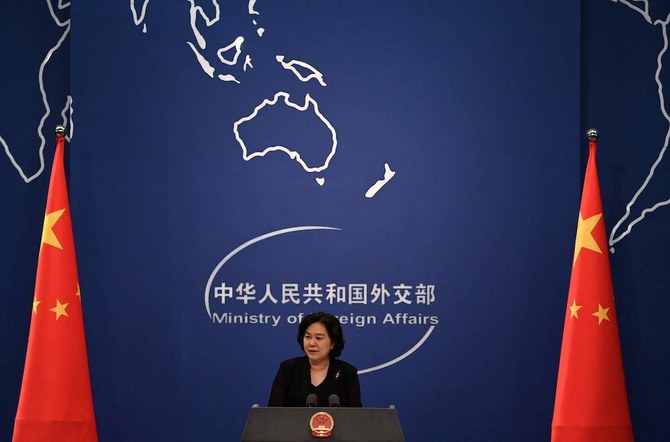
Chinese foreign ministry spokeswoman Hua Chunying said the military exercises were necessary to ‘resolutely protect national sovereignty.’ (AFP)
2 / 2
Pelosi’s visit to Taipei has been fiercely criticized by China. (Reuters)
Short Url
Updated 03 August 2022
Follow

China says military drills around Taiwan Strait ‘necessary and just’

  • Pelosi’s visit to Taipei has been fiercely criticized by China

BEIJING/TAIPEI: China insisted Wednesday its military exercises around the Taiwan Strait were “necessary and just” in the wake of US House Speaker Nancy Pelosi’s visit to the self-ruled island.

“The Chinese military’s conducting of military exercises in the sea near China’s Taiwan are a necessary and just measure to resolutely protect national sovereignty,” foreign ministry spokeswoman Hua Chunying told a regular briefing.

The United States wants Taiwan to always have freedom with security and will not back away from that, US House of Representatives Speaker Nancy Pelosi said on Wednesday, during a visit to Taipei fiercely criticized by China.

While respecting the “One China” policy, our solidarity with Taiwan is more important than ever, Pelosi said, during a joint news conference with Taiwan President Tsai Ing-wen. The US supports the status quo and does not want anything to happen to Taiwan by force, Pelosi added.

Asked about the economic consequences Taiwan has to face as a result of her visit, Pelosi said the US’ chips act opens the door for better economic exchanges between the United States and Taiwan.

Taiwan is committed to maintaining the status quo across the Taiwan strait, Tsai said, adding that China’s military exercises, launched in response to Pelosi’s visit are an unnecessary reaction.

Chinese Foreign Minister Wang Yi meanwhile vowed Wednesday to punish those who offend Beijing, state media reported, as the country seethes over Pelosi’s visit to Taiwan.

“This is a complete farce. The United States is violating China’s sovereignty under the guise of so-called ‘democracy’... those who offend China will be punished,” Wang said on the sidelines of a meeting of the Association of Southeast Asian Nations in Phnom Penh.


8 in 10 British Muslims face ‘financial faith penalty’ when seeking home finance, survey finds

Updated 5 sec ago
Follow

8 in 10 British Muslims face ‘financial faith penalty’ when seeking home finance, survey finds

  • Restricted choices plague potential buyers

LONDON: Eight in 10 British Muslims say their home finance choices are restricted because of their faith, according to a new national survey that highlighted what researchers describe as a growing “financial faith penalty” in the UK housing market.

The report, published by Islamic home finance fintech firm Offa, found that 80 percent of Muslim respondents believe their religious beliefs limit their access to suitable home finance, while those who do use Islamic products often face slower decisions, heavier paperwork and poorer customer experiences than in the conventional mortgage market.

Based on surveys of 1,000 British Muslims conducted by Muslim Census, and 2,000 non-Muslims carried out by OnePoll, the research calls on providers, brokers and policymakers to modernize Islamic home finance and improve access to Sharia-compliant products.

Among the 24.3 percent of British Muslims who have used Islamic home finance, just 5 percent said they had received a same-day decision.

Some 62 percent waited up to two weeks, while 33 percent waited more than 15 days, including 16 percent who waited over a month.

Long decision times were cited as the biggest challenge by 28 percent of respondents, followed by excessive paperwork (22.6 percent) and poor customer service (18.9 percent).

Islamic home finance differs from conventional mortgages by avoiding interest and steering investment away from sectors considered harmful to society, including gambling, alcohol, tobacco, arms trading and animal testing.

Sagheer Malik, chief commercial officer and managing director of home finance at Offa, said the findings showed British Muslims were being underserved by outdated systems.

Malik said: “Property is the asset class of choice for many of the UK’s 3.87 million Muslims, both as a route to generational wealth and as a long-term financial foundation, yet our insightful research report reveals that British Muslims are being underserved and deterred by slow, outdated and opaque Islamic home finance provision.

“This is not a niche concern. It goes to the heart of financial fairness and inclusion in modern Britain.”

He added that Muslims deserved Sharia-compliant products that matched mainstream standards on “price, speed and simplicity.”

Despite strong demand, uptake remains low.

Only 12.8 percent of British Muslims surveyed said they currently use Islamic home finance, with a further 11.5 percent having done so in the past. More than three quarters (75.7 percent) have never used it.

Faith plays a central role in financial decisions, with 94.2 percent saying it is important that their financial products align with their ethical or religious beliefs. Yet more than half of those using conventional mortgages said they felt unhappy or uneasy about doing so because of their faith.

The study also found that British Muslims share similar home ownership aspirations to the wider population, with 79.1 percent citing the desire to provide a stable home for their family, while 18.6 percent said building generational wealth was their main motivation. Only 2.2 percent said they did not want to own a home.

The report suggests Islamic finance could appeal beyond Muslim communities. While 64 percent of non-Muslim respondents had never heard of Islamic home finance, 63 percent said they favored its ethical principles once explained.

Younger generations were the most receptive, with 43 percent of Generation Z and 37 percent of millennials saying they would consider using Islamic home finance, compared with just 7 percent of baby boomers. More than three quarters of Gen Z and 72 percent of millennials also said it was important that their finance provider avoided investing in ethically harmful sectors.

Offa said the findings pointed to an opportunity to expand ethical finance in the UK, provided the industry can deliver faster, simpler and more transparent services.