

TRSP 5th anniversary: Five years of firsts at The Red Sea Project

Short Url
Updated 31 July 2022
Follow

TRSP 5th anniversary: Five years of firsts at The Red Sea Project

  • Throughout its short journey, The Red Sea Project achieved significant milestones

RIYADH: Since it was announced to the public five years ago, The Red Sea Project was set to be a pioneer.

It was the first of its kind in the Kingdom. A tourism project designed to provide responsible tourism while developing pristine islands that were untouched for centuries.

It introduced the concept of regenerative tourism where the developers and operators should focus on not only preserving what's there, but adding to it.

Throughout its short journey, TRSP achieved significant milestones.

Not only is it achieving tangible progress and getting closer to bringing its vision to reality, but its positive impact is noticeable, in line with Vision 2030.

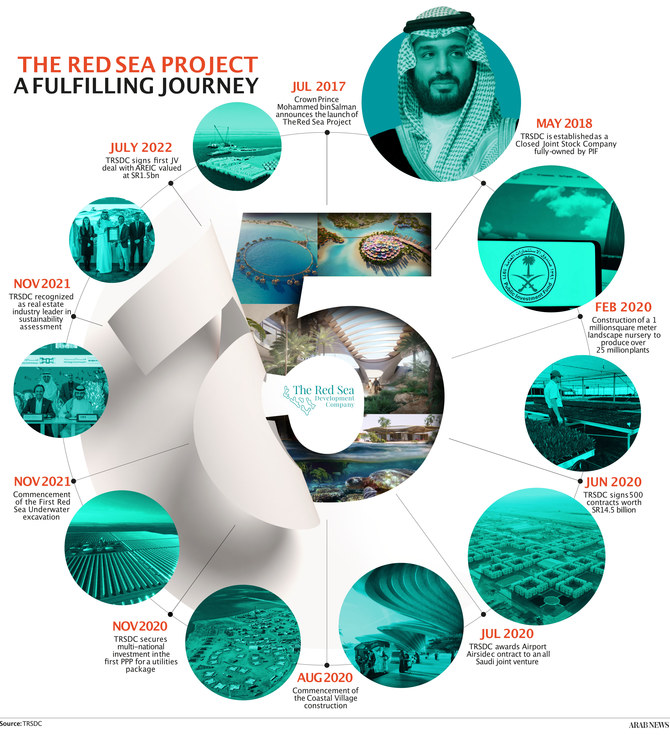
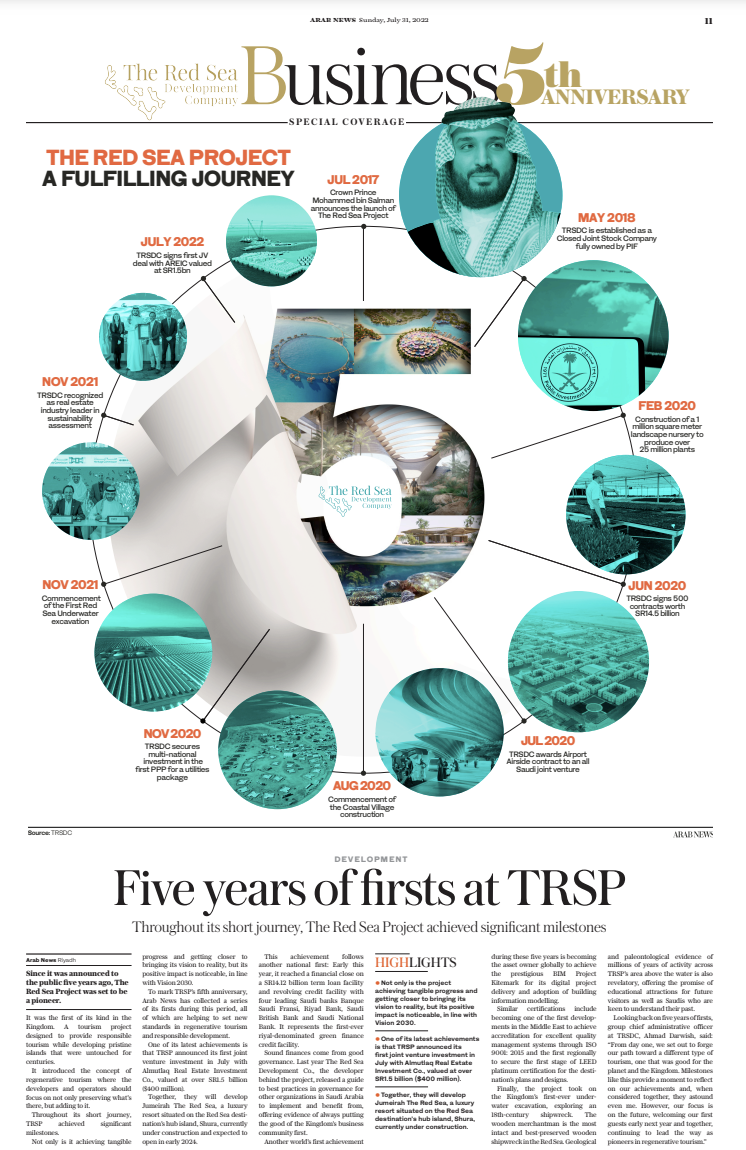
To mark TRSP’s fifth anniversary, Arab News has collected a series of its firsts during this period, all of which are helping to set new standards in regenerative tourism and responsible development.

HIGHLIGHTS

• Not only is the project achieving tangible progress and getting closer to bringing its vision to reality, but its positive impact is noticeable, in line with Vision 2030.

• One of its latest achievements is that TRSP announced its first joint venture investment in July with Almutlaq Real Estate Investment Co., valued at over SR1.5 billion ($400 million).

• Together, they will develop Jumeirah The Red Sea, a luxury resort situated on the Red Sea destination’s hub island, Shura, currently under construction.

One of its latest achievements is that TRSP announced its first joint venture investment in July with Almutlaq Real Estate Investment Co, valued at over SR1.5 billion ($400 million).

Together, they will develop Jumeirah The Red Sea, a luxury resort situated on the Red Sea destination’s hub island, Shura, currently under construction and expected to open in early 2024.

This achievement follows another national first: early this year, it reached a financial close on a SR14.12 billion term loan facility and revolving credit facility with four leading Saudi banks Banque Saudi Fransi, Riyad Bank, Saudi British Bank and Saudi National Bank. It represents the first-ever riyal-denominated green finance credit facility.

Sound finances come from good governance. Last year The Red Sea Development Co., the developer behind the project, released a guide to best practices in governance for other organizations in Saudi Arabia to implement and benefit from, offering evidence of always putting the good of the Kingdom’s business community first.

Another world’s first achievement during these five years is becoming the asset owner globally to achieve the prestigious BIM Project Kitemark for its digital project delivery and adoption of Building Information Modelling.

Similar certifications include becoming one of the first developments in the Middle East to achieve accreditation for excellent quality management systems through ISO 9001: 2015 and the first regionally to secure the first stage of LEED platinum certification for the destination’s plans and designs.

Finally, the project took on the Kingdom’s first-ever underwater excavation, exploring an 18th-century shipwreck. The wooden merchantman is the most intact and best-preserved wooden shipwreck in the Red Sea. Geological and paleontological evidence of millions of years of activity across TRSP’s area above the water is also revelatory, offering the promise of educational attractions for future visitors as well as Saudis who are keen to understand their past.

Looking back on five years of firsts, group chief administrative officer at TRSDC, Ahmad Darwish, said: “From day one, we set out to forge our path towards a different type of tourism, one that was good for the planet and the Kingdom. Milestones like this provide a moment to reflect on our achievements and, when considered together, they astound even me. However, our focus is on the future, welcoming our first guests early next year and together, continuing to lead the way as pioneers in regenerative tourism.”

First EU–Saudi roundtable on critical raw materials reflects shared policy commitment

Updated 16 January 2026
Follow

First EU–Saudi roundtable on critical raw materials reflects shared policy commitment

RIYADH: The EU–Saudi Arabia Business and Investment Dialogue on Advancing Critical Raw Materials Value Chains, held in Riyadh as part of the Future Minerals Forum, brought together senior policymakers, industry leaders, and investors to advance strategic cooperation across critical raw materials value chains.

Organized under a Team Europe approach by the EU–GCC Cooperation on Green Transition Project, in coordination with the EU Delegation to Saudi Arabia, the European Chamber of Commerce in the Kingdom and in close cooperation with FMF, the dialogue provided a high-level platform to explore European actions under the EU Critical Raw Materials Act and ResourceEU alongside the Kingdom’s aspirations for minerals, industrial, and investment priorities.

This is in line with Saudi Vision 2030 and broader regional ambitions across the GCC, MENA, and Africa.

ResourceEU is the EU’s new strategic action plan, launched in late 2025, to secure a reliable supply of critical raw materials like lithium, rare earths, and cobalt, reducing dependency on single suppliers, such as China, by boosting domestic extraction, processing, recycling, stockpiling, and strategic partnerships with resource-rich nations.

The first ever EU–Saudi roundtable on critical raw materials was opened by the bloc’s Ambassador to the Kingdom, Christophe Farnaud, together with Saudi Deputy Minister for Mining Development Turki Al-Babtain, turning policy alignment into concrete cooperation.

Farnaud underlined the central role of international cooperation in the implementation of the EU’s critical raw materials policy framework.

“As the European Union advances the implementation of its Critical Raw Materials policy, international cooperation is indispensable to building secure, diversified, and sustainable value chains. Saudi Arabia is a key partner in this effort. This dialogue reflects our shared commitment to translate policy alignment into concrete business and investment cooperation that supports the green and digital transitions,” said the ambassador.

Discussions focused on strengthening resilient, diversified, and responsible CRM supply chains that are essential to the green and digital transitions.

Participants explored concrete opportunities for EU–Saudi cooperation across the full value chain, including exploration, mining, and processing and refining, as well as recycling, downstream manufacturing, and the mobilization of private investment and sustainable finance, underpinned by high environmental, social, and governance standards.

From the Saudi side, the dialogue was framed as a key contribution to the Kingdom’s industrial transformation and long-term economic diversification agenda under Vision 2030, with a strong focus on responsible resource development and global market integration.

“Developing globally competitive mineral hubs and sustainable value chains is a central pillar of Saudi Vision 2030 and the Kingdom’s industrial transformation. Our engagement with the European Union through this dialogue to strengthen upstream and downstream integration, attract high-quality investment, and advance responsible mining and processing. Enhanced cooperation with the EU, capitalizing on the demand dynamics of the EU Critical Raw Materials Act, will be key to delivering long-term value for both sides,” said Al-Babtain.

Valere Moutarlier, deputy director-general for European industry decarbonization, and directorate-general for the internal market, industry, entrepreneurship and SMEs at European Commission, said the EU Critical Raw Materials Act and ResourceEU provided a clear framework to strengthen Europe’s resilience while deepening its cooperation with international partners.

“Cooperation with Saudi Arabia is essential to advancing secure, sustainable, and diversified critical raw materials value chains. Dialogues such as this play a key role in translating policy ambitions into concrete industrial and investment cooperation,” she added.