

After Kabul trip, Pakistani clerics' delegation says ‘positive’ Taliban will reopen girls’ schools soon

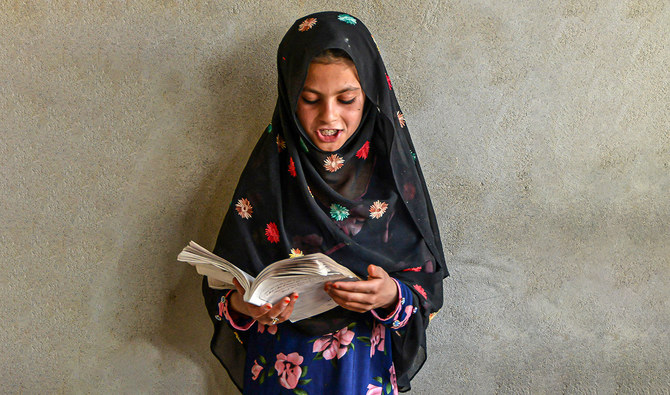
An Afghan girl reads a book inside a private educational center in Panjwai district of Kandahar, Afghanistan, on June 7, 2022. (AFP/File)
Short Url
Updated 30 July 2022
Follow

After Kabul trip, Pakistani clerics' delegation says ‘positive’ Taliban will reopen girls’ schools soon

  • Allowing girls and women into schools has been one of the key demands the international community has made of the Taliban
  • Pakistani scholars met Afghanistan’s acting PM, interior minister and top education officials this week

PESHAWAR: A prominent member of a delegation of Pakistani religious scholars who visited Kabul this week told Arab News on Saturday the Afghan Taliban were likely to reopen high schools for female students soon.

Allowing girls and women into schools and colleges has been one of the key demands the international community has made of the Taliban since they took control of Afghanistan in August last year.

In mid-March, after months of uncertainty, the Taliban said they would let girls around the country to return to class, but eventually backtracked on the announcement, saying high schools would remain closed for female students until the government prepared a plan in accordance with Islamic law to allow them back.

The Pakistani delegation of religious scholars was in Kabul to push forward the ongoing peace process between Islamabad and the outlawed Tehreek-e-Taliban Pakistan (TTP) militant group. The TTP, which has carried out some of the bloodiest attacks inside Pakistan since 2007, is not directly affiliated with the Afghan Taliban, but the latter have been engaged in mediation between the group and the Pakistani government.

Hafiz Salman Ul Haq Haqqani, deputy administrator of Dar al-Ulum Haqqania, an Islamic seminary in Akora Khattak, Khyber Pakhtunkhwa province, who was part of the delegation, said that besides the TTP talks, the top agenda of the trip was women’s education in Afghanistan, and they had held “very productive meetings” with Afghanistan’s acting Prime Minister Mullah Mohammad Hasan Akhund, acting Interior Minister Sirajuddin Haqqani, and acting Education Minister Noorullah Munir, as well as other education ministry officials.

“Our focus in those meetings was allowing girls to attend schools and we got positive response,” Haqqani told Arab News.

The Haqqania school is known as one of the oldest seminaries, and many Taliban leaders have educational links to it.

“During our meetings, scholars from the Pakistani side presented before the Afghan side convincing arguments in support of girls’ education. We told them an educated female in Pakistan has translated the Holy Qur’an in other languages such as Pashto. The Afghan side listened to us patiently and they hinted to open all girls’ schools and colleges very soon,” Haqqani said.

Maulvi Ahmad Taqi, a senior official at Afghanistan’s Ministry of Higher Education, told Arab News that Pakistani religious scholars held a series of meetings with Afghan education officials.

“I hope the meetings were positive and will lead to the opening of all girls’ schools,” he said. “Universities for females are though opened but girls of all age groups will soon be going to schools and colleges.”


Pakistan cabinet reviews private Hajj policy as mandatory pilgrim training enforced

Updated 10 sec ago
Follow

Pakistan cabinet reviews private Hajj policy as mandatory pilgrim training enforced

  • Cabinet sends draft Private Hajj Policy 2027–2030 to committee for further review
  • Religion minister warns pilgrims who skip mandatory training will be barred from Hajj

ISLAMABAD: Pakistan’s federal cabinet on Wednesday reviewed proposals for stricter oversight of private Hajj operators, as authorities separately warned that pilgrims who failed to complete mandatory training would be barred from performing Hajj next year.

The cabinet, chaired by Prime Minister Shehbaz Sharif, was briefed on a draft Private Hajj Policy for 2027–2030, which includes third-party registration and scrutiny of private Hajj operator companies, according to a statement from the Prime Minister’s Office.

“The Federal Cabinet directed that the draft Private Hajj Policy 2027–2030, presented by the Ministry of Religious Affairs and Interfaith Harmony regarding third-party registration and scrutiny of private Hajj operators’ companies, be referred to the Hajj Policy Committee for further deliberation in light of the views of Cabinet members,” the prime minister’s office said in a statement.

The development comes as Religious Affairs Minister Sardar Muhammad Yousaf said on Wednesday pilgrims who failed to attend both phases of mandatory Hajj training would not be allowed to perform the pilgrimage.

“Pilgrims who do not complete mandatory Hajj training will be barred from performing Hajj,” the ministry quoted Yousaf as saying during a training workshop in Islamabad.

Around 120,000 pilgrims are currently undergoing training at 200 locations nationwide, with the second phase scheduled to begin after Ramadan. The training aims to familiarize pilgrims with Saudi laws, Hajj rituals and safety protocols to prevent accidents in crowded areas.

Saudi Arabia has allocated 179,210 pilgrims to Pakistan for Hajj 2026, including about 118,000 seats under the government scheme, while the remainder will be handled by private tour operators.

Under Pakistan’s government Hajj package, the estimated cost ranges from Rs1.15 million to Rs1.25 million ($4,049.93 to $4,236), subject to final agreements with service providers.