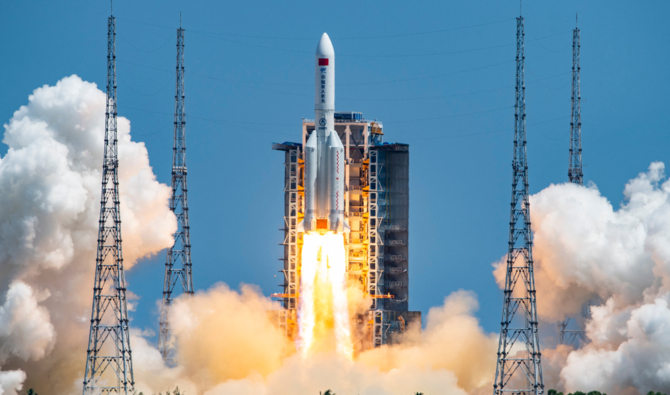
ISLAMABAD: Pakistan’s national space agency on Friday invited scientists, researchers and students to contribute to the country’s first-ever human spaceflight mission by submitting proposals for innovative experiments to be conducted aboard a Chinese space station.
Earlier this year in February, the Pakistan Space and Upper Atmosphere Research Commission (SUPARCO) signed a cooperation agreement with China, paving the way for a Pakistani astronaut to travel to the Tiangong space station.
The mission is expected to take place by the end of 2026 following the completion of astronaut training.
“As Pakistan’s first astronaut prepares to undertake a historic journey to the Chinese Space Station (CSS), the national space agency calls for proposals for innovative experiments to be conducted in the extreme thermal, complete vacuum and microgravity environment of the CSS to maximize the scientific impact of this mission,” SUPARCO said in an official statement.
“This is a significant chance for Pakistan’s scientific community and emerging scientists and engineers to contribute to the nation’s space journey and make a lasting impact on the future of space exploration,” it added.
The statement said the Chinese space station orbits the Earth at an altitude of around 380 kilometers, completing one revolution every 92 minutes at a speed of approximately 7.7 kilometers per second.
The space station features state-of-the-art facilities, including specialized experiment racks for research in life sciences, biotechnology, fundamental physics, fluid dynamics, material science and astrophysics.
The Pakistani agency particularly encouraged proposals in agriculture and medical sciences, noting the potential of microgravity to generate groundbreaking insights in those fields.
“Proposed experiments should be novel, cost-effective, lightweight and feasible within a week in microgravity,” it said. “Submissions must align with CSS research priorities, be unique, and support sustainable development goals.”
SUPARCO highlighted the selected experiments could lead to high-impact scientific publications, patents or commercial applications, emphasizing the project’s potential to contribute to socio-economic development.
The deadline to submit proposals is April 30.

Pakistan invites scientists, students to pitch experiments for mission to Chinese space station
https://arab.news/nq6pa
Pakistan invites scientists, students to pitch experiments for mission to Chinese space station
- The country’s space agency has partnered with China to send first Pakistani astronaut to space
- The mission is expected take place by late 2026 following the completion of astronaut training
Pakistan terms climate change, demographic pressures as ‘pressing existential risks’
- Pakistan has suffered frequent climate change-induced disasters, including floods this year that killed over 1,000
- Pakistan finmin highlights stabilization measures at Doha Forum, discusses economic cooperation with Qatar
ISLAMABAD: Pakistan’s Finance Minister Muhammad Aurangzeb on Saturday described climate change and demographic pressures as “pressing existential risks” facing the country, calling for urgent climate financing.
The finance minister was speaking as a member of a high-level panel at the 23rd edition of the Doha Forum, which is being held from Dec. 6–7 in the Qatari capital. Aurangzeb was invited as a speaker on the discussion titled: ‘Global Trade Tensions: Economic Impact and Policy Responses in MENA.’
“He reaffirmed that while Pakistan remained vigilant in the face of geopolitical uncertainty, the more pressing existential risks were climate change and demographic pressures,” the Finance Division said.
Pakistan has suffered repeated climate disasters in recent years, most notably the 2022 super-floods that submerged one-third of the country, displaced millions and caused an estimated $30 billion in losses.
This year’s floods killed over 1,000 people and caused at least $2.9 billion in damages to agriculture and infrastructure. Scientists say Pakistan remains among the world’s most climate-vulnerable nations despite contributing less than 1 percent of global greenhouse-gas emissions.
Aurangzeb has previously said climate change and Pakistan’s fast-rising population are the only two factors that can hinder the South Asian country’s efforts to become a $3 trillion economy in the future.
The finance minister noted that this year’s floods in Pakistan had shaved at least 0.5 percent off GDP growth, calling for urgent climate financing and investment in resilient infrastructure.
When asked about Pakistan’s fiscal resilience and capability to absorb external shocks, Aurangzeb said Islamabad had rebuilt fiscal buffers. He pointed out that both the primary fiscal balance and current account had returned to surplus, supported significantly by strong remittance inflows of $18–20 billion annually from the Middle East and North Africa (MENA) and Gulf Cooperation Council (GCC) regions.
Separately, Aurangzeb met his Qatari counterpart Ali Bin Ahmed Al Kuwari to discuss bilateral cooperation.
“Both sides reaffirmed their commitment to strengthening economic ties, particularly by maximizing opportunities created through the newly concluded GCC–Pakistan Free Trade Agreement, expanding trade flows, and deepening energy cooperation, including long-term LNG collaboration,” the finance ministry said.
The two also discussed collaboration on digital infrastructure, skills development and regulatory reform. They agreed to establish structured mechanisms to continue joint work in trade diversification, technology, climate resilience, and investment facilitation, the finance ministry said.


