

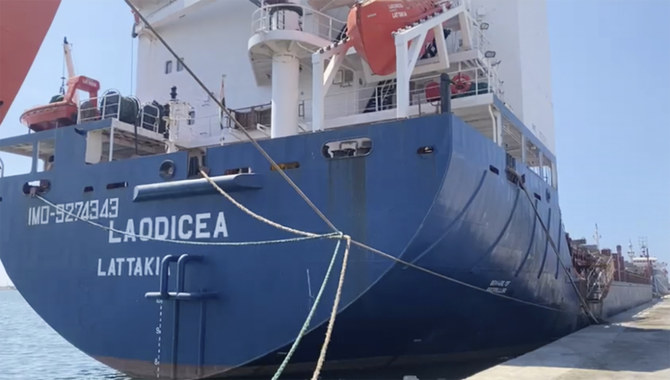

BEIRUT: A Syrian ship under US sanctions has docked in the northern Lebanese port of Tripoli carrying barley and wheat that Ukraine Embassy officials in Beirut claim has been plundered by Russia from Ukrainian stores.
The Laodicea moored up in the Mediterranean city on Wednesday, according to shipping data website MarineTraffic.
In a statement, the embassy said: “The ship has traveled from a Crimean port that is closed to international shipping, carrying 5,000 tons of barley and 5,000 tons of flour that we suspect was taken from Ukrainian stores.”
Nasser Yassin, Lebanon’s caretaker environment minister, said: “Lebanon respects international laws. The ship said to be stolen from Ukraine and docked in Tripoli had not been offloaded.”
He added that the matter was being looked into by the Lebanese ministers of economy and public works.
Igor Ostatch, the Ukrainian ambassador to Lebanon, notified Lebanese President Michel Aoun of the situation during a meeting, warning that “imports of Ukrainian grain stolen by Russia might harm bilateral relations.”
However, the Russian Embassy in Lebanon said that “the Syrian ship carrying the cargo is from a private company in Lebanon,” and it denied any “knowledge of or relation to it.”
It added: “The accusations of the Ukrainian ambassador against Russia regarding the flour stolen from Ukrainian warehouses are unfounded.”
Some Lebanese observers fear certain parties may take advantage of the economic and political chaos in Lebanon to smuggle goods into Syria and circumvent US sanctions on the war-torn country, especially following claims that the Laodicea belonged to the Syrian General Directorate of Ports.
Lebanon is currently facing an acute bread shortage due to a scarcity of flour and a lack of funds to import subsidized wheat. The country used to import 60 percent of its needs from Ukraine.
A Lebanese Economy Ministry source told Arab News: “Importing wheat or flour from abroad doesn’t require the approval of the ministry unless it was subsidized by the central bank.
“Other than that, private companies and mills have the right to freely import wheat or flour, provided that the Lebanese customs check the legitimacy of the importation.”
The Ukrainian Embassy in Lebanon has claimed that, “since the invasion of Ukraine last February, Russia worked on sending about 100,000 tons of stolen wheat to Syria.”
In May, the Ukrainian Ministry of Defense stated that “ships carrying stolen Ukrainian wheat and raising the Russian flag were heading to Syria.”
An officer from the Turkey-based grains trading company, Loyal Agro, told Reuters: “Russia is the source of the flour carried by the ship docked in Tripoli. The flour wasn’t stolen from Ukraine and the company sought to import 5,000 tons of flour to Lebanon to sell it to buyers from the private sector and not the Lebanese government.
“The cargo had not been offloaded and the Lebanese customs had not yet granted an import license, as they were investigating Ukraine’s assertions that the flour has been stolen by Russia from its territories following the invasion.
“The company provided the Lebanese customs with documentation clarifying that the source of the cargo was legitimate,” the official added.
Lebanon’s Minister of Foreign Affairs Abdallah Bou Habib said Lebanese authorities had not been able as of the early hours of Friday to “determine the source of the flour and barley cargo carried by the ship.”
He noted that Lebanon had “received a number of complaints and warnings from a number of Western countries” following the docking of the ship.
The maritime row comes a week before Lebanon commemorates the second anniversary of the Beirut port blast on Aug. 4. A ship called the MV Rhosus had carried the ammonium nitrate to the port seven years before it exploded, killing 232 people, and leaving thousands injured. The chemicals had been stored in one of the port’s hangars.
In recent days dust has been seen rising from blast-damaged grain silos at the port forcing Lebanese authorities to take precautionary measures and put security forces on alert in case the structures collapse. Around 200,000 masks have been distributed among residents in the area.


