

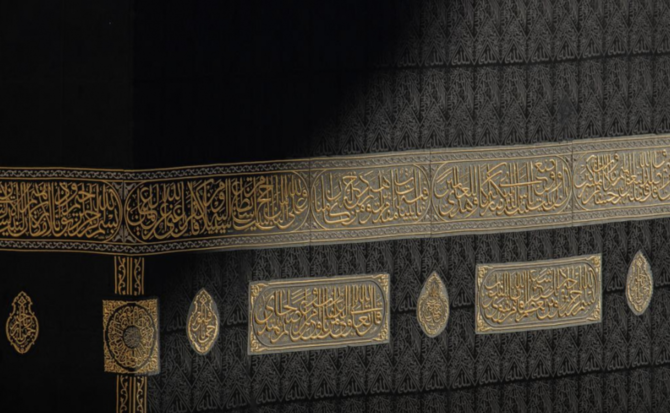
Kaaba adorned in new Kiswa Saturday as Muslim world watches

The cost of making a new 850-kilogram Kiswa is estimated to cost SR25 million, or over $6.5 million making it the world’s most expensive covering. (@ReasahAlharmain)
Short Url
Updated 30 July 2022
Follow

Kaaba adorned in new Kiswa Saturday as Muslim world watches

  • Shift in traditional change from eve of Arafat to Muharram 1
  • The covering weighs over 850kg and costs $6.5m

MAKKAH: One of the most watched ceremonies in the Islamic world takes place this Saturday when the Kaaba is adorned with its new Kiswa.

In a change of tradition, the General Presidency for the Two Holy Mosques will perform the annual event on the night of the new Islamic year of Muharram 1, 1444, or Saturday, July 30.

This marks “a shift from a decades-old custom of replacing it on the eve of Arafat, as per a royal decision issued recently,” said Abdulrahman Al-Sudais, president of the body.

The Kiswa, or the covering of the Kaaba, is replaced annually in a tradition observed for centuries.

For many decades the Kiswa was replaced on the morning of Dhul Hijjah 9, when pilgrims depart to the plains of Arafat. This was usually the time when the Haram was empty, to allow for the smooth replacement.

The new Kiswa will stay in place until Hajj next year.

A team of 200 Saudi technicians working at the King Abdulaziz Complex for Manufacturing the Kaaba’s Kiswa, will carry out the task.

The factory does the weaving, stitching and printing by hand and machines using 47 pieces of cloth and thread. The world’s largest computerized sewing machine, at 16 meters in length, carries out the process.

The cloth is stitched together in five different parts and fixed to the base with copper rings.

Around 670 kilograms of raw silk is dyed black at the complex.

The Kiswa is decorated with Quranic verses embroidered onto the cloth with 120 kilograms of 21-karat gold thread and 100 kilograms of silver thread.

The cost of making a new 850-kilogram Kiswa is estimated to cost SR25 million, or over $6.5 million, making it the world’s most expensive covering.


Najran’s camels are embedded in local culture and traditions

Camels are not only a vital livestock resource in Najran, but also a cornerstone of local identity and tradition. (SPA)
Updated 25 December 2025
Follow

Najran’s camels are embedded in local culture and traditions

  • Several distinct camel breeds are found in the region
  • Animals permeate Arab consciousness, says expert

RIYADH: In Najran, camels are not only a vital livestock resource but also a cornerstone of local identity and tradition.

According to Hadi Benyan Al-Amer, head of Najran’s Camel Association, the region has several distinct camel breeds.

Principal among them is the Awarik, an ancient Arabian lineage linked to territories where arak trees flourish, the Saudi Press Agency reported on Thursday.

These light-colored, sparsely-haired camels possess remarkable resilience, and are prevalent across southern Arabia.

The Majahim are characterized by dark hues spanning black to brown, and excel in both milk yield and endurance.

The Asayil are prized for their sleek, lean physiques, and dominate in speed-based competitions.

Al-Amer said traditional water sources known as Odood, or traditional water wells and artesian wells, have sustained herders navigating the Empty Quarter’s grazing lands for generations.

These permanent water points, equipped with dedicated drinking basins for camels, showcase the animals’ extraordinary environmental resilience.

Among the principal wells accessible from Najran are Al-Minkhali, Abu Shadid, Hamra Nathil, Tamani, Umm Al-Wahat, and Khujaima.

Countless additional wells dot the Empty Quarter and adjacent territories, forming the backbone of camel owners’ far-reaching pastoral networks.

Dr. Hind bint Dawood Al-Shuqair of Najran University’s Arabic Language Department explained how camels have permeated Arab consciousness through legends and stories spanning thousands of years.

Representing endurance, power, and grace, they have become inseparable from Arab cultural identity.

Archaeological evidence at Al-Ukhdood, Mount Al-Tharwa and Hima, preserves through carvings and ancient artwork the deep bond between people and camels, Al-Shuqair said.

She drew attention to Saudi Arabia’s substantial investment in camel heritage, exemplified by proclaiming 2024 as the Year of the Camel.

This designation emphasizes their importance to national prosperity and cultural heritage while backing global initiatives to promote awareness of camels as valuable economic and cultural assets.

The Kingdom further demonstrates its commitment to protecting the animals through the annual King Abdulaziz Festival, the SPA reported.